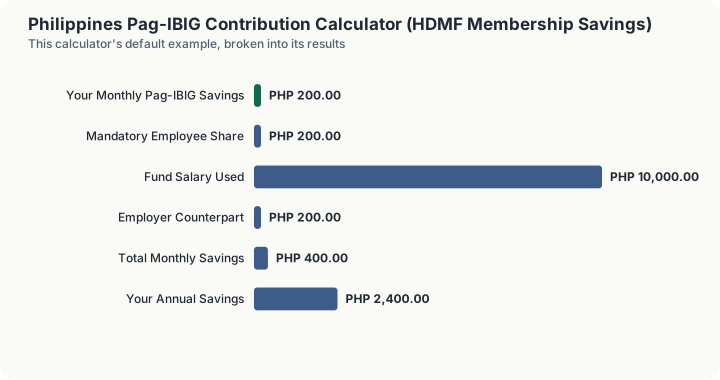
Quick Answer: An employee earning PHP 20,000 a month saves PHP 200.00 a month in Pag-IBIG. The fund salary is capped at PHP 10,000, the employee rate above PHP 1,500 is 2%, and the employer adds a matching PHP 200 counterpart, for PHP 400 credited to the member's account each month. Over a year the employee's own savings come to PHP 2,400.
What does this calculator do?
Pag-IBIG, formally the Home Development Mutual Fund, is the Philippines' national savings and housing finance programme. Unlike SSS and PhilHealth, what you pay in is not a premium consumed by an insurance pool. It is savings credited to your own account, earning an annual dividend, and it underwrites your eligibility for a Pag-IBIG housing loan or multi purpose loan.
Membership is mandatory for essentially everyone in formal employment, including employees covered by the SSS and by the GSIS, uniformed personnel, seafarers, and household workers. Employers must remit a counterpart contribution alongside the employee's savings, and are expressly forbidden from recovering that counterpart from the worker's wages.
The current rates come from HDMF Circular No. 460, which took effect in February 2024. Its headline change was doubling the Maximum Fund Salary from PHP 5,000 to PHP 10,000 under Section 7 of Republic Act No. 9679. That single change doubled the mandatory contribution for almost every formal sector worker, from PHP 100 a month to PHP 200, because virtually everyone earns above the cap.
The rate table itself is short. For a fund salary of PHP 1,500 and below, the employee saves 1.0% and the employer contributes 2.0%. Above PHP 1,500, both sides contribute 2.0%. Because the fund salary is capped at PHP 10,000 before the rate is applied, the mandatory maximum is PHP 200 from each side, PHP 400 in total.
Members may save more than the mandatory amount, and many do, since additional savings still earn the fund's dividend. This calculator lets you add a voluntary top up, which raises your own share without changing the employer counterpart.
How is this calculated?
The rate is applied not to your pay but to your fund salary, which is your pay capped at the Maximum Fund Salary:
Fund Salary = min(Monthly Compensation, Maximum Fund Salary)
The employee rate is then selected from the fund salary:
Employee Rate = 1.0%, if Fund Salary ≤ 1,500; 2.0%, if Fund Salary > 1,500
And each side's amount follows directly:
Employee Share = Fund Salary × Employee Rate
Employer Counterpart = Fund Salary × 2.0%
Any voluntary top up you enter is added to the employee share alone. The employer counterpart stays fixed at the rate on your capped fund salary, because the statutory counterpart is defined against that figure and not against whatever you choose to save.
Total Monthly Savings = Employee Share + Top Up + Employer Counterpart
Worked Example
Scenario 1: an employee earning PHP 20,000 a month.
Step 1: Apply the Maximum Fund Salary cap.
min(20,000, 10,000) = 10,000
Fund salary: PHP 10,000.00
Step 2: Select the employee rate from the fund salary.
PHP 10,000 is above the PHP 1,500 band boundary, so the upper rate applies.
Employee rate: 2.0%
Step 3: Compute the employee's share.
10,000 × 2% = 200
Employee monthly savings: PHP 200.00
Step 4: Compute the employer counterpart at 2.0%.
10,000 × 2% = 200
Employer counterpart: PHP 200.00
Step 5: Total the monthly credit to the member's account.
200 + 200 = 400
Total monthly savings: PHP 400.00
Step 6: Annualize the employee's own share.
200 × 12 = 2,400
Employee annual savings: PHP 2,400.00
Scenario 2: a worker on a PHP 1,500 fund salary.
Step 1: The cap does not bind, so the fund salary is PHP 1,500.
Step 2: PHP 1,500 is in the lower band, so the employee rate is 1.0%.
1,500 × 1% = 15
Employee monthly savings: PHP 15.00
Step 3: The employer counterpart is still 2.0%, not 1.0%.
1,500 × 2% = 30
Employer counterpart: PHP 30.00
The asymmetry in the lower band is deliberate. It halves the low wage worker's own deduction while leaving the employer's contribution untouched.
What does this calculator not account for?
- Whether the Circular 460 rates are still current. The Maximum Fund Salary, the employee rate and the employer rate are all editable fields, because Pag-IBIG sets them by circular rather than by statute and can revise them. Confirm the current figures with Pag-IBIG before relying on the defaults.
- A sourcing caveat on the circular itself. The rate table and the PHP 10,000 Maximum Fund Salary were read from a scan of the signed HDMF Circular No. 460, but not from pagibigfund.gov.ph directly, because that site was behind a browser verification interstitial when this page was built. The figures are those of the circular; the retrieval route was not the issuing agency's own server.
- The kasambahay schedule. Household workers with a fund salary below PHP 5,000 have their entire membership savings shouldered by the employer, at 3.0% or 4.0% depending on the band. This calculator models the standard mandatory coverage employee and does not implement that separate schedule.
- Pag-IBIG MP2 savings. The Modified Pag-IBIG 2 programme is a distinct voluntary savings product with its own term and its own dividend rate. The voluntary top up field here models additional regular savings, not MP2.
- Dividends. Regular savings earn an annual dividend declared by the Board of Trustees. This calculator shows what is contributed, not what the account grows to.
- Loan amortizations. Housing loan and multi purpose loan repayments deducted through payroll are separate from the savings computed here.
What mistakes do people make with this?
- Computing 2% of your actual salary. The rate is applied to the fund salary after the Maximum Fund Salary cap. For anyone earning above PHP 10,000, the mandatory employee contribution is PHP 200 flat, not 2% of pay.
- Using the old PHP 100 figure. Before February 2024 the cap was PHP 5,000, which produced PHP 100 a side. HDMF Circular No. 460 doubled it. Tables published before 2024 are out of date.
- Assuming the employer rate drops in the lower band. It does not. Only the employee rate halves to 1.0% at or below a PHP 1,500 fund salary; the employer stays at 2.0%.
- Expecting the employer to match a voluntary top up. The statutory counterpart is fixed against the capped fund salary. Saving more is entirely at your own cost, though the extra still earns the dividend.
- Thinking of Pag-IBIG as a tax or a premium. It is savings in your own name. The money is returnable at maturity, membership termination or death, unlike an insurance premium.
Frequently Asked Questions
How much is the Pag-IBIG contribution per month?
What is the Maximum Fund Salary?
Who pays 1% instead of 2%?
Can I contribute more than the mandatory amount?
Is Pag-IBIG deducted before income tax?
Can my employer deduct their counterpart from my pay?
Sources
- HDMF Circular No. 460, "Guidelines on the Pag-IBIG Fund's Implementation of Increase in the Maximum Fund Salary (MFS) Effective February 2024", issued under Section 7 of Republic Act No. 9679. The circular sets the contribution rates at 1.0% employee and 2.0% employer for a fund salary of PHP 1,500 and below, and 2.0% for both above PHP 1,500; raises the maximum fund salary from PHP 5,000 to PHP 10,000; and forbids the employer from recovering its counterpart from the employee's wages. Read 31 August 2026 from a scan of the signed circular, because the issuing site pagibigfund.gov.ph was behind a browser verification interstitial: mpm.ph/wp-content/uploads/2024/01/HDMF-Circular-No.-460-Pag-ibig-HDMF-Table-2024.pdf
- Bureau of Internal Revenue (Philippines), the official authority for the national tax authority this calculator relates to. bir.gov.ph
Also consulted: Republic Act No. 9679, Home Development Mutual Fund Law of 2009, Section 7, the statutory basis for the fund salary cap and for mandatory coverage.