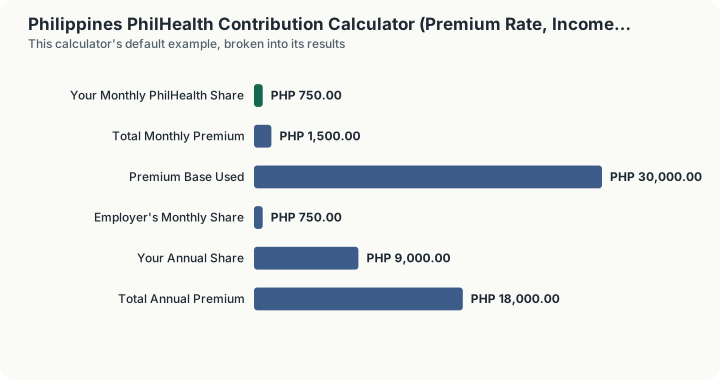
Quick Answer: An employed member with a monthly basic salary of PHP 30,000 pays PHP 750.00 a month in PhilHealth premiums. The total premium is PHP 1,500 at the 5% rate, shared equally with the employer. Over a year the employee's own share is PHP 9,000. Read the disclosure below before relying on the rate: the published PhilHealth schedule this page uses stops at calendar year 2025.
What does this calculator do?
PhilHealth is the Philippines' national health insurance programme, and membership is compulsory for every Filipino under the Universal Health Care Act, Republic Act No. 11223. Employed workers are "direct contributors" whose premium is shared with their employer.
The premium is deliberately simple by design. There is a single rate applied to monthly basic salary, an income floor below which everyone pays the same minimum, and an income ceiling above which everyone pays the same maximum. There are no bands in between, which distinguishes PhilHealth from the SSS salary credit table.
The schedule this calculator uses comes from PhilHealth Circular No. 2019-0009, which set out the year by year premium ramp mandated by the Universal Health Care Act. That ramp ran from 2.75% in 2019 up to 5.00%, with the income ceiling rising alongside it from PHP 50,000 to PHP 100,000. The final band of the published schedule is labelled "2024 to 2025": a 5.00% rate, a PHP 10,000 income floor and a PHP 100,000 income ceiling.
That is where an honest calculator has to be candid. The published schedule terminates at calendar year 2025. It says nothing about 2026 or later, and no PhilHealth circular extending or replacing it could be retrieved when this page was built. The defaults here are therefore the last published values, not a confirmed current schedule. The rate, the floor, the ceiling and the employee's share are all editable fields so you can enter whatever PhilHealth is charging now.
How is this calculated?
The premium base is your monthly basic salary held between the floor and the ceiling:
Premium Base = min(max(Monthly Basic Salary, Floor), Ceiling)
The premium is the rate applied to that base:
Monthly Premium = Premium Base × Premium Rate
And it is divided between the two sides:
Employee Share = Monthly Premium × Employee Share Percentage
Employer Share = Monthly Premium − Employee Share
For an employed member under RA 11223 the employee share percentage is 50%, so the premium splits evenly. A self employed or voluntary direct contributor shoulders the entire premium, which you can model by setting the employee share to 100%.
With the last published values of a 5% rate, a PHP 10,000 floor and a PHP 100,000 ceiling, the floor produces a minimum total premium of PHP 500 a month and the ceiling produces a maximum of PHP 5,000 a month. Both figures are shown in the results.
Worked Example
Scenario 1: a mid salary employee on PHP 30,000 a month.
Step 1: Apply the income floor and ceiling to the basic salary.
PHP 30,000 is above the PHP 10,000 floor and below the PHP 100,000 ceiling, so neither binds.
Premium base: PHP 30,000.00
Step 2: Apply the premium rate.
30,000 × 5% = 1,500
Total monthly premium: PHP 1,500.00
Step 3: Take the employee's half.
1,500 × 50% = 750
Employee monthly share: PHP 750.00
Step 4: The employer pays the balance.
1,500 − 750 = 750
Employer monthly share: PHP 750.00
Step 5: Annualize the employee's own cost.
750 × 12 = 9,000
Employee annual share: PHP 9,000.00
Scenario 2: a low earner on PHP 8,000 a month.
Step 1: Apply the income floor.
PHP 8,000 is below the PHP 10,000 floor, so the floor replaces it.
Premium base: PHP 10,000.00
Step 2: Apply the rate and split it.
10,000 × 5% = 500; 500 × 50% = 250
Employee monthly share: PHP 250.00
Scenario 3: a high earner on PHP 250,000 a month.
Step 1: Apply the income ceiling.
PHP 250,000 exceeds the PHP 100,000 ceiling, so the ceiling replaces it.
Premium base: PHP 100,000.00
Step 2: Apply the rate and split it.
100,000 × 5% = 5,000; 5,000 × 50% = 2,500
Employee monthly share: PHP 2,500.00
This is the maximum any employed member pays at the last published rate, no matter how high the salary goes.
What does this calculator not account for?
- The premium rate, floor and ceiling for 2026 and later. This is the most important limitation on this page. PhilHealth Circular No. 2019-0009 published a schedule whose final band is "2024 to 2025", and no later circular could be retrieved when this calculator was built. The defaults are the last published values. Confirm the current figures with PhilHealth and change the fields if they have moved. Note also that the ramp was suspended once before: a footnote on PhilHealth's own schedule records that the rate stayed at 4% for calendar year 2023 despite the table showing 4.5%, following a presidential order. A published schedule is not a guarantee of what is actually collected.
- What counts as monthly basic salary. Premiums for employed members are computed on basic salary, not on gross pay including allowances and overtime. Where your employer draws that line is a payroll question this calculator cannot answer.
- Indirect contributors. Indigent members, senior citizens and others enrolled as indirect contributors are subsidized by government and do not pay a premium at all.
- Overseas Filipino Workers and other direct contributor categories. Land based and sea based OFWs and certain other categories have their own premium arrangements that differ from the employed member split modelled here.
- Benefit entitlements. This computes the premium, not what PhilHealth pays out. Case rates, the Konsulta package and benefit eligibility rules are outside this page.
- Late payment penalties and retroactive adjustments. Employers who remit late face separate charges that are not modelled.
What mistakes do people make with this?
- Computing the premium on gross pay. Allowances, overtime and premiums are excluded. Using gross pay overstates the contribution for most employees.
- Assuming the ceiling means high earners pay proportionally more. They do not. Above PHP 100,000 of basic salary the premium is flat, so the effective rate falls as salary rises.
- Forgetting the floor. A part time or low wage worker below PHP 10,000 still pays the minimum premium computed on the floor, not a smaller amount computed on actual pay.
- Treating the whole premium as an employee cost. For employed members it is split evenly. Only self employed and voluntary members carry the full amount.
- Trusting a rate quoted for a year outside the published schedule. Widely circulated tables for years after 2025 exist, but the schedule that PhilHealth actually published stops at 2025. Verify before relying on a figure.
Frequently Asked Questions
What is the PhilHealth contribution rate?
How is PhilHealth computed for employees?
What is the maximum PhilHealth contribution?
What is the minimum PhilHealth contribution?
Do self employed members pay the whole premium?
Is PhilHealth deducted before income tax?
Sources
- PhilHealth Circular No. 2019-0009, "Premium Contribution Schedule in the National Health Insurance Program (NHIP) Pursuant to R.A. No. 11223 (Universal Health Care Act)", effective 7 December 2019. The official premium schedule graphic sets out each year's rate, income floor and income ceiling, ending with the band labelled 2024 to 2025 at a 5.00% rate, a PHP 10,000 floor and a PHP 100,000 ceiling, and carries the footnote recording that the rate remained at 4% for calendar year 2023. philhealth.gov.ph/partners/employers/ContributionTable_v2.pdf (read 31 August 2026)
Also consulted: Republic Act No. 11223, Universal Health Care Act, the statutory authority for compulsory membership, the premium ramp, and the equal sharing of the premium between an employed member and the employer.