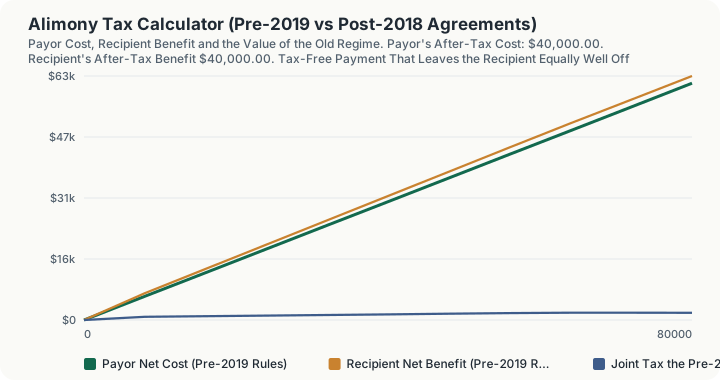
Quick Answer: $40,000 a year paid under an instrument executed after 31 December 2018 costs the payor $40,000.00 after tax and is worth $40,000.00 to the recipient. There is no deduction and no inclusion, so the payment is taxed once, in the payor's bracket. A tax-free $31,850.00 would have left that recipient as well off as $40,000 of pre-2019 taxable alimony did.
What does this calculator do?
There is no single federal answer to how alimony is taxed. There are two regimes running side by side, and which one a payment sits in is a fact about a document rather than about the payment or the year.
Section 11051 of the Tax Cuts and Jobs Act repealed Internal Revenue Code section 215, the payor's deduction, and section 71, the recipient's inclusion. The repeal reaches any divorce or separation instrument executed after 31 December 2018, and reaches an earlier instrument that is later modified only where the modification expressly provides that the amendments apply. An instrument signed on 30 December 2018 and still being paid in 2026 is deductible and includible. An otherwise identical instrument signed two days later is neither.
That is why the execution date is an input on this page and never an assumption, and why the page reports the regime it applied, in words, alongside the authority for it.
The change matters far more than a reallocation of paperwork. Under the old rules, alimony moved a dollar of income out of the payor's bracket and into the recipient's. Where the payor's rate was higher, which is the usual case since alimony flows from the higher earner, the two households together paid less tax on the same total income. That saving was real, it was quantifiable, and it was routinely the bargaining chip that let a payor agree to a larger gross number. TCJA deleted the saving and put nothing in its place.
The consequence is that a post-2018 agreement setting the same gross figure as a pre-2019 one delivers more after-tax money to the recipient and costs the payor more after tax. The correct response was to re-price the payment. This calculator computes that re-priced figure exactly.
How is this calculated?
Each party's federal tax is computed on the 2026 ordinary rate schedule with the standard deduction, before and after the regime's adjustment:
Payor Net Cost = A − [ Tax (Iₚ) − Tax (Iₚ − A⋅d)]
Recipient Net Benefit = A − [ Tax (Iᵣ + A⋅i) − Tax (Iᵣ)]
where $A$ is the annual payment, $d$ is 1 when the instrument allows a deduction and 0 otherwise, and $i$ is 1 when inclusion is required and 0 otherwise. The re-pricing is the payment that leaves the recipient whole after the tax the old regime would have charged:
A_equivalent = A − [ Tax (Iᵣ + A) − Tax (Iᵣ)]
Step 1: Identify the regime from the instrument date. The default is an instrument executed after 31 December 2018, so section 215 gives no deduction and section 71 requires no inclusion: deductible: No, includible: No
Step 2: Compute the payor's taxable income. $200,000 of income, with no alimony deduction available, less the 2026 single standard deduction of $16,100: $200,000 - $16,100 = $183,900
Step 3: Compute the payor's federal tax on that income. Running $183,900 through the 2026 single brackets gives $36,734.00, and the last dollar falls in the 24% bracket, so the payor's marginal rate is 24%
Step 4: Compute the payor's after-tax cost. There is no deduction, so no tax comes back: $40,000 - $0 = $40,000.00
Step 5: Compute the recipient's taxable income and tax. $60,000 - $16,100 = $43,900 of taxable income, giving $5,020.00 of federal tax, with the last dollar in the 12% bracket
Step 6: Compute the recipient's after-tax benefit. The payment is not includible, so it adds no tax: $40,000 - $0 = $40,000.00
Step 7: Price the same payment under the other regime, to size what was lost. Under the pre-2019 rules the payor would deduct $40,000 and the recipient would include it. Combined federal tax across both households would be $40,304.00 instead of $41,754.00, so this arrangement costs the two households $1,450.00 more federal tax in total.
Step 8: Compute the re-priced, tax-free equivalent. The tax the recipient would have paid on $40,000 of includible alimony is the difference between tax on $100,000 and tax on $60,000: $13,170.00 - $5,020.00 = $8,150.00 $40,000.00 - $8,150.00 = $31,850.00
Step 9: Express the gap as a percentage. $8,150.00 / $40,000.00 = 20.375%
Worked Example
The re-pricing step is the one that changes negotiations, so it is worth walking on its own. Suppose a mediator opens with "the standard around here is $40,000 a year", a figure inherited from settlements written before 2019.
Step 1: Establish what the recipient actually needs. Under the old rules, $40,000 of taxable alimony left this recipient with $40,000 less the $8,150 of tax it triggered, so $31,850 in hand.
Step 2: Match that after tax under the new rules. Because a post-2018 payment is not taxable to the recipient, the payment that leaves them with $31,850 in hand is $31,850.
Step 3: Price the overpayment. $40,000.00 - $31,850.00 = $8,150.00 a year the payor hands over above what the old number was ever worth to the recipient.
Step 4: Total it over a ten-year term. $8,150.00 x 10 = $81,500.00
Step 5: Note what the payor cannot recover. Under the old rules the deduction would have returned $40,000 x 24% = $9,600 of tax to the payor. Under the new rules that $9,600 is simply gone, which is the other half of why the gross figure has to move.
Both effects run in the same direction, and both are consequences of the date on the document rather than of anything either party did.
What does this calculator not account for?
- State income tax. Several states did not conform to the federal repeal and still allow a state-level alimony deduction. Everything on this page is federal.
- The section 71(f) recapture rules, which applied to pre-2019 instruments and can claw back the deduction where payments front-load in the first three post-separation years. This page values a level stream.
- Child support, which was never deductible or includible under either regime, and the section 71(c)(2) rule treating a payment that drops on a child-related contingency as child support. Amounts entered here are treated as spousal support only.
- The qualification requirements a pre-2019 payment had to meet to be alimony at all: cash only, not designated as non-alimony, no liability surviving the recipient's death, and separate households.
- Property settlements under section 1041, which are not taxable events to either spouse in either regime.
- Credits and phase-outs that alimony moves by changing AGI, including the premium tax credit, IRA deductibility and the section 199A threshold. Only the ordinary rate schedule and the standard deduction are applied.
- Itemised deductions. Both parties are computed on the standard deduction.
- The recipient's IRA contribution eligibility, which pre-2019 alimony supported as compensation and post-2018 alimony does not.
What mistakes do people make with this?
- Assuming the payment year decides the treatment. It does not. The execution date of the instrument does, and a 1998 agreement still being paid today is still deductible and includible.
- Modifying a pre-2019 agreement without reading the modification clause. A modification pulls the instrument into the new rules only where it expressly says the TCJA amendments apply. Silence preserves the old treatment, and that silence is worth money.
- Copying a pre-2019 dollar figure into a post-2018 agreement. At these inputs that overpays by 20.38%, every year, for the term.
- Arguing about the lost deduction rather than re-pricing. The joint saving is gone and no drafting recovers it. The negotiable question is the gross number.
- Confusing the payor's marginal rate with the recipient's. The re-pricing depends on the recipient's tax, not the payor's. Here the spread is 12 percentage points, and it is the recipient's 12% band, not the payor's 24% band, that sets the equivalent payment.
- Forgetting that alimony has to actually be paid to be anything. No treatment here applies to an obligation that goes unpaid.
Frequently Asked Questions
Is alimony deductible in 2026?
Does the recipient pay tax on alimony now?
How much should a post-2018 alimony payment be reduced?
What happens if we modify a pre-2019 divorce agreement?
Why do the two households together pay more tax now?
Does this calculator tell me what alimony I will be ordered to pay?
Sources
- Public Law 115-97 (Tax Cuts and Jobs Act), section 11051, repealing 26 U.S.C. 215 and 71 for instruments executed after 31 December 2018, and section 11051(c) for the effective-date and modification rules. law.cornell.edu/uscode/text/26/215
- 26 U.S.C. 71 (repealed): law.cornell.edu/uscode/text/26/71
- IRS, "Alimony, child support, court awards, damages": irs.gov/faqs/interest-dividends-other-types-of-income/alimony-child-support-court-awards-damages
- 2026 ordinary rate brackets and standard deductions: IRS Revenue Procedure 2025-32, Internal Revenue Bulletin 2025-45, irs.gov/pub/irs-drop/rp-25-32.pdf, held in this project as
engine/tables/2026/federal-tax.json.