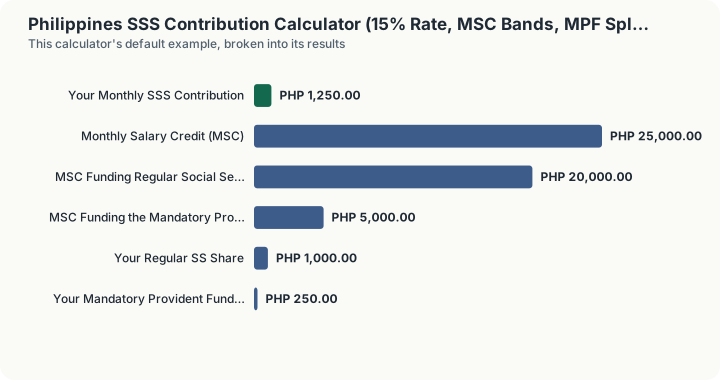
Quick Answer: An employee earning PHP 25,000 a month is assigned a Monthly Salary Credit of PHP 25,000 and pays PHP 1,250.00 a month in SSS contributions. The employer pays PHP 2,530.00, which includes a PHP 30 Employees' Compensation premium, for a combined remittance of PHP 3,780.00 a month. Over a year the employee's own share comes to PHP 15,000.
What does this calculator do?
The Social Security System is the Philippines' mandatory social insurance scheme for private sector workers. It funds retirement pensions, sickness and maternity benefits, disability and death benefits, and a separate provident savings account. Contributions are compulsory for employees, and both the worker and the employer contribute.
The rate structure in force comes from SSS Circular No. 2024-006, which implemented the final scheduled step of Republic Act No. 11199, the Social Security Act of 2018. Effective January 2025 the contribution rate is 15%, the minimum Monthly Salary Credit is PHP 5,000, and the maximum is PHP 35,000. The 15% splits 10 percentage points to the employer and 5 to the employee.
The feature that trips people up is that the rate is not applied to your salary. It is applied to a Monthly Salary Credit, which is your salary bucketed into a table of PHP 500 bands. A worker on PHP 25,100 and a worker on PHP 25,200 land in the same band and pay exactly the same contribution.
A second structural feature is the split between two programmes. The first PHP 20,000 of your salary credit funds the Regular Social Security programme, which pays the pension and the other traditional benefits. Any salary credit above PHP 20,000 funds the Mandatory Provident Fund, sometimes called WISP, which is an individual savings account rather than a share of the pension pool. Both are charged at the same 15%, but they buy different things, and the calculator shows the split explicitly.
Because contribution schedules are set by circular and change on the agency's timetable rather than the legislature's, the rate, the split and both salary credit limits are exposed here as editable fields. If the SSS issues a newer circular, you can enter its figures without waiting for this page to be rebuilt.
How is this calculated?
First the salary credit. Your monthly compensation is rounded to the nearest PHP 500 band and then clamped between the floor and the ceiling:
MSC = min(max(500 × round (Compensation/500), 5,000), 35,000)
That salary credit is then divided between the two programmes:
Regular SS Credit = min(MSC, 20,000); MPF Credit = max(MSC − 20,000, 0)
Each side pays its rate on both portions:
Employee Share = (Regular SS Credit + MPF Credit) × 5%
Employer Share = (Regular SS Credit + MPF Credit) × 10% + EC Premium
The Employees' Compensation premium is a flat employer charge that steps once: PHP 10 where the salary credit is below PHP 15,000, and PHP 30 at or above it. The employee never pays it.
Worked Example
A rank and file employee earns PHP 25,000 a month.
Step 1: Convert the salary into a Monthly Salary Credit band.
25,000 ÷ 500 = 50; 50 × 500 = 25,000
PHP 25,000 is already on a band boundary and sits between the PHP 5,000 floor and the PHP 35,000 ceiling.
Monthly Salary Credit: PHP 25,000.00
Step 2: Split the salary credit between the two programmes.
min(25,000, 20,000) = 20,000; 25,000 − 20,000 = 5,000
Regular Social Security credit: PHP 20,000.00. Mandatory Provident Fund credit: PHP 5,000.00
Step 3: Compute the employee's Regular Social Security share at 5%.
20,000 × 5% = 1,000
Employee Regular SS share: PHP 1,000.00
Step 4: Compute the employee's Mandatory Provident Fund share at 5%.
5,000 × 5% = 250
Employee MPF share: PHP 250.00
Step 5: Add them for the employee's monthly deduction.
1,000 + 250 = 1,250
Employee monthly contribution: PHP 1,250.00
Step 6: Compute the employer's share at 10% on both portions.
(20,000 × 10%) + (5,000 × 10%) = 2,000 + 500 = 2,500
Employer programme contributions: PHP 2,500.00
Step 7: Add the Employees' Compensation premium.
The salary credit of PHP 25,000 is at or above PHP 15,000, so the premium is PHP 30.
2,500 + 30 = 2,530
Employer monthly contribution: PHP 2,530.00
Step 8: Total the remittance.
1,250 + 2,530 = 3,780
Total remitted to the SSS: PHP 3,780.00 a month
Each of these figures matches the printed row for the PHP 24,750 to PHP 25,249.99 compensation range in SSS Circular No. 2024-006.
What does this calculator not account for?
- Kasambahay members. Household workers have a different salary credit floor and, below a threshold, the employer shoulders the whole contribution. This calculator models the standard employed member only.
- OFW members. Overseas Filipino Worker members start at a higher salary credit floor and are self-remitting.
- Self employed and voluntary members. These members pay the entire 15% themselves with no employer counterpart, so the employer column here does not apply to them.
- Whether the 2025 schedule is still current. SSS Circular No. 2024-006 carries no expiry, and no superseding circular was found when this page was built. Contribution schedules are nonetheless issued by the agency at its own timetable. The rate, split and both salary credit limits are editable fields precisely so a later circular can be entered.
- Salary loan amortizations and other payroll deductions. Only the contribution itself is computed. Loan repayments deducted through payroll are separate.
- Benefit amounts. This calculates what goes in, not what comes out. Pension and other benefit computations depend on your credited years of service and average salary credit, and are outside this page.
What mistakes do people make with this?
- Applying 5% to your actual salary. The rate is applied to the Monthly Salary Credit, not to your pay. For anyone above PHP 35,000 the two figures are very different.
- Assuming a raise always raises your contribution. Within a PHP 500 band it does not, and above PHP 34,750 it never does, because the salary credit is already at the ceiling.
- Reading the Employees' Compensation premium as an employee cost. It is charged to the employer only. It appears on the employer line of the SSS table, never on the employee line.
- Treating the Mandatory Provident Fund portion as extra pension. It is a separate individual savings account with its own rules, not additional credited service toward the regular pension.
- Using an older 14% table. The rate rose to 15% and the salary credit ceiling to PHP 35,000 in January 2025. Tables published before that understate both sides of the contribution.
Frequently Asked Questions
What is the SSS contribution rate for employees?
What is a Monthly Salary Credit?
What is the maximum SSS contribution?
What is the Mandatory Provident Fund or WISP?
Are SSS contributions tax deductible?
Why did my contribution not change when I got a raise?
Sources
- Social Security System, Circular No. 2024-006, "Schedule of SSS Contributions Effective January 2025", issued pursuant to Republic Act No. 11199 (Social Security Act of 2018) and Social Security Commission Resolution No. 560-s.2024 dated 15 November 2024. The circular states the 2025 increases to a 15% contribution rate, a PHP 5,000 minimum Monthly Salary Credit and a PHP 35,000 maximum, and prints the full contribution table from which the PHP 20,000 regular programme cap, the employer and employee columns, and the PHP 10 and PHP 30 Employees' Compensation premiums were read. sss.gov.ph/wp-content/uploads/2024/12/CI-2024-006-Publication.pdf (read 31 August 2026)
Also consulted: Republic Act No. 11199, Social Security Act of 2018, the statutory authority for the scheduled rate and salary credit increases.