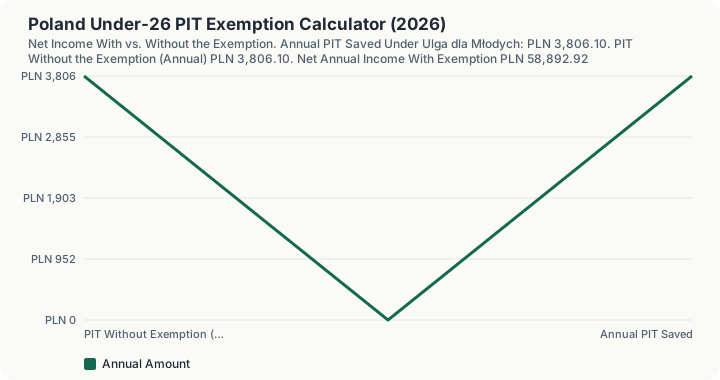
Quick Answer: An employee under 26 earning PLN 70,000.00 gross per year from an employment contract owes PLN 0.00 in PIT under the ulga dla młodych exemption, versus PLN 3,288.36 they would owe without it -- a saving of PLN 3,288.36 per year, since their entire przychód falls under the PLN 85,528.00 annual exemption cap.
Overview
Ulga dla młodych ("relief for the young") is Poland's zero-PIT regime for taxpayers who have not yet turned 26. Introduced in 2019 and unchanged in its core structure since, it exempts qualifying income from personal income tax entirely, up to an annual cap of PLN 85,528.00. Income above that cap is taxed normally under the standard progressive scale (skala podatkowa).
The relief applies specifically to income from an employment contract (umowa o pracę) and a contract of mandate (umowa zlecenie) -- the two most common ways young workers in Poland earn wages. It does NOT apply to self-employment (B2B) income, to civil-law contracts for a specific work product (umowa o dzieło), or to internship stipends outside an employment relationship. Critically, the exemption is a PIT-only benefit: ZUS social insurance and NFZ health insurance contributions still apply in full, exactly as they would for an older worker on the same contract -- only the income tax itself is waived.
This calculator answers the question most under-26 workers actually have: not "am I eligible," but "how much does this actually save me in PLN, on my specific income." It computes your PIT liability twice -- once under the standard skala podatkowa with no exemption, and once with the ulga dla młodych exemption applied -- and reports the exact difference, whether your income falls entirely under the cap or spills over it.
How This Is Calculated
- Baseline (without exemption). Taxable income is computed exactly as it would be for any other worker: gross income minus ZUS minus the applicable deductible cost (KUP), then taxed under the standard 12%/32% skala podatkowa.
- With the exemption applied. The calculator applies the statutory rule in Article 21(1)(148): the FIRST PLN 85,528 of qualifying przychód (gross revenue, before ZUS and before KUP) is exempt, and only the excess above it reaches the tax base.
Two rules then shrink that taxable slice before the scale is applied. Article 22(3b) caps deductible costs (KUP) at the taxable part of przychód, and Article 26(1)(2) blocks the deduction of social-security contributions whose contribution base is exempt income, so the calculator deducts only the share of your ZUS attributable to the taxed slice.
- Tax saved. The difference between the two PIT figures is the actual annual saving from the exemption.
Note that even after the exemption is applied, any REMAINING taxable income can still generate zero PIT if it falls under the effective PLN 30,000 kwota wolna (tax-free amount) threshold that applies to every taxpayer -- so income moderately above the 85,528 PLN cap can still owe nothing at all, a genuinely useful and often-missed detail.
Worked Example
Employment contract, PLN 70,000.00 gross/year (fully under the cap):
- Without the exemption: ZUS = 9,597.00; NFZ base = 60,403.00; taxable income (after 3,000 KUP) = 57,403.00. PIT = 57,403.00 × 12% − 3,600 = PLN 3,288.36.
- With the exemption: gross (70,000) is under the 85,528 cap, so the entire przychód is exempt and nothing reaches the tax base. PIT = PLN 0.00.
- Saved: 3,288.36 − 0.00 = PLN 3,288.36 per year.
Employment contract, PLN 200,000.00 gross/year (exceeds the cap):
- Without the exemption: taxable income = 169,580.00, in the 32% bracket. PIT = 10,800 + 32% × (169,580 − 120,000) = PLN 26,665.60.
- With the exemption: the first 85,528 of przychód is exempt, leaving taxable przychód of 200,000 − 85,528 = 114,472.00. That is 57.24% of gross, so 57.24% of the 27,420.00 ZUS, or 15,694.11, is deductible; KUP is 3,000.00. Tax base = 114,472.00 − 15,694.11 − 3,000.00 = 95,777.89, which falls back into the 12% bracket. PIT = 95,777.89 × 12% − 3,600 = PLN 7,893.35.
- Saved: 26,665.60 − 7,893.35 = PLN 18,772.25 per year.
Note what happened in the second example: the relief pulled a PLN 200,000 earner out of the 32% bracket entirely, because the exemption removes przychód before the bracket thresholds are tested.
What This Does Not Account For
- How ZUS is apportioned across the cap. The PIT Act itself is explicit only that contributions on exempt income are not deductible, without setting out a formula for a single wage stream that straddles the cap. The Minister of Finance fills that gap: under section 7 of the objaśnienia podatkowe of 14 April 2020 on the ulga dla młodych, a taxpayer who does not know the exact amount of contributions withheld on the exempt revenue deducts the share "odpowiadającą udziałowi przychodów podlegających opodatkowaniu w sumie przychodów objętych ulgą dla młodych oraz przychodów podlegających opodatkowaniu" (the share of taxable revenue in total revenue). That is exactly the pro rata split this calculator applies. If your PIT-11 separately identifies the contributions withheld on the exempt revenue, use those actual figures instead, since the proportion is the Ministry's fallback for when they are not separately stated, and uneven pay across the year can make the two differ slightly.
- The combined shelter above the cap. The ordinary PLN 30,000 kwota wolna still applies to whatever survives the exemption, so a young worker on a standard employment contract pays no PIT at all until gross pay reaches roughly PLN 123,771, not PLN 85,528. That crossover moves with your KUP rate and contract type.
- Eligibility conditions beyond age. This calculator assumes eligibility is already confirmed. Real eligibility also requires the income to be from an employment contract or zlecenie specifically (not B2B, umowa o dzieło, or most benefits/pensions), and requires the taxpayer to not have turned 26 during the tax year.
- Mid-year birthdays. The exemption applies only up to the day before your 26th birthday; income earned after that date in the same calendar year is taxed normally. This calculator models a full tax year under one age status, not a split year.
- The zlecenie student ZUS exemption. A separate rule fully exempts a student/pupil under 26 from ZUS and NFZ on a zlecenie contract -- independent of, and stackable with, this PIT exemption. That ZUS-side rule is modeled in this platform's Poland Net Salary Calculator, not here.
- Employer withholding mechanics. In practice, an employer applies the exemption to withholding automatically once you confirm eligibility in writing; this calculator computes your actual annual liability, which is what reconciles at filing, not the month-by-month withholding itself.
- Voluntary opt-out. A young taxpayer can request that their employer NOT apply the exemption (for example, to preserve eligibility for certain means-tested benefits or a mortgage-affordability calculation based on taxed income); this calculator always compares the two scenarios rather than modeling an opt-out choice.
- Very small zlecenie amounts under PLN 200 gross, which are subject to a separate flat 12% withholding regime not covered by this calculator.
Common Pitfalls
- Assuming the relief is capped per PAYMENT rather than per YEAR. The PLN 85,528 figure is an annual cumulative cap across all qualifying income sources, not a per-paycheck or per-contract limit.
- Forgetting that ZUS and NFZ still apply in full. Many young workers mistakenly expect a PIT exemption to mean no deductions at all; in reality, ZUS and NFZ contributions are unaffected -- take-home pay rises because PIT drops to zero, not because ALL deductions disappear.
- Missing the interaction with the standard kwota wolna. The ordinary PLN 30,000 tax-free amount still applies to whatever is left after the exemption, so a young worker on an employment contract generally pays no PIT at all until gross pay approaches roughly PLN 123,771, not PLN 85,528. Stopping at the headline cap understates how far the relief actually reaches.
- Applying the exemption to B2B income. Self-employment income is explicitly excluded from ulga dla młodych, regardless of the owner's age; only employment-contract and zlecenie income qualify.
- Not filing a PIT return when required. A young taxpayer whose ONLY income is fully covered by the exemption (under the 85,528 cap) generally has no annual filing obligation for that income, but combining exempt and non-exempt income sources can still trigger a filing requirement -- check your specific situation rather than assuming exemption implies no paperwork.
Frequently Asked Questions
Does this exemption apply automatically, or do I need to request it?
What happens the year I turn 26?
Can I benefit from this exemption AND standard tax-reducing deductions in the same year?
Is this the same as being exempt from ZUS?
Why would someone want to opt OUT of this exemption?
Sources
- Ministerstwo Finansów / Krajowa Administracja Skarbowa (podatki.gov.pl): "Ulga dla mlodych PIT" -- eligibility rules and the PLN 85,528 annual cap, 2026. podatki.gov.pl
Also consulted: Art. 21 ust. 1 pkt 148 of the PIT Act: the exemption applies to przychody up to PLN 85,528 in the tax year, with the nadwyzka above that limit taxed under the ordinary skala podatkowa. Re-verified 2026-08-28, together with Art. 22 ust. 3b (KUP capped at the taxable part of przychód) and Art. 26 ust. 1 pkt 2 (no deduction for contributions based on exempt revenue). The PLN 30,000 kwota wolna then applies to what remains, so on a standard employment contract the first PIT is owed at roughly PLN 123,771 of gross pay; Objaśnienia podatkowe Ministra Finansów of 14 April 2020, "Ulga w podatku dochodowym od osób fizycznych dla osób do 26. roku życia", read directly from the Ministry's own PDF, 2026-08-28. Section 6 confirms the Art. 22 ust. 3b cap on KUP at the taxable part of przychód. Section 7, and its Wyjaśnienia praktyczne (13), prescribe the proportional ZUS deduction used here: a taxpayer with revenue of 85,000 of which 50,000 is taxable deducts 58.82% of total contributions (50,000 ÷ 85,000); Cross-corroborating secondary sources (2026 figures verified identically across multiple independent publishers): pit.pl, ifirma.pl, kadrywpigulce.pl, szlachetnapaczka.pl, dkms.pl, hrappka.pl.