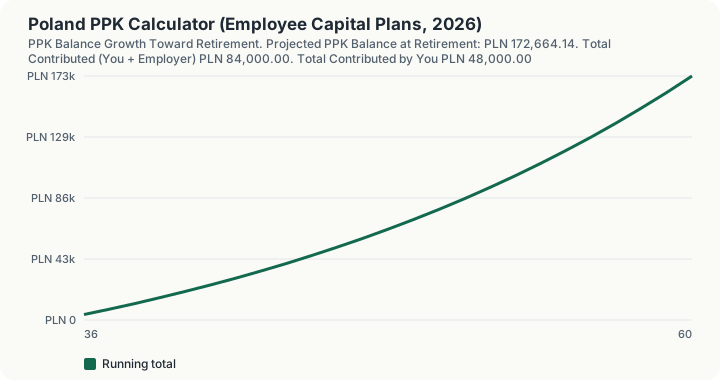
Quick Answer: An employee earning PLN 72,000.00 gross per year, contributing the basic 2% employee rate against a 1.5% employer match starting at age 30, is projected to reach PLN 15,569.81 in their PPK account by age 35 -- including PLN 12,600.00 in combined employee and employer contributions, PLN 1,450.00 in government payments (a one-time 250 PLN welcome payment plus five years of the 240 PLN annual top-up), and PLN 1,519.81 in investment growth at an assumed 5% annual return.
Overview
PPK (Pracownicze Plany Kapitałowe -- Employee Capital Plans) is Poland's semi-mandatory workplace retirement savings program, introduced in 2019 and now covering employers of all sizes. Every eligible employee is automatically enrolled (with the right to opt out and back in every four years) into a target-date investment fund, funded by contributions from three sources at once: the employee's own paycheck, a matching contribution from the employer, and periodic top-ups from the Polish state.
The basic structure is simple -- employees contribute 2% of gross salary, employers add 1.5% -- but two features make PPK meaningfully different from a plain workplace savings plan. First, both employee and employer can voluntarily add more (up to 4% total each), turning PPK into a genuine supplemental retirement vehicle rather than a fixed 3.5% program. Second, the government adds real money on top: a one-time 250 PLN "welcome payment" (wpłata powitalna) once you have contributed for three months, and a 240 PLN annual top-up (dopłata roczna) for every year your own qualifying contributions clear a minimum threshold. This calculator projects how those three funding streams compound together toward retirement.
PPK savings can be withdrawn penalty-free from age 60 regardless of gender, a meaningful improvement over Poland's separate ZUS state pension system, which still has different statutory retirement ages for men (65) and women (60). Withdrawing early is possible but forfeits most of the employer and government contributions, so PPK is best modeled -- as this calculator does -- as a genuine hold-to-60 retirement account.
How This Is Calculated
- Annual contributions. Employee contribution = gross annual salary × your selected rate (2%-4%); employer contribution = gross annual salary × the employer's selected rate (1.5%-4%).
- Annual top-up eligibility. The 240 PLN government top-up is paid for any year in which your own qualifying contributions (employee + employer combined, per the statutory formula) reach at least 6 × the minimum wage × 3.5% -- PLN 1,009.26 for 2026 (6 × 4,806 × 3.5%). Below that, no top-up is paid that year, though the account still grows from the contributions and returns you do have.
- Welcome payment. A one-time 250 PLN payment is added to the account once basic contributions have been made for at least three months -- modeled here as landing in year one and compounding alongside every subsequent year's growth.
- Compounding growth. Each year's ending balance = last year's balance × (1 + assumed annual return) + that year's total contribution (employee + employer + any government top-up), compounding annually until your target retirement/withdrawal age.
Worked Example
Using the calculator's default inputs (PLN 72,000.00 salary, 2% employee / 1.5% employer, age 30 → 35, 5% assumed return):
- Annual employee contribution: 72,000 × 2% = PLN 1,440.00. Annual employer contribution: 72,000 × 1.5% = PLN 1,080.00. Combined: PLN 2,520.00/year.
- 2,520.00 ≥ the PLN 1,009.26 threshold, so the 240 PLN annual top-up applies every year.
- Opening balance: the PLN 250.00 welcome payment (no prior balance).
- Year 1: 250.00 × 1.05 + (2,520.00 + 240.00) = 262.50 + 2,760.00 = PLN 3,022.50.
- Year 2: 3,022.50 × 1.05 + 2,760.00 = PLN 5,933.63. ... continuing for 5 years reaches PLN 15,569.81 by age 35.
- Total contributed (employee + employer only): 5 × 2,520.00 = PLN 12,600.00. Total government money: 250.00 + (5 × 240.00) = PLN 1,450.00. The remaining PLN 1,519.81 is investment growth.
What This Does Not Account For
- Rising salary over time. Contributions are modeled as a fixed percentage of your CURRENT gross salary held constant for the entire projection period; real salaries usually grow, which would increase later years' contributions.
- The reduced employee rate for low earners. Employees earning less than 1.2× the minimum wage may reduce their basic employee contribution to as low as 0.5% (rather than the standard 2%); this calculator only models rates from 2% upward.
- Fund performance variability. PPK defaults to an age-appropriate target-date fund that automatically shifts from equities toward bonds as you approach retirement; this calculator instead assumes one constant annual return for the entire period, which is a simplification of how a real target-date fund's risk (and expected return) changes over time.
- Fees. PPK fund management fees (capped by law, but nonzero) are not deducted in this projection.
- Employer contributions as taxable income. Employer PPK contributions are additional taxable income for PIT purposes (though not subject to ZUS/NFZ); this calculator models the savings growth only, not the payroll tax treatment.
- Withdrawal taxation and the 25%-30%-forfeit early-withdrawal rules. This calculator assumes a hold-to-retirement scenario; early withdrawal forfeits most employer and government money and has its own tax treatment, not modeled here.
- The reduced qualifying-contribution top-up threshold for very low earners, which is lower than the standard 6× minimum-wage formula used here.
Common Pitfalls
- Opting out without understanding the true cost. Every four years, employers must re-enroll opted-out employees, but the years spent opted out mean a permanently missed employer match and government top-ups that cannot be backfilled retroactively.
- Assuming the employer match is "free money" with no strings. It generally is, in the sense that it costs the employee nothing extra to receive it -- but the account is meant to be held to age 60; withdrawing early gives up most of the employer and government contributions.
- Missing the annual top-up threshold in a partial or low-income year. If your combined contributions in a given year fall short of the minimum threshold (for example, due to unpaid leave or part-time hours), that year's 240 PLN top-up is simply not paid -- it doesn't carry forward.
- Forgetting that the welcome payment is one-time only. Unlike the annual top-up, the 250 PLN welcome payment is paid exactly once, upon meeting the three-month participation requirement -- it should not be modeled as a recurring annual benefit.
- Ignoring voluntary additional contributions when comparing PPK to other savings vehicles. The default 3.5% combined rate is often compared unfavorably to other retirement products, but PPK allows up to 8% combined (4% + 4%) voluntarily, which changes the comparison considerably.
Frequently Asked Questions
Can I lose my PPK savings?
What happens to my PPK account if I change employers?
Is PPK the same as ZUS (the state pension)?
Do self-employed (B2B) workers get PPK?
Why does my projected balance depend so much on the assumed return rate?
Sources
- 2026 minimum wage (PLN 4,806/month), used in the annual top-up eligibility threshold: verified across ifirma.pl, symfonia.pl, and poradnikprzedsiebiorcy.pl 2026 summaries. dol.gov/agencies/whd/minimum-wage/state
- Polish National Revenue Administration, the official authority for the national tax authority this calculator relates to. podatki.gov.pl
Also consulted: mojeppk.pl: the official PPK program portal, contribution-rate structure, welcome payment, and annual top-up rules, 2026; Ustawa z dnia 4 października 2018 r. o pracowniczych planach kapitałowych (the PPK Act); Cross-corroborating secondary sources (2026 figures verified identically across multiple independent publishers): allianz.pl, adwokatslawomirduda.pl, europim.pl, amplicolife.pl.