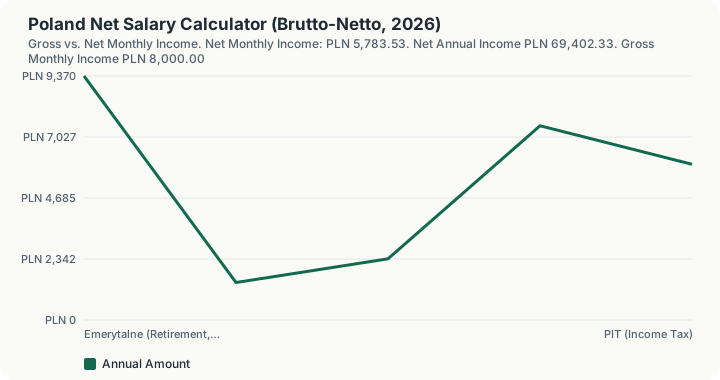
Quick Answer: A Polish employee (umowa o pracę) earning PLN 96,000.00 gross per year, with the standard 250 PLN/month tax-deductible cost and no special exemption, takes home PLN 69,402.33 net per year -- PLN 5,783.53 per month -- after PLN 13,161.60 in ZUS social insurance, PLN 7,455.46 in NFZ health insurance, and PLN 5,980.61 in PIT income tax.
Overview
This calculator converts a gross Polish income (wynagrodzenie brutto) into take-home pay (netto) for 2026, covering the three most common ways to earn income in Poland: an employment contract (umowa o pracę), a contract of mandate (umowa zlecenie), and self-employment (B2B, formally jednoosobowa działalność gospodarcza -- a sole proprietorship). Each is taxed and insured under a genuinely different set of rules, and Poland's payroll system layers several distinct deductions on top of gross pay before arriving at net: mandatory ZUS (Zakład Ubezpieczeń Społecznych) social insurance contributions, NFZ (Narodowy Fundusz Zdrowia) health insurance, and PIT (podatek dochodowy od osób fizycznych) personal income tax under the two-bracket skala podatkowa.
An employment contract carries the fullest set of employee protections and the most standardized deduction stack: 13.71% combined ZUS (retirement, disability, and mandatory sickness insurance), 9% NFZ health insurance, and PIT after a small flat monthly deductible-cost allowance. A contract of mandate is similar but with sickness insurance optional and a 20% deductible-cost rate instead of a flat monthly amount, and it carries a distinctive full ZUS exemption for students and pupils under 26. Self-employment shifts the entire ZUS and health-insurance burden onto the business owner (who pays both the "employee" and "employer" shares) and lets the owner choose between a flat 19% tax on income (podatek liniowy) or a lump-sum tax on revenue with no cost deduction (ryczałt), each with its own health-contribution formula.
This calculator models all three side by side so you can compare take-home pay across contract types on the same gross income, and see exactly which deduction -- ZUS, NFZ, or PIT -- drives the difference.
How This Is Calculated
Employment contract (umowa o pracę):
- ZUS employee contributions: 9.76% emerytalne (retirement) + 1.5% rentowe (disability) + 2.45% chorobowe (sickness, mandatory) = 13.71% of gross salary.
- NFZ health insurance: 9% of the ZUS-reduced base (gross minus ZUS). Not deductible from PIT since the 2022 Polski Ład reform.
- Taxable income: ZUS-reduced base minus the standard 250 PLN/month (3,000 PLN/year) deductible cost (koszty uzyskania przychodu, KUP), or 300 PLN/month (3,600 PLN/year) if you commute from outside your work locality with no separation allowance.
- PIT: 12% of taxable income up to 120,000 PLN, minus the 3,600 PLN annual kwota zmniejszająca podatek (tax-reducing amount); above 120,000 PLN, 10,800 PLN plus 32% of the excess.
Contract of mandate (umowa zlecenie): identical structure, except chorobowe is voluntary (elected separately), the deductible cost is 20% of the ZUS-reduced base instead of a flat amount, and a student or pupil under 26 is fully exempt from ZUS and NFZ.
Self-employment (B2B): ZUS is a fixed monthly amount based on a contribution-base rule (30% of the minimum wage for the first 24 months, "preferential ZUS"; 60% of the forecast average wage afterward, "duży ZUS" / standard ZUS) rather than a percentage of revenue. Podatek liniowy taxes income (revenue minus costs minus ZUS) at a flat 19%, plus a 4.9%-of-income health contribution (minimum 432.54 PLN/month). Ryczałt taxes gross revenue (no cost deduction) at a rate that depends on your business activity, plus a flat monthly health contribution set by three revenue tiers.
Worked Example
Employment contract, PLN 96,000.00 gross/year, standard KUP:
- ZUS: 96,000 × 13.71% = PLN 13,161.60.
- ZUS-reduced base: 96,000 − 13,161.60 = 82,838.40. NFZ: 82,838.40 × 9% = PLN 7,455.46.
- Taxable income: 82,838.40 − 3,000 (standard KUP) = PLN 79,838.40.
- PIT: 79,838.40 × 12% − 3,600 = 9,580.61 − 3,600 = PLN 5,980.61.
- Net: 96,000 − 13,161.60 − 7,455.46 − 5,980.61 = PLN 69,402.33 per year, or PLN 5,783.53 per month.
Self-employment (B2B), podatek liniowy, PLN 180,000.00 revenue/year, PLN 20,000.00 costs, standard ZUS:
- Standard ZUS (base 5,652 PLN/month): emerytalne 1,103.27 + rentowe 452.16 + chorobowe 138.47 + wypadkowe 94.39 + Fundusz Pracy 138.47 = 1,926.76/month → PLN 23,121.12/year.
- Income before health: 180,000 − 20,000 − 23,121.12 = 136,878.88. Monthly: 11,406.57. Health (4.9%): 558.92/month → PLN 6,707.04/year (fully deductible, under the 14,100 PLN cap).
- Taxable base: 136,878.88 − 6,707.04 = 130,171.84. Tax: 130,171.84 × 19% = PLN 24,732.65.
- Net: 180,000 − 20,000 − 23,121.12 − 6,707.04 − 24,732.65 = PLN 105,439.19 per year, or PLN 8,786.60 per month.
What This Does Not Account For
- Employer-side costs. This calculator shows only the employee's/contractor's own deductions, not the employer's additional ZUS burden (roughly 20%+ of gross for an employment contract) -- the full cost to a Polish employer is significantly higher than gross salary.
- The Copyright/creative-work 50% KUP rate for zlecenie. Some contracts of mandate involving copyrighted creative work qualify for a 50% deductible-cost rate instead of the standard 20%; this calculator models only the standard rate.
- PPK (Employee Capital Plans) contributions. PPK is modeled separately in this platform's dedicated Poland PPK Calculator; it is not netted out of the take-home figures here.
- Multiple simultaneous income sources or multiple employers. Each contract type is calculated independently, as if it were your sole source of income for the year; combining jobs changes annual ZUS caps and PIT bracket crossings.
- The 6-month "ulga na start" and "Mały ZUS Plus" self-employment reliefs. This calculator models only the standard preferential ZUS (first 24 months) and standard "duży ZUS" bases, not the separate health-insurance-only starter period or the income-scaled Mały ZUS Plus program.
- VAT. Self-employed individuals may also owe VAT depending on revenue and activity type; this is entirely outside the scope of a personal income calculator.
- Non-standard ryczałt activity codes. Ryczałt rates depend on a detailed PKWiU activity classification; this calculator offers the most common rates as a selection rather than a full lookup.
- Monthly cumulative withholding mechanics. Real Polish payroll applies these rules cumulatively month by month (with kwota zmniejszająca podatek applied monthly via a PIT-2 declaration); this calculator computes a full-year snapshot instead.
Common Pitfalls
- Forgetting that NFZ is no longer deductible from PIT. Before the 2022 Polski Ład reform, 7.75 percentage points of the 9% health contribution reduced your tax bill directly; that deduction is gone, and the standard 9% is paid in full regardless of your PIT liability.
- Assuming ryczałt is always cheaper than podatek liniowy. Ryczałt taxes gross revenue with no cost deduction at all -- a high-cost business (e.g. one buying a lot of equipment or subcontracting heavily) can easily owe more under ryczałt than under a cost-deducting method, even at a lower headline rate.
- Missing the umowa zlecenie sickness-insurance election. Chorobowe is voluntary on a zlecenie contract and must be actively elected; without it, no sick-pay benefit accrues, but the contribution (and its tax deduction) is also skipped.
- Confusing the student ZUS exemption with the under-26 PIT exemption. A student/pupil under 26 on a zlecenie contract is exempt from ZUS/NFZ specifically because of student status (not age alone); the separate ulga dla młodych PIT exemption depends purely on age and applies whether or not you are a student. The two can, and often do, stack.
- Not accounting for the ZUS annual contribution cap. Emerytalne and rentowe contributions stop once a worker's cumulative annual base reaches 282,600 PLN (2026); this calculator does not model that cap, so very high earners may see a slightly overstated ZUS figure toward the top of the year.
Frequently Asked Questions
Why is B2B usually more take-home per PLN of revenue than an employment contract?
Is chorobowe worth electing on a zlecenie contract?
What is the difference between "preferential ZUS" and "duży ZUS"?
Does the calculator model VAT for B2B?
Can I be under 26 and still owe PIT on this calculator?
Sources
- Ministerstwo Finansów / Krajowa Administracja Skarbowa (podatki.gov.pl): "Serwis o podatkach" -- PIT skala podatkowa, kwota wolna od podatku, and "Dochody z pracy" methodology, 2026. podatki.gov.pl
Also consulted: Zakład Ubezpieczeń Społecznych (zus.pl): 2026 contribution-rate and contribution-base announcements for employee, zlecenie, and self-employed ZUS; Cross-corroborating secondary sources (2026 figures verified identically across multiple independent publishers): ifirma.pl, poradnikprzedsiebiorcy.pl, symfonia.pl, gofin.pl, pit.pl, pitax.pl, e-pity.pl, inewi.pl, faktura.pl, bizky.ai, bizneserp.pl, kadrywpigulce.pl.