Quick Answer: WACC is the blended, weighted-average return a company must generate on its assets to satisfy both its shareholders and its lenders, and it is the discount rate most commonly used to value a company's future cash flows.
Overview
Every company is financed with some combination of equity (money from shareholders) and debt (money borrowed from lenders). Each source of capital has its own cost. Shareholders demand a return commensurate with the risk of owning the business, since equity has no guaranteed payout and sits behind debt in a bankruptcy. Lenders demand interest, a contractual and generally lower-risk return, because they get paid before shareholders and often hold collateral.
The Weighted Average Cost of Capital blends these two costs into a single number, weighted by how much of the company's total capital comes from each source. That single blended rate represents the minimum return a company's investments need to clear in order to create value for everyone who financed the business. Fall short of WACC, and a project or company is actually destroying value even if it is nominally "profitable."
WACC's most common use is as the discount rate in a discounted cash flow (DCF) valuation, where a company's projected free cash flows are discounted back to the present using WACC to estimate the business's intrinsic value.
How This Is Calculated
The classic WACC formula is:
WACC = (E / V) × Cost of Equity + (D / V) × Cost of Debt × (1 − Tax Rate)
Breaking down each term:
- E is the market value of equity, ideally share price multiplied by shares outstanding for a public company, or another reasonable estimate of equity value for a private one.
- D is the market value of debt, commonly approximated using the book value of interest-bearing debt from the balance sheet, since market values for private debt are rarely observable.
- V is total capital, simply E + D.
- Cost of Equity is the return shareholders require, most often estimated using the Capital Asset Pricing Model: risk-free rate plus Beta multiplied by the equity risk premium.
- Cost of Debt is the company's effective borrowing rate, before any tax adjustment.
- (1 − Tax Rate) is the tax shield adjustment. Interest expense is deductible for tax purposes in most jurisdictions, which effectively lowers the true after-tax cost of borrowing. Dividends paid to equity holders receive no such deduction, so no equivalent adjustment applies to the cost of equity term.
The two weighted terms, (E/V) × Cost of Equity and (D/V) × after-tax Cost of Debt, are simply added together to produce the final blended rate.
Worked Example
Consider a company with $6,000,000 in market value of equity and $4,000,000 in market value of debt, a 12% cost of equity, a 6% pre-tax cost of debt, and a 21% marginal tax rate.
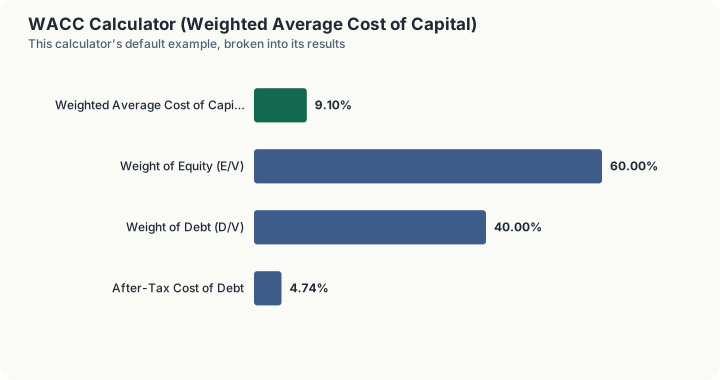
Step 1: Total capital and weights. V = $6,000,000 + $4,000,000 = $10,000,000. Weight of Equity = $6,000,000 / $10,000,000 = 0.60, or 60%. Weight of Debt = $4,000,000 / $10,000,000 = 0.40, or 40%.
Step 2: After-tax cost of debt. 6% × (1 − 0.21) = 6% × 0.79 = 4.74%.
Step 3: Weighted components. Equity component: 0.60 × 12% = 7.20%. Debt component: 0.40 × 4.74% = 1.896%.
Step 4: Sum the components. 7.20% + 1.896% = 9.096%.
This company's WACC is 9.096%. Any investment or project the company undertakes needs to clear roughly a 9.1% return to satisfy both its shareholders and its lenders simultaneously. If this company were being valued with a discounted cash flow model, its projected free cash flows would be discounted at 9.096% to arrive at an estimate of enterprise value.
As a useful sanity check, notice that a company with no debt at all (100% equity financed) would have a WACC exactly equal to its cost of equity, since the debt term simply disappears from the formula. You can verify this in the calculator by setting the market value of debt to zero.
What This Does Not Account For
- Changing capital structure. WACC is calculated at a single point in time using current weights. A company actively shifting its debt-to-equity mix (through buybacks funded by new debt, for example) needs its WACC recalculated to reflect the new structure.
- Multiple classes of capital. This formula assumes just common equity and straightforward debt. Companies with preferred stock, convertible debt, or multiple debt tranches at different rates need a more granular weighted calculation across every capital source.
- Project-specific risk. A single company-wide WACC assumes every project or division carries the same risk as the company as a whole. A conglomerate should, in principle, use a different discount rate for a low-risk utility division than for a high-risk venture division.
- Market value estimation error. For private companies or firms with illiquid debt, both E and D are estimates rather than observed market prices, and the resulting WACC inherits that estimation uncertainty.
- Changes in the tax code. The tax shield benefit is only as reliable as the assumed marginal tax rate remaining stable and the company remaining consistently profitable enough to use the deduction.
Common Pitfalls
- Using book value of equity instead of market value. Book value of equity (from the balance sheet) can differ enormously from market value (share price times shares outstanding), especially for growth companies. Market value is the theoretically correct input.
- Forgetting the tax shield on debt. Applying the pre-tax cost of debt directly, without the (1 − Tax Rate) adjustment, systematically overstates WACC, since it ignores the real cash benefit of the interest deduction.
- Applying a company-wide WACC to a wildly different-risk project. Using one blended discount rate for every investment decision, regardless of how risky that specific investment is relative to the company's core business, is one of the most common practical misuses of WACC in corporate finance.
- Using a stale cost of equity. Cost of equity, especially when estimated via CAPM, moves with interest rates and market risk premiums. A Beta or risk-free rate pulled from several years ago can meaningfully understate or overstate the true current cost of equity.
- Ignoring negative or unusual tax situations. A company with large net operating loss carryforwards may not actually benefit from the interest tax shield in the near term, making the standard (1 − Tax Rate) adjustment overly generous until those losses are used up.
Frequently Asked Questions
Why is the cost of debt adjusted for taxes but the cost of equity is not?
What is the difference between WACC and the cost of equity?
How is cost of equity usually estimated?
Should I use book value or market value of debt?
Why does WACC matter for valuing a company?
Can WACC be lower than both the cost of equity and the cost of debt individually?
Sources
- CFA Institute Curriculum: Corporate Issuers, Cost of Capital. cfainstitute.org
- U.S. Securities and Exchange Commission, Investor.gov, the official authority for the investing this calculator relates to. investor.gov
Also consulted: Modigliani, F. and Miller, M.H. (1958). "The Cost of Capital, Corporation Finance and the Theory of Investment." American Economic Review.; Brealey, R., Myers, S., and Allen, F. Principles of Corporate Finance, chapters on the cost of capital; Damodaran, A. Applied Corporate Finance, chapters on estimating the cost of capital.