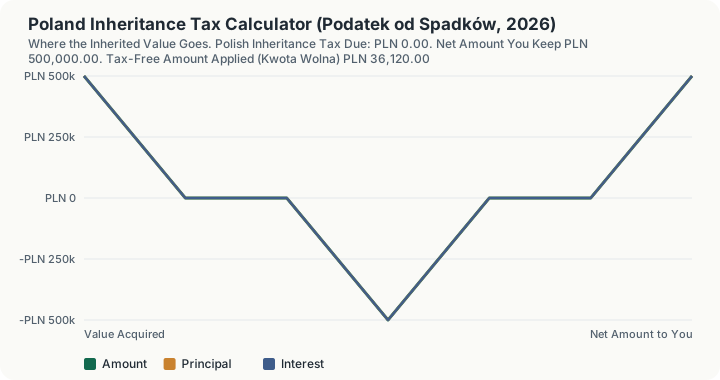
Quick Answer: A child inheriting PLN 500,000 from a parent in Poland pays PLN 0 -- but only if form SD-Z2 is filed with the tax office within 6 months. Miss that single deadline and the same inheritance costs PLN 31,762, because the exemption is lost outright and the acquisition is taxed under ordinary Group I rules. A friend or unmarried partner inheriting the same PLN 500,000 pays PLN 97,434.
Overview
Polish inheritance and gift tax (podatek od spadków i darowizn) is governed by the Act of 28 July 1983. It is assessed per acquirer -- on what each individual heir or donee personally receives -- not once on the estate as a whole. Two things then determine the bill: which statutory tax group the acquirer falls into, and, for the closest family, whether one form was filed on time.
Every acquirer sits in one of three statutory groups (art. 14):
- Group I -- spouse, descendants (children, grandchildren, great-grandchildren), ascendants (parents, grandparents), stepchild, son-in-law, daughter-in-law, siblings, stepparent, and parents-in-law. Tax-free amount: PLN 36,120.
- Group II -- descendants of siblings (nieces and nephews), siblings of parents (aunts and uncles), descendants and spouses of stepchildren, spouses of siblings, siblings of spouses, and spouses of other descendants. Tax-free amount: PLN 27,090.
- Group III -- everyone else: unrelated persons, unmarried cohabiting partners, friends. Tax-free amount: PLN 5,733.
Sitting inside Group I is a smaller circle known as the zero tax group (zerowa grupa podatkowa, art. 4a): spouse, descendants, ascendants, stepchild, siblings, and stepparent. These acquirers pay nothing at all, with no threshold and no ceiling -- a PLN 5 million inheritance from a parent is as tax-free as a PLN 50,000 one.
That exemption is not automatic. It is conditional on filing form SD-Z2 with the tax office within 6 months of the date the tax obligation arose. This calculator treats that deadline as hard, because that is the majority position among Polish tax sources, and because building in a grace period that may not exist would understate real risk.
One critical exclusion. Parents-in-law, sons-in-law and daughters-in-law are Group I -- but they are explicitly excluded from the zero group. They get the PLN 36,120 threshold and the Group I scale, and no SD-Z2 filing changes that.
How This Is Calculated
Step 1: Apply ulga mieszkaniowa (housing relief), if it applies.
Where the acquisition includes a residential building or apartment, art. 16 relief excludes the dwelling's value from the tax base, capped at 110 sqm of usable floor area. A dwelling of 110 sqm or less is sheltered entirely. A larger one is sheltered pro rata by floor area:
The relief covers the dwelling only -- not the land it stands on, and not any other asset in the estate. It carries three standing conditions: the acquirer must not already own another dwelling, must take up permanent registered residence in the property (generally within 1 year), and must not sell it for 5 years.
Step 2: Add up everything received from the same person over the rolling 5-year window.
The tax-free amount is cumulative per donor (art. 9 para. 2). Gifts and inheritances received from the same person within 5 years are pooled before the threshold is applied -- so a threshold already partly consumed by earlier gifts shelters less of the current acquisition.
Step 3: Group 0 -- check the SD-Z2 filing.
If the relationship is in the zero group and SD-Z2 was filed within 6 months, the tax is zero and the calculation stops here.
If the deadline was missed, the exemption is lost entirely -- not reduced, not prorated. The acquirer is then taxed as an ordinary Group I acquirer, because every zero-group relationship is also a Group I relationship. Continue to step 4 with the Group I threshold and scale.
Step 4: Deduct the group tax-free amount.
| Group | Tax-Free Amount (Kwota Wolna) |
|---|---|
| I | PLN 36,120 |
| II | PLN 27,090 |
| III | PLN 5,733 |
Step 5: Apply the statutory scale (art. 15) to the excess -- not to the total value.
Group I:
| Taxable Excess | Tax |
|---|---|
| Up to PLN 11,833 | 3% |
| PLN 11,833 - 23,665 | PLN 355.05 + 5% of the amount over PLN 11,833 |
| Over PLN 23,665 | PLN 946.60 + 7% of the amount over PLN 23,665 |
Group II:
| Taxable Excess | Tax |
|---|---|
| Up to PLN 11,833 | 7% |
| PLN 11,833 - 23,665 | PLN 828.40 + 9% of the amount over PLN 11,833 |
| Over PLN 23,665 | PLN 1,893.30 + 12% of the amount over PLN 23,665 |
Group III:
| Taxable Excess | Tax |
|---|---|
| Up to PLN 11,833 | 12% |
| PLN 11,833 - 23,665 | PLN 1,420.00 + 16% of the amount over PLN 11,833 |
| Over PLN 23,665 | PLN 3,313.20 + 20% of the amount over PLN 23,665 |
The base amounts written into the statute (355.05, 946.60, 828.40, 1,893.30, 1,420.00, 3,313.20) are legislated constants and do not exactly equal the bracket width multiplied by the bracket rate. They are used verbatim here, as the law states them.
Step 6: Round to full złoty. Tax liabilities are rounded to whole złoty under Ordynacja podatkowa art. 63.
Worked Example
Child inherits PLN 500,000 and files SD-Z2 in time.
- Relationship is in the zero group (a descendant). SD-Z2 filed within 6 months.
- Tax due: PLN 0. No threshold applies, and the amount is irrelevant -- the exemption has no ceiling.
Son-in-law inherits PLN 500,000 from a mother-in-law.
A son-in-law is Group I, but explicitly outside the zero group, so filing SD-Z2 achieves nothing.
- Tax-free amount: PLN 36,120. Taxable excess: 500,000 - 36,120 = PLN 463,880.
- That lands in the top Group I bracket: PLN 946.60 + 7% × (463,880 - 23,665).
- 7% × 440,215 = PLN 30,815.05. Total: 946.60 + 30,815.05 = PLN 31,761.65.
- Rounded to full złoty: PLN 31,762. Net kept: PLN 468,238. Effective rate: 6.35%.
Unrelated heir (Group III) inherits PLN 500,000.
- Tax-free amount: PLN 5,733. Taxable excess: 500,000 - 5,733 = PLN 494,267.
- Top Group III bracket: PLN 3,313.20 + 20% × (494,267 - 23,665).
- 20% × 470,602 = PLN 94,120.40. Total: 3,313.20 + 94,120.40 = PLN 97,433.60.
- Rounded: PLN 97,434. Net kept: PLN 402,566. Effective rate: 19.49% -- roughly three times what the Group I son-in-law pays on the identical amount.
What a missed deadline actually costs. Take the first example again -- the child inheriting PLN 500,000 -- but with SD-Z2 filed in month seven instead of month five. The child does not fall back to some reduced relief. The exemption is gone, and the child is taxed exactly as the son-in-law was: PLN 31,762. One late form, and two heirs with completely different legal standing end up with identical bills.
Housing relief, Group II nephew. A nephew inherits a 160 sqm apartment worth PLN 800,000 and nothing else.
- Relief shelters the first 110 sqm pro rata: 800,000 × (110 / 160) = PLN 550,000 excluded.
- Taxable value: 800,000 - 550,000 = PLN 250,000.
- Group II tax-free amount PLN 27,090: taxable excess = 250,000 - 27,090 = PLN 222,910.
- Top Group II bracket: 1,893.30 + 12% × (222,910 - 23,665) = 1,893.30 + 23,909.40 = PLN 25,802.70.
- Rounded: PLN 25,803. Without the relief, the same nephew would owe PLN 91,803.
What This Does Not Account For
- A January 2026 amendment on late SD-Z2 filings, confirmed but not modeled. Ustawa z dnia 21 listopada 2025 r. (Dz.U. 2025, poz. 1854), in force from 7 January 2026, lets an acquirer who missed the 6-month deadline request restoration of the exemption by proving the delay was without fault, within a tight ~7-day window of filing the overdue SD-Z2. This is confirmed current law, not a rumor -- but because restoration is a discretionary, fact-specific tax-authority decision rather than a deterministic formula, this calculator models only the hard-deadline outcome (no restoration attempted or granted). If you have missed the deadline and believe you were not at fault, this is exactly the point on which to consult a Polish tax advisor (doradca podatkowy) about pursuing restoration under this mechanism.
- Valuation of the inherited assets. The calculator assumes the value you enter is the correct taxable value, already determined and already net of deductible debts, funeral costs, and other charges (długi i ciężary). Property valuation disputes with the tax office are common and are outside this calculation.
- The land under an inherited house. Ulga mieszkaniowa covers the residential building or apartment. The value of the land it sits on is not sheltered and remains fully taxable.
- Whether you actually satisfy the housing relief conditions. The calculator applies the relief when you tick the box. It does not test whether you already own another dwelling, whether you will register permanent residence in time, or whether you might sell within 5 years -- any of which can cause the relief to be withdrawn retroactively, with interest.
- Multiple heirs of one estate. Each acquirer is taxed separately on their own share, under their own group. If an estate is divided among several people, run the calculator once per heir.
- Sale of an inherited asset. Selling inherited property within 5 years of the end of the year the deceased acquired it can trigger a separate PIT liability on the gain. That is a different tax entirely and is not modeled here.
- Cross-border and non-resident cases. Polish inheritance and gift tax turns on the citizenship or residence of the acquirer and the location of the assets. Foreign-situs assets, foreign heirs, and any applicable double-taxation relief are outside this calculator.
- Business succession and agricultural relief. Separate regimes exist for certain agricultural land and business assets; none are modeled here.
- Penalties, interest, and the 20% sanction rate. Undisclosed acquisitions revealed during a tax inspection can be taxed at a punitive 20% rate regardless of group. This calculator computes only the ordinary liability on a properly disclosed acquisition.
Common Pitfalls
- Treating the SD-Z2 exemption as automatic. It is not. It is a filing-conditioned exemption, and the filing window is 6 months from when the tax obligation arose -- the final court inheritance order, the notarial certificate of succession, or acceptance of a gift. No form, no exemption.
- Assuming a late filing costs you only part of the benefit. It costs you all of it. A late-filing child does not get a reduced exemption or a partial credit; they get the standard Group I threshold of PLN 36,120 and the Group I scale on everything above it. On a PLN 500,000 inheritance that is a PLN 31,762 swing on a single piece of paperwork.
- Assuming every Group I relative is in the zero group. Parents-in-law, sons-in-law and daughters-in-law are Group I but are carved out of the art. 4a exemption. They pay Group I tax no matter how promptly they file.
- Forgetting an unmarried partner is Group III. A long-term cohabiting partner with no marriage or registered partnership is legally a stranger for this tax: a PLN 5,733 threshold and rates up to 20%. This is the single largest tax gap in the Polish system between two people who may have shared a home for decades.
- Applying the bracket rate to the whole inheritance. The scale applies to the excess over the threshold, and each bracket taxes only its own slice. Crossing PLN 23,665 of excess does not retroactively tax the earlier slices at the top rate.
- Ignoring the rolling 5-year cumulation. Gifts already received from the same person inside the 5-year window consume the threshold. A parent who gave PLN 30,000 four years ago has already used most of a Group I child's PLN 36,120 threshold, should the exemption route be unavailable.
- Claiming housing relief while owning another flat. The relief requires that you do not already own another dwelling and that you keep the inherited one for 5 years. Claiming it and then selling in year three means paying the tax back, with interest.
Frequently Asked Questions
What exactly is the "zero tax group"?
When exactly does the 6-month clock start?
What happens if I miss the 6-month SD-Z2 deadline?
Is inheritance tax paid on the whole estate or on my share?
Do I still have to file something if I owe tax?
How does ulga mieszkaniowa interact with the tax-free amount?
Does the 110 sqm cap mean a larger flat gets no relief?
Are gifts and inheritances taxed the same way?
Does the tax-free amount reset each year?
Sources
- Krajowa Administracja Skarbowa (podatki.gov.pl) is the official source of record for forms SD-Z2 and SD-3 and for any case-specific ruling. podatki.gov.pl
Also consulted: Ustawa z dnia 28 lipca 1983 r. o podatku od spadków i darowizn (Inheritance and Gift Tax Act), as amended -- art. 4a (zero tax group and the 6-month SD-Z2 notification), art. 9 (tax-free amounts and 5-year cumulation), art. 14 (tax group definitions), art. 15 (progressive scale), art. 16 (ulga mieszkaniowa, 110 sqm cap); Tax-free amounts of PLN 36,120 / PLN 27,090 / PLN 5,733, at the levels in force since 1 July 2023 and unchanged for 2026 -- verified with high confidence and cross-corroborated across independent Polish tax publishers reporting identical figures; Statutory scale base amounts (PLN 355.05, 946.60, 828.40, 1,893.30, 1,420.00, 3,313.20) and bracket ceilings (PLN 11,833 and PLN 23,665) -- taken verbatim from art. 15 as reported consistently across sources; Ordynacja podatkowa art. 63 -- rounding of tax liabilities to full złoty; Ustawa z dnia 21 listopada 2025 r. o zmianie ustawy o podatku od spadków i darowizn (Dz.U. 2025, poz. 1854), in force from 7 January 2026, confirming the late-SD-Z2 deadline-restoration mechanism (art. 4c) on proof of lack of fault. Confirmed current law; not modeled here since restoration is a discretionary, fact-specific tax-authority decision rather than a formula -- this calculator implements the hard-deadline outcome only.