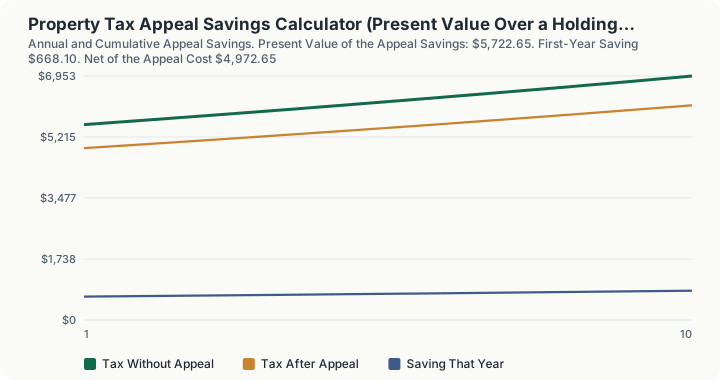
Quick Answer: A successful 12% appeal on a $425,000 Texas assessment is worth $5,722.65 in present value across a ten-year hold at a 5% discount rate. The first-year saving is only $668.10, which is the figure an appeal notice usually quotes, so the present value is 8.57 times the number most people use to decide. Net of a $750 cost of pursuing it, the appeal is worth $4,972.65 and repays its own cost in 2 years.
What does this calculator do?
Almost every discussion of a property tax appeal is framed around the wrong number. The assessor's office, the appeal consultant, and the homeowner all reach for the same figure: the assessed value removed, multiplied by the effective tax rate. That is one year of saving.
But a successful appeal does not produce one year of saving. It lowers the base from which every subsequent year's tax is computed, for as long as you own the property, and it lowers a base that is itself growing with reassessments. The correct valuation is a present value: an annuity of savings over the holding period, each year's saving grown at the assessment growth rate and discounted back at your cost of capital, less what the appeal costs to pursue.
Over a ten-year hold, that present value routinely lands between six and nine times the one-year figure. That is the difference between an appeal that looks marginal and one that is obviously worth filing.
The single most important assumption is persistence. This calculator models a reduction that sticks: the reduced value becomes the new base and grows from there. Jurisdictions differ. Some hold an appealed value for a fixed number of cycles, some reset to market at the next general reassessment. Where the reduction does not persist, shorten the holding period to the number of years it will survive.
How is this calculated?
PV = ∑(n = 1 to N) (A⋅p⋅t⋅(1 + g)^(n − 1))/((1 + d)ⁿ)
where $A$ is the assessed value, $p$ the reduction percentage, $t$ the effective tax rate, $g$ assessment growth, $d$ the discount rate and $N$ the holding period. The effective tax rate is not entered by hand: it is read from the state benchmark table for the state you select.
Step 1: Look up the effective property tax rate for the state. Texas = 1.31% of assessed value (8th highest in the national ranking)
Step 2: Compute the current annual tax before any appeal. $425,000 x 1.31% = $5,567.50
Step 3: Compute the assessed value the appeal would remove. $425,000 x 12% = $51,000.00
Step 4: Compute the assessed value after a successful appeal. $425,000 - $51,000 = $374,000.00
Step 5: Compute the first year's tax on the reduced value. $374,000 x 1.31% = $4,899.40
Step 6: The first-year saving is the difference. $5,567.50 - $4,899.40 = $668.10
Step 7: Discount that first-year saving back one year at 5%. $668.10 / 1.05 = $636.29
Step 8: Grow both assessments by 2.5% and repeat for year two. $425,000 x 1.025 = $435,625, taxed at 1.31% = $5,706.69; the reduced base gives $5,021.89, a saving of $684.80
Step 9: Sum the undiscounted savings across all ten years. Total nominal saving = $7,484.98
Step 10: Sum the discounted savings across all ten years. Present value = $5,722.65
Step 11: Express the present value as a multiple of the one-year figure. $5,722.65 / $668.10 = 8.57 times
Step 12: Subtract the cost of pursuing the appeal. $5,722.65 - $750.00 = $4,972.65 net present value
Step 13: Find the first year whose cumulative undiscounted saving covers the cost. Year 1 cumulative $668.10 is below $750; year 2 cumulative $1,352.90 exceeds it, so recovery is in year 2
Note what step 11 does and does not say. The savings stream is not eight times larger because of anything clever; it is larger because there are ten of them, each slightly bigger than the last, and the discounting only partly offsets the growth. The multiple is a direct consequence of the holding period, which is why the holding period, not the size of the reduction, is usually the input that decides whether an appeal is worth filing.
Worked Example
Take the same $425,000 assessment, the same 12% reduction and the same $750 cost, but assume you will sell in three years rather than ten.
Step 1: The first-year saving is unchanged. $51,000 x 1.31% = $668.10
Step 2: Year two's saving, after 2.5% growth. $51,000 x 1.025 x 1.31% = $684.80
Step 3: Year three's saving. $51,000 x 1.025^2 x 1.31% = $701.92
Step 4: Discount each back at 5%. $668.10/1.05 = $636.29; $684.80/1.05^2 = $621.13; $701.92/1.05^3 = $606.35
Step 5: Sum the discounted savings. $636.29 + $621.13 + $606.35 = $1,863.77
Step 6: Net of the appeal cost. $1,863.77 - $750.00 = $1,113.77
Still worth doing, but worth a fifth of what the ten-year hold is worth, on an identical appeal with an identical first-year saving. Now shrink the reduction to 2% on that same three-year hold and the present value falls to roughly $311, which no longer covers the $750 cost at all. Neither the reduction nor the hold decides this alone; their product does.
What does this calculator not account for?
- It does not estimate your chance of winning. Every figure here is conditional on the appeal succeeding at the reduction you enter. A rational decision multiplies the net present value by your probability of success, which this tool does not attempt to assess.
- It uses a statewide effective rate, not your parcel's actual rate. The rate comes from a state benchmark table of median taxes paid over median home value. Your county, city, school district and special districts combine into a rate that may differ materially. There is no assessed-value ratio, millage lookup or local levy modelling in this calculator.
- It does not model reassessment cycles. The reduction is assumed to persist and to grow at the stated rate. Jurisdictions that reset appealed values at the next general reassessment will deliver less than this shows.
- It does not model exemptions or caps. Homestead exemptions, senior freezes, and assessment caps such as a 10% annual limit change both the base and the growth path, and none of them are applied here.
- It does not model contingency fees correctly if they recur. Enter a single up-front cost. A consultant taking a percentage of savings every year is a different structure.
- It does not consider the risk of an increase. In some jurisdictions an appeal can result in a higher assessment. That downside is not modelled.
- It ignores the effect of the deduction. Property tax may be deductible on your federal return, subject to the state and local tax cap, which reduces the after-tax value of any saving.
What mistakes do people make with this?
- Judging the appeal on the first-year saving. This is the pitfall the calculator exists to correct. On the defaults, the one-year figure understates the value by a factor of 8.57.
- Assuming the market value on the notice is the assessed value. In many states the assessed value is a statutory fraction of market value. Enter the figure the tax is actually computed on, which is the figure on the notice.
- Confusing the reduction percentage with the tax reduction. A 12% cut in assessed value cuts the tax by 12%, not by 12 percentage points, and the dollar saving depends entirely on the rate.
- Over-estimating the holding period. The present value is dominated by how long you hold. If you might sell in four years, model four, not fifteen.
- Ignoring the appeal cost when the reduction is small. A 2% reduction on a short hold is the classic case where a $750 cost is not recovered.
- Forgetting the deadline. Appeal windows are short, often 30 to 45 days from the notice date, and missing one costs you the entire present value shown here until the next cycle.
Frequently Asked Questions
Is a property tax appeal worth it?
How much of a reduction can I expect?
Does winning an appeal lower my taxes forever?
Why does the same appeal save more in New Jersey than in Texas?
What does the discount rate change?
Sources
- U.S. Census Bureau, American Community Survey 2024 1-Year, table B25103 (median real estate taxes paid) and table B25077 (median home value), state level; each effective rate in
engine/tables/2026/state-property-tax.jsonis B25103 divided by B25077. data.census.gov/table/ACSDT1Y2024.B25103 - Internal Revenue Service, the official authority for the tax rules this calculator relates to. irs.gov
Also consulted: U.S. Census Bureau, American Community Survey 1-Year Estimates, the underlying source of median real estate taxes paid and median home value used to derive the effective rates; Present-value method: standard discounted cash flow over the holding period, implemented in engine/primitives/property-tax-appeal.ts. No statutory data is used in the present-value step; Your assessment notice and your county assessor's office: the authoritative source for your assessed value, your actual combined tax rate, your appeal deadline and your jurisdiction's rules on how long a successful appeal persists.