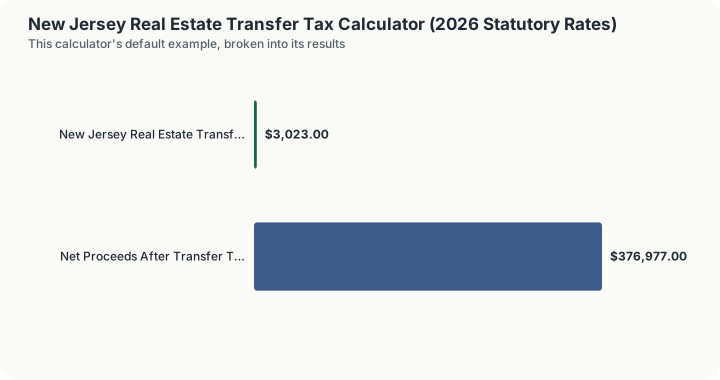
Quick Answer: A $380,000 home sale in New Jersey owes $3,023.00 in Realty Transfer Fee, an effective 0.796% rate from marginal state brackets, while sales at or above $1,000,000 also trigger a separate seller-paid Mansion Fee applied to the entire price.
Overview
New Jersey's Realty Transfer Fee applies marginal brackets ranging from 0.58% on the lowest tier of consideration up to 1.21% on amounts above $1 million, under the schedule in N.J.S.A. 46:15-7. Layered separately on top, a Graduated Fee, commonly called the mansion fee, applies once consideration reaches $1 million or more, and unlike the base brackets it is a cliff: the full bracket rate, running from 1% up to 3.5% at the highest tier, applies to the entire consideration, not just the amount above the threshold.
A change effective July 10, 2025 shifted the mansion fee's payer from the buyer to the seller, reversing the rule that had applied for two decades before that date; the base Realty Transfer Fee remains seller-paid as it always has been. Because of that 2025 amendment, closing documents or advice referencing the older buyer-paid mansion tax rule should be treated as outdated for any New Jersey transaction closing under current law.
How This Is Calculated
New Jersey runs both structures at once: a graduated base fee that is genuinely marginal, and a Mansion Fee above $1,000,000 that is a cliff and applies its rate to the entire price.
| Portion of Sale Price | Base Fee Rate |
|---|---|
| $0 to $150,000 | 0.58% |
| $150,000 to $200,000 | 0.85% |
| $200,000 to $550,000 | 0.96% |
| $550,000 to $850,000 | 1.06% |
| $850,000 to $1,000,000 | 1.16% |
| Above $1,000,000 | 1.21% |
At $1,000,000 the Mansion Fee is added, and its rate hits the whole consideration rather than the excess over the threshold:
| Total Consideration | Mansion Fee Rate, applied to the full price |
|---|---|
| $1,000,000 to $2,000,000 | 1.0% |
| $2,000,000 to $2,500,000 | 2.0% |
| $2,500,000 to $3,000,000 | 2.5% |
| $3,000,000 to $3,500,000 | 3.0% |
| Above $3,500,000 | 3.5% |
The engine walks the six base brackets marginally, tests the price against the $1,000,000 threshold, computes the cliff fee on the full price if it is met, and sums the two. Since 10 July 2025 the Mansion Fee is paid by the seller. Senior, blind, disabled and affordable-housing partial exemptions are not modeled.
Worked Example
New Jersey runs two levies with two different shapes: a marginal six-bracket Realty Transfer Fee, and a Mansion Fee that is a cliff. The baseline sale triggers only the first.
Step 1 -- The consideration. Contract sale price = $380,000
Step 2 -- Base bracket 1, $0 to $150,000 at 0.58%. $150,000 x 0.0058 = $870.00
Step 3 -- Base bracket 2, $150,000 to $200,000 at 0.85%. $50,000 x 0.0085 = $425.00
Step 4 -- Base bracket 3, $200,000 to $380,000 at 0.96%. $180,000 x 0.0096 = $1,728.00
Step 5 -- Base Realty Transfer Fee subtotal. $870.00 + $425.00 + $1,728.00 = $3,023.00
Step 6 -- The Mansion Fee test. $380,000 is below the $1,000,000 threshold, so the Mansion Fee is $0.00
Step 7 -- Total transfer tax due. $3,023.00 + $0.00 = $3,023.00
Step 8 -- Net proceeds after tax. $380,000.00 - $3,023.00 = $376,977.00
Step 9 -- The effective rate. $3,023.00 / $380,000 = 0.796%
Now put the two prices that straddle the threshold side by side, because that discontinuity is the single most consequential number on this page.
Step 10 -- A $999,000 sale: base fee across five brackets. $870.00 + $425.00 + $3,360.00 + $3,180.00 + $1,728.40 = $9,563.40
Step 11 -- A $999,000 sale: Mansion Fee. Below the threshold, so $0.00, and the total is $9,563.40
Step 12 -- A $1,000,000 sale: base fee, now filling all six brackets to the line. $870.00 + $425.00 + $3,360.00 + $3,180.00 + $1,740.00 = $9,575.00
Step 13 -- A $1,000,000 sale: the Mansion Fee on the ENTIRE price at 1.0%. $1,000,000 x 0.01 = $10,000.00
Step 14 -- A $1,000,000 sale: total transfer tax due. $9,575.00 + $10,000.00 = $19,575.00
One thousand dollars of extra price adds $10,011.60 of tax. That is the cliff, and it is why New Jersey contracts cluster just under seven figures. Note precisely what Step 13 does: the 1% is charged on the whole $1,000,000, not on the amount above the threshold, so there is no gradual phase-in to soften the edge. The calculator's own luxury scenario shows the same mechanism at a higher price: at $1,500,000 the base fee is $15,625.00, the Mansion Fee is $15,000.00, and the total is $30,625.00, an effective rate of 2.042%. And the cliff repeats at each Mansion Fee tier: at exactly $2,000,000 the rate steps from 1.0% to 2.0% on the full price, taking the total to $61,675.00 against $41,652.90 at $1,999,000. Since 10 July 2025 the Mansion Fee is the seller's obligation rather than the buyer's. Senior, blind, disabled and affordable-housing partial exemptions are not modelled.
What This Does Not Account For
- Senior, blind, disabled, and affordable-housing partial exemptions. New Jersey offers reduced Realty Transfer Fee rates for qualifying senior citizens, blind or disabled sellers, and certain low- and moderate-income housing transactions, none of which this calculator models.
- The exact cliff-edge behavior just above $1,000,000. Because the Mansion Fee applies its full bracket rate to the entire price rather than marginally, a sale at exactly $999,999 and a sale at $1,000,001 can produce a materially different total fee. This calculator computes the correct statutory result at any price entered, but users should be aware of how sharply the cost changes right at the threshold.
- County recording fees. New Jersey county clerks charge separate flat recording fees per document, unrelated to the value-based Realty Transfer Fee and Mansion Fee calculated here.
- New construction and certain commercial transaction nuances. Some New Jersey transaction types carry fee variations not captured by the standard consideration-over-$350,000 schedule this calculator uses.
Common Pitfalls
- Treating the Mansion Fee as marginal. Unlike the base Realty Transfer Fee, the Mansion Fee is a cliff: once the $1,000,000 threshold is met, the bracket rate applies to the full consideration, not just the amount above $1,000,000. Applying it marginally understates the tax significantly.
- Forgetting the Mansion Fee is seller-paid. As of the July 2025 amendments, the Graduated (Mansion) Fee is specifically a seller obligation, distinct from the base Realty Transfer Fee, which historically has different buyer and seller cost-sharing conventions depending on transaction type.
- Assuming the old $1,000,000 flat 1% mansion tax rule still applies. New Jersey's mansion tax structure changed substantially in 2025 to a graduated cliff schedule with rates up to 3.5%, replacing the previous flat 1% rule; using outdated guidance will produce the wrong number on higher-value sales.
- Using a rounded average rate instead of the marginal bracket table for the base fee. Because the base fee has six distinct brackets, estimating with a single blended percentage instead of working through each tier produces an inaccurate result, especially for sales near a bracket boundary.
Frequently Asked Questions
What is New Jersey's real estate transfer tax rate?
Who pays New Jersey's transfer taxes?
Why does the tax jump so much once a sale crosses $1,000,000?
Did New Jersey's mansion tax change recently?
Are any New Jersey property transfers exempt from these fees?
Sources
- New Jersey Division of Taxation; NJ Realty Transfer Fee Act amendments (P.L.2025, c.66), N.J.S.A. 46:15-7. nj.gov/treasury/taxation