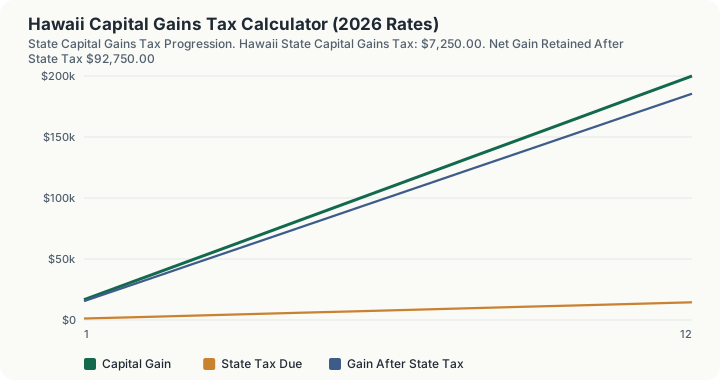
Quick Answer: On a $100,000 long-term capital gain layered on $75,000 of other income, Hawaii's tax is $7,250, an effective rate of 7.25%. Hawaii's ordinary graduated brackets would produce $7,750.00, but the alternative capital gains tax under HRS § 235-51(f) caps long-term gains at 7.25%, and you pay the lower of the two.
Two Computations, and You Pay the Lower
Hawaii is one of the few states that offers a preferential rate on long-term capital gains. Under HRS § 235-51(f), a taxpayer with net long-term capital gain may elect an alternative tax: ordinary graduated tax computed on taxable income excluding the net long-term gain, plus a flat 7.25% on that gain. The taxpayer pays the lesser of the alternative tax and the regular tax, so in practice Hawaii's long-term capital gains carry an effective ceiling of 7.25%, well below the 11.00% top ordinary bracket. It is reported on Schedule D of Form N-11 (residents) or N-15 (non-residents and part-year residents).
Hawaii's ordinary graduated schedule still runs from 1.40% to a top marginal rate of 11.00%, and it still governs short-term capital gains, which get no preferential treatment and are taxed as ordinary income. The 7.25% ceiling therefore only helps assets held more than one year. For a taxpayer whose income is low enough that the regular graduated calculation already produces less than 7.25% of the gain, the regular calculation controls and the alternative tax is simply not elected, the cap is a ceiling, not a floor.
This calculator applies that MIN() logic automatically: it computes the graduated stacked-bracket tax on the gain and the 7.25% alternative tax on the gain, and reports whichever is lower.
High-net-worth individuals, portfolio managers, corporate executives, and real estate investors all need a handle on state-level capital gains taxation, since state income taxes affect net internal rates of return on capital dispositions, 1031 exchange planning, installment sale structuring, and equity compensation exercises (ISOs, NSOs, and RSUs).
In institutional wealth management and private equity underwriting, capital gains calculations must account for both statutory tax rates and multi-jurisdictional residency rules. That holds whether the asset being disposed of is a block of publicly traded securities, a privately held business interest, real property, or a digital asset: evaluating state-level tax exposure is a core part of pre-liquidity tax modeling and post-sale wealth preservation.
Proper capital asset planning in Hawaii also means tracking taxable events across federal and state reporting cycles. Timing and holding structure dictate net after-tax proceeds, so investors need to look closely at how federal adjusted gross income (AGI) baselines interact with state modifications before closing substantial transactions.
How This Is Calculated
Hawaii runs a twelve-band ordinary schedule that reaches 11%, but a long-term capital gain rarely meets it. Under the alternative tax election, a taxpayer with net long-term gain may pay ordinary tax on everything except that gain plus a flat 7.25% on the gain itself, and pays whichever of the two figures is lower. The practical effect is a 7.25% ceiling on long-term gain: it is a rate cap, not an exclusion, so the whole gain stays in the base and only the rate is limited.
The calculator computes both figures and reports the smaller one. It treats the gain you enter as long-term, since it does not ask for a holding period.
How the two figures are built and compared:
- Start with the net gain. Capital losses and loss carryforwards are netted against the gain first.
- Stack the gain on your other income. Ordinary income fills the lower bands first and the gain is taxed at the rates still open above it, which produces the regular graduated figure. Enter other income as a taxable-income figure: the calculator does not subtract a standard deduction or personal exemption for you.
- Run the alternative tax test (HRS § 235-51(f)). Multiply the net long-term gain by 7.25% and compare it with the regular figure.
- Take the lower of the two. That is the election a Hawaii filer makes on Schedule D, and it is what the calculator reports.
- Effective rate. Controlling tax divided by realized gain, which for a long-term gain never exceeds 7.25% no matter how large the gain or the salary underneath it.
- Net proceeds. Subtract the state tax from the gain to get what you keep before federal tax.
Worked Example
Consider an investor in Hawaii who realizes $100,000 in capital gains on top of $75,000 in baseline ordinary income for the year.
- Stack the income. Under the regular graduated computation, income fills the lower brackets first, so the $75,000 of baseline income already occupies the lower tiers and the $100,000 gain stacks on top into higher brackets.
- Apply the marginal brackets. Working through Hawaii's bracket schedule, each slice of the gain is taxed at its own bracket's rate, with the highest slice reaching the 9.00% bracket. The regular tax attributable to the gain totals $8,437.50.
- Run the alternative tax test. HRS § 235-51(f) allows an alternative tax of 7.25% on the net long-term gain: 7.25% × $100,000 = $7,250.00.
- Take the lower figure. $7,250.00 is less than $8,437.50, so the alternative capital gains tax controls. Hawaii state tax due is $7,250.00.
- Effective rate. Dividing by the $100,000 gain gives an effective rate of exactly 7.25%, the statutory ceiling for long-term gains, not the 9.00% ordinary bracket.
- Net proceeds. After paying $7,250.00 in state tax, the investor keeps $92,750.00 of the $100,000 gain, before any federal tax applies.
If this had been a short-term gain, the 7.25% alternative tax would not be available and the full $8,437.50 of graduated tax would apply. And if the taxpayer's income were low enough, say a $50,000 long-term gain with no other income, where the graduated tax is only $3,378.60 versus a $3,625.00 alternative tax, the regular graduated calculation would win instead.
HARPTA: 7.25% Withholding on Non-Resident Real Estate Sales
If you are selling Hawaii real property and you are not a Hawaii resident, a separate rule applies at closing: the Hawaii Real Property Tax Act (HARPTA), codified at HRS § 235-68.
HARPTA requires the buyer (in practice, escrow) to withhold 7.25% of the gross amount realized, the full sale price, not the gain, and remit it to the Hawaii Department of Taxation on Form N-288 and N-288A, generally within 20 days of the transfer.
Three points matter most, and they are the ones most often misunderstood:
- HARPTA is a withholding mechanism, not a tax. It is a prepayment against your eventual Hawaii income tax liability, exactly as payroll withholding prepays your wage tax. It is not an additional tax and it is not necessarily your final tax.
- Because it applies to gross sale price, it very often over-withholds. On a $900,000 sale with a $150,000 gain, HARPTA takes $65,250 at closing, while the actual Hawaii tax on the gain at the 7.25% alternative rate is roughly $10,875. You recover the difference by filing a Hawaii non-resident return (Form N-15) for the year of sale, or earlier by applying for a withholding waiver or early refund on Form N-288B (before closing) or Form N-288C (after closing, before the return is due).
- The 7.25% figures are a coincidence of rate, not the same rule. HRS § 235-68's withholding percentage and HRS § 235-51(f)'s alternative capital gains rate are separate provisions that happen to share a number. One is applied to gross proceeds; the other is applied to net long-term gain.
Common exemptions include sales where the seller certifies Hawaii residency, sales qualifying for the federal principal-residence exclusion under IRC § 121 up to the statutory limit, § 1031 like-kind exchanges where no gain is recognized, and certain low-value transactions. This calculator models the Hawaii income tax on the gain; it does not model the HARPTA amount withheld at closing.
A parallel federal rule, FIRPTA (IRC § 1445), separately requires up to 15% withholding when the seller is a foreign person. A foreign seller of Hawaii property can face both.
The Point Where the 7.25% Cap Starts Binding
Hawaii is the only state in this family where the other-income field genuinely changes the answer, because the tax is the lesser of two computations: the ordinary graduated schedule, and the alternative tax under HRS 235-51(f) that charges 7.25% on the long-term gain. Which one wins depends on how much other income sits underneath the gain, and the switch happens at a findable point.
At $13,300 of other income. On the $100,000 baseline gain the engine returns $7,249.20, and the marginal rate output reads 7.60%. The graduated schedule is still the cheaper of the two, so the gain is being taxed through Hawaii's ordinary brackets.
At $13,400 of other income, one hundred dollars later. The engine returns $7,250.00 and the marginal rate output reads 7.25%. The alternative tax has taken over. The step costs eighty cents.
And then it stops moving entirely. This is the part worth carrying away. Once the cap binds, adding other income changes nothing: the engine returns $7,250.00 at $13,400 of other income, at $20,000, at $50,000, at the $75,000 baseline and at $200,000. A Hawaii taxpayer above roughly $13,400 of other income pays exactly 7.25% of the long-term gain and no more, whatever else they earn.
Below the crossover, the gain is genuinely cheaper. At $0 of other income the engine returns $6,491.20 on the same $100,000 gain, an effective rate of 6.49%, because the first tranches of the gain fall into Hawaii's 1.4%, 3.2%, 5.5% and 6.4% brackets before reaching 7.6%. That $758.80 saving against the capped figure is the entire value of realising a gain in a year with no other income.
The marginal figure once the cap binds. Each additional $1,000 of long-term gain costs $72.50. The engine returns $7,322.50 on a $101,000 gain against $7,250.00 on $100,000, and $72,500.00 on a $1,000,000 gain. The relationship is exactly linear above the crossover, which it is not below it.
The reverse question. An investor working to a $5,000 Hawaii tax budget can realise $68,965.52 of long-term gain at the baseline other income, where the engine returns exactly $5,000.00 and $63,965.52 of net proceeds.
What the two computations do not include. The engine assumes the whole entered gain qualifies as net long-term capital gain eligible for the alternative tax. It has no holding-period input, so a short-term gain, which Hawaii taxes at ordinary rates with no 7.25% ceiling, will be understated here by whatever the cap saved. Federal capital gains tax, the 3.8% net investment income tax and the section 121 residence exclusion are all outside the calculation.
What This Does Not Account For
While this calculator provides penny-exact state statutory modeling, additional federal and transactional complexities warrant supplementary review: - Federal Capital Gains Taxes: Federal long-term brackets (0%, 15%, 20%) and short-term ordinary rates up to 37% under IRC § 1. - Net Investment Income Tax (NIIT): The 3.8% surtax on net investment income under IRC § 1411 for single filers over $200,000 (married joint over $250,000). - Alternative Minimum Tax (AMT): Federal AMT calculations under IRC § 55 impacting incentive stock option (ISO) exercise spread. - Section 1031 Like-Kind Exchanges: Tax deferral mechanisms for real property held for productive use in trade, business, or investment. - Qualified Small Business Stock (QSBS): Federal Section 1202 gain exclusions where state conformity varies significantly.
Common Pitfalls
- Overpaying by Ignoring the Alternative Rate: Most states have no preferential long-term capital gains rate, and taxpayers (and most online calculators) assume Hawaii is the same. It is not. Failing to elect the HRS § 235-51(f) alternative tax means paying up to 11.00% where 7.25% was available.
- Failing to Track Holding Periods: The 7.25% alternative rate applies only to net long-term gain. Assets held one year or less are taxed at full ordinary graduated rates in Hawaii, up to 11.00%, on top of higher federal short-term rates.
- Treating HARPTA Withholding as Final: Non-resident sellers frequently write off the 7.25%-of-gross withheld at closing as a tax paid. It is a prepayment; filing Form N-15 (or N-288B/N-288C) usually recovers a substantial refund.
- Underestimating Multi-State Apportionment: Selling real estate or business assets located in other jurisdictions triggers multi-state non-resident return filing obligations.
- Neglecting Underpayment Penalties: Substantial one-time liquidity events require prompt estimated tax payments within the quarter of sale to avoid statutory penalties.
- Mismatched Cost Basis Records: Failure to document reinvested dividends, stock splits, or structural return-of-capital distributions leads to inflated taxable gain calculations.
Frequently Asked Questions
Does Hawaii have a state capital gains tax?
What is Hawaii's capital gains tax rate?
How are short-term and long-term capital gains taxed in Hawaii?
What is HARPTA and does it mean I owe 7.25% on my home sale?
Do I have to file a Hawaii return if I only sold property there?
Are retirement account distributions subject to capital gains tax in Hawaii?
Can capital losses offset capital gains in Hawaii?
When are estimated state tax payments required on capital gains?
Sources
- Hawaii Department of Taxation: 2026 Statutory Individual Income Tax Rate Schedules; Form N-11 and N-15 instructions. tax.hawaii.gov
- Internal Revenue Service (IRS): Publication 544 (Sales and Other Dispositions of Assets) and Publication 550 (Investment Income and Expenses). irs.gov/publications/p544
Also consulted: Hawaii Revised Statutes § 235-51(f): Alternative tax on net long-term capital gain (7.25% ceiling), reported on Form N-11/N-15 Schedule D; Hawaii Revised Statutes § 235-68: Hawaii Real Property Tax Act (HARPTA), 7.25% withholding on the amount realized by non-resident transferors of Hawaii real property; Forms N-288, N-288A, N-288B, N-288C.