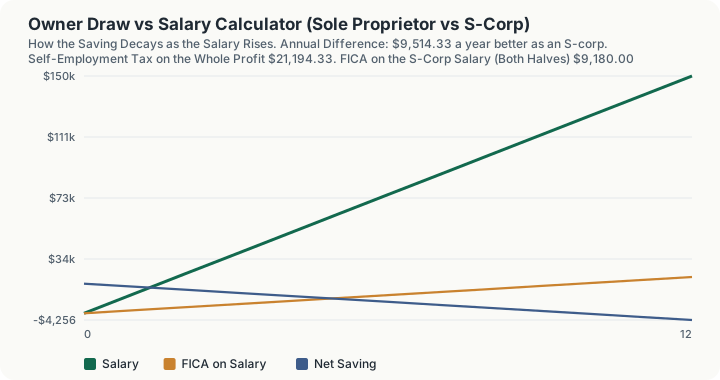
Quick Answer: On $150,000 of net business profit with a $60,000 S-corp salary and $2,500 a year to run the structure, the S-corp election is $9,514.33 a year better than operating as a sole proprietor. Self-employment tax on the whole profit would be $21,194.33; FICA on a $60,000 salary is $9,180.00 across both halves; the $12,014.33 difference less $2,500 of administrative cost leaves $9,514.33, or 6.34% of profit. The advantage disappears entirely once the salary reaches $122,185.18.
What does this calculator do?
A sole proprietor or single-member LLC pays self-employment tax on the entire net profit of the business, whether they draw it or leave it in. It does not matter what they call the money. Schedule SE charges 15.3% on 92.35% of net profit up to the Social Security wage base, then 2.9% Medicare with no ceiling above it, plus the 0.9% Additional Medicare Tax above the threshold for the filing status.
An S-corporation splits the same profit into two streams. A W-2 salary, which carries FICA at the same combined 15.3% across the employee and employer halves. And a distribution, which carries no payroll tax at all. The entire economic case for the election is that the distribution escapes a tax the sole proprietor cannot escape.
There are two constraints that make this less of a free lunch than it looks. The first is administrative: running an S-corp means a payroll service, an 1120-S return, and in many states a franchise tax or annual report fee. No authority publishes what that costs, so it is a user input here. The second is legal and far more important: the salary is not a free choice. It must be reasonable compensation for the services the owner actually performs, and the IRS both audits this and litigates it. Driving the salary toward zero to maximise the distribution is the single most reliable way to lose the benefit and acquire penalties.
Because the saving shrinks dollar for dollar as the salary rises, there is a salary above which the election stops paying for itself. This calculator finds it.
How is this calculated?
SE tax = 0.9235 × profit × applicable rates (Schedule SE)
FICA = salary × 15.3% up to the wage base, then 2.9%
net saving = SE tax − FICA − admin cost
Step 1: Apply the 92.35% factor to net profit. $150,000 x 0.9235 = $138,525.00
This is the net earnings from self-employment. The 7.65% haircut exists to put a self-employed person on the same footing as an employee, whose employer half is not part of their wages.
Step 2: Apply the Social Security rate up to the wage base. The 2026 Social Security wage base is $184,500. $138,525.00 is below it, so the whole amount is taxed. $138,525.00 x 12.4% = $17,177.10
Step 3: Apply the Medicare rate, which has no ceiling. $138,525.00 x 2.9% = $4,017.23
Step 4: Check the Additional Medicare Tax. The 0.9% Additional Medicare Tax applies above $200,000 for a single filer. $138,525.00 is below it, so $0.00.
Step 5: Total self-employment tax. $17,177.10 + $4,017.23 = $21,194.33
Step 6: Note the above-the-line deduction. Half the SE tax is deductible in arriving at adjusted gross income under IRC section 164(f): $21,194.33 / 2 = $10,597.17
This reduces income tax, not self-employment tax, and it is not netted into the comparison below.
Step 7: Split the profit under an S-corp election. Salary: $60,000.00 Distribution: $150,000 - $60,000 = $90,000.00
Step 8: Compute the employee half of FICA on the salary. Social Security: $60,000 x 6.2% = $3,720.00 Medicare: $60,000 x 1.45% = $870.00 Employee half: $4,590.00
Step 9: Compute the employer half. Identical rates on the same wage: $4,590.00
Step 10: Total FICA on the salary. $4,590.00 + $4,590.00 = $9,180.00
The distribution of $90,000 carries none of this.
Step 11: Gross payroll tax saving. $21,194.33 - $9,180.00 = $12,014.33
Step 12: Subtract the cost of running the structure. $12,014.33 - $2,500.00 = $9,514.33
Step 13: Express as a share of profit. $9,514.33 / $150,000 = 6.34% of profit
Step 14: Find the breakeven salary. The saving falls as the salary rises, because FICA rises while the SE tax figure is fixed. The crossing point is the salary at which FICA equals the SE tax less the administrative cost: $21,194.33 - $2,500.00 = $18,694.33 of FICA $18,694.33 / 15.3% = $122,185.18
Above that wage the election costs more than it saves.
Worked Example
A consultant nets $150,000 a year. Filing single. She is quoted $2,500 a year for payroll processing, the 1120-S return and her state's annual report fee.
Step 1: As a sole proprietor. Every dollar of the $150,000 is self-employment income whether she draws it or not. Net earnings: $150,000 x 0.9235 = $138,525.00 Social Security: $138,525.00 x 12.4% = $17,177.10 Medicare: $138,525.00 x 2.9% = $4,017.23 Total: $21,194.33
Step 2: As an S-corp paying herself $60,000. FICA employee half: $4,590.00 FICA employer half: $4,590.00 Total FICA: $9,180.00 The remaining $90,000.00 comes out as a distribution with no payroll tax.
Step 3: The gross difference. $21,194.33 - $9,180.00 = $12,014.33
Step 4: Net of the structure's cost. $12,014.33 - $2,500.00 = $9,514.33 a year
Step 5: What happens if she raises the salary to $100,000. FICA: $100,000 x 15.3% = $15,300.00 Gross saving: $21,194.33 - $15,300.00 = $5,894.33 Net saving: $5,894.33 - $2,500.00 = $3,394.33
Every extra dollar of salary costs 15.3 cents of the benefit.
Step 6: At a $122,185.18 salary the saving reaches zero. FICA: $122,185.18 x 15.3% = $18,694.33 Gross saving: $21,194.33 - $18,694.33 = $2,500.00, exactly consumed by the administrative cost. Net saving: $0.00
Step 7: At a salary equal to the whole $150,000 profit there is no distribution left at all, FICA is $22,950.00 against SE tax of $21,194.33, and the election is worse by $1,755.67 before the $2,500 cost. The whole benefit lives in the distribution.
Step 8: The low-profit case. At $45,000 of profit with a $30,000 salary, SE tax is $6,353.76 and FICA is $4,590.00, a gross saving of $1,763.76, which the $2,500 administrative cost more than consumes. The election loses money.
Step 9: The high-profit case. At $400,000 of profit with a $150,000 salary, net earnings of $369,400 exceed the $184,500 wage base, so only Medicare at 2.9% plus the Additional Medicare Tax applies to the excess. The saving grows far more slowly than the profit does, because the 12.4% Social Security component is capped on both sides.
What does this calculator not account for?
- Income tax is not modelled at all. This is a payroll tax comparison only. Both structures ultimately deliver the same profit to the same 1040, so income tax is broadly a wash, but there are real second-order differences and none is computed.
- The section 199A qualified business income deduction is ignored. It applies to both structures and interacts with W-2 wages paid, which means the salary level can affect the deduction. That interaction can materially change the optimal salary and is not modelled here.
- The half-SE-tax deduction under section 164(f) is reported but not netted. It reduces adjusted gross income, so it is worth the deduction multiplied by your marginal income tax rate, and that partially offsets the sole proprietor's disadvantage. The comparison here is on payroll tax alone.
- No state income tax, and no state payroll or unemployment tax. SUTA and FUTA apply to the S-corp salary and not to a sole proprietor's draw, which widens the administrative gap. Some states also tax S-corps at the entity level or impose franchise taxes far above the default assumed here.
- Reasonable compensation is not tested. The calculator will happily accept a $10,000 salary on a $500,000 profit. The IRS will not.
- Retirement plan interactions are ignored. Solo 401(k) and SEP contribution limits depend on W-2 wages for an S-corp and on net self-employment earnings for a sole proprietor, and a low salary can sharply reduce the amount you can shelter.
- Health insurance treatment differs between the structures and is not modelled.
- No comparison to a C-corporation or to a partnership.
- The administrative cost is a single flat annual figure you supply. No authority publishes it; it varies by payroll provider, by state and by the complexity of the return.
- One owner only. Multiple shareholders, differing service contributions and the single-class-of-stock rule are all outside scope.
What mistakes do people make with this?
- Believing that not drawing the money avoids the tax. A sole proprietor pays self-employment tax on the full net profit whether it is drawn or left in the business account. The draw is not a taxable event; the profit is.
- Setting an unreasonably low salary. This is the failure mode that produces the case law. The salary must be reasonable compensation for the services actually performed, and the IRS can and does recharacterise distributions as wages, with back payroll tax, interest and penalties. The saving in this calculator is only available on a defensible salary.
- Forgetting the employer half. People compare 7.65% of salary against 15.3% of profit and conclude the saving is enormous. The S-corp pays both halves, so the correct comparison is 15.3% against 15.3%, and the entire saving comes from the fact that the distribution carries neither half.
- Ignoring the administrative cost. At small profits it swamps everything. On $45,000 of profit here, a $2,500 annual cost turns a $1,764 gross saving into a $736 annual loss.
- Extrapolating the saving to high profits. Above the Social Security wage base only the 2.9% Medicare portion is still in play, so the benefit grows far more slowly than the profit. The election is not four times as good at $600,000 as at $150,000.
- Optimising payroll tax in isolation. A lower salary raises the payroll tax saving and can simultaneously reduce the section 199A deduction and cut how much you can put into a retirement plan. The payroll tax number is one input to that decision, not the decision.
- Assuming the election is always right above some profit threshold. The breakeven depends on the salary you can defend, not on the profit. A business whose owner must be paid $120,000 to be reasonable gets almost no benefit at $150,000 of profit, however large the profit gets relative to some rule of thumb.
Frequently Asked Questions
Why does the S-corp election save money at all?
What salary is reasonable?
At what profit level does the election become worthwhile?
Does the S-corp election reduce my income tax?
What happens above the Social Security wage base?
Is half the self-employment tax really deductible?
Sources
- Social Security Administration 2026 COLA fact sheet, the source of the FICA parameters used here: Social Security employee and employer rates of 6.2% each and a self-employed rate of 12.4%, with a 2026 wage base of $184,500; Medicare employee and employer rates of 1.45% each and a self-employed rate of 2.9%, with no wage base. ssa.gov/news/press/factsheets/colafacts2026.pdf (verified 2026-08-21)
- IRC section 1402(a)(12) and Schedule SE. Net earnings from self-employment are 92.35% of net profit, the factor applied in step 1. law.cornell.edu/uscode/text/26/1402
- IRC section 164(f). One half of the self-employment tax is deductible in arriving at adjusted gross income. law.cornell.edu/uscode/text/26/164
- IRC section 1372 and the reasonable compensation requirement for S-corporation shareholder-employees, which the IRS enforces by recharacterising distributions as wages where the salary is inadequate for the services performed. law.cornell.edu/uscode/text/26/1372
Also consulted: Additional Medicare Tax, 0.9% employee-only, with thresholds of $200,000 for single filers, $250,000 married filing jointly, $125,000 married filing separately and $200,000 head of household.
The annual cost of running an S-corp is a user input and no authority publishes it. The $2,500 default is illustrative. It varies with your payroll provider, the preparer of your 1120-S, and your state's franchise tax or annual report fee, and you should replace it with quotes from your own providers and your Secretary of State's published fee schedule.