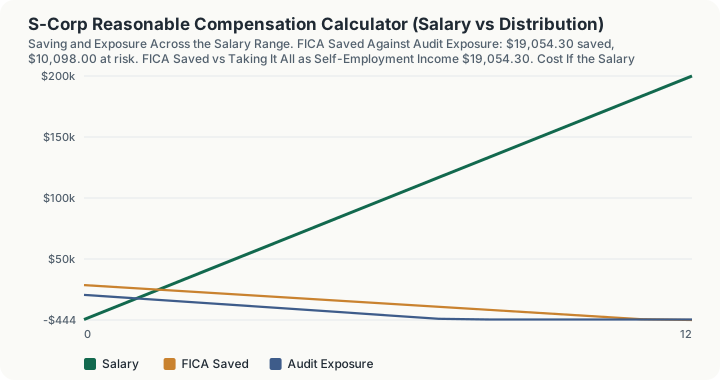
Quick Answer: Paying yourself a $60,000 W-2 salary out of $200,000 of S-corp profit saves $19,054.30 of FICA and puts $10,098.00 at risk if the IRS recharacterises the salary to the $120,000 it would assert, penalty included. The saving still exceeds the exposure by $8,956.30, but that gap is a margin of safety, not a prediction.
What does this calculator do?
An S corporation shareholder who works in the business must be paid reasonable compensation as W-2 wages before taking distributions. Wages carry FICA; distributions do not. That single asymmetry is the entire reason the S corporation election is popular among owner-operators, and the entire reason it is audited.
What makes this hard is that there is no number. IRC section 3121(d)(1) and Rev. Rul. 74-44 establish the requirement, but neither Congress nor the IRS publishes a dollar figure, a percentage of profit, or a safe harbour. Every rule of thumb you have heard (60/40, one-third salary, "match the industry median") is somebody's convention, not law. This calculator therefore takes the defensible salary as your input and will not guess it. What it does instead is price both sides of the decision honestly: how much FICA the split saves against the sole-proprietor alternative, and how much the position costs if an examiner successfully raises the wage.
How is this calculated?
FICA saved = SE tax on the whole profit − (employee FICA + employer FICA) on the wage
Step 1: Split the profit. $200,000 − $60,000 = $140,000 of distribution, which carries no FICA The salary is 30.00% of profit.
Step 2: Employee FICA on the salary. Social Security at 6.2% and Medicare at 1.45%, on $60,000 (below both the wage base and the $200,000 Additional Medicare threshold): $3,720.00 + $870.00 = $4,590.00
Step 3: Employer FICA on the salary. The employer match is identical: $4,590.00
Step 4: Total FICA on the salary, both halves. $4,590.00 + $4,590.00 = $9,180.00
Step 5: Compute the Schedule SE base for the alternative. Self-employment tax is charged on 92.35% of net profit, not on all of it: $200,000 x 92.35% = $184,700.00
Step 6: Social Security portion of the self-employment tax. Capped at the 2026 wage base of $184,500, which binds here by $200: $184,500 x 12.4% = $22,878.00
Step 7: Medicare portion, uncapped. $184,700 x 2.9% = $5,356.30
Step 8: Total self-employment tax if there were no S corporation. $22,878.00 + $5,356.30 = $28,234.30
Step 9: FICA saved by the structure. $28,234.30 − $9,180.00 = $19,054.30
Step 10: Size the wages an examiner would recharacterise. $120,000 asserted − $60,000 paid = $60,000
Step 11: Additional employment tax on the higher salary. FICA at $120,000 is ($7,440 + $1,740) x 2 = $18,360.00. The additional tax is the marginal difference: $18,360.00 − $9,180.00 = $9,180.00 Computing it as a difference of two salary levels rather than a flat rate on the shortfall is what makes the wage base and the Additional Medicare threshold apply correctly.
Step 12: Apply the penalty band. $9,180.00 x 10% = $918.00
Step 13: Total audit exposure. $9,180.00 + $918.00 = $10,098.00 Interest is not included.
Step 14: Compare. $19,054.30 − $10,098.00 = $8,956.30 of saving net of exposure
Worked Example
A consultant runs a single-shareholder S corporation. Profit before her own wage is $200,000. She pays herself $60,000 through payroll and takes $140,000 as distributions. She believes an examiner would argue her services are worth $120,000, and assumes the 10% failure-to-deposit band if the position were lost.
Step 1: What the S corporation costs in employment tax. $60,000 x 15.3% (both halves of Social Security and Medicare) = $9,180.00
Step 2: What a sole proprietorship would have cost. 92.35% of $200,000 is $184,700, of which $184,500 is inside the Social Security wage base: $22,878.00 + $5,356.30 = $28,234.30
Step 3: The benefit of the structure. $28,234.30 − $9,180.00 = $19,054.30 a year
Step 4: The cost of losing an audit. Recharacterised wages of $60,000, additional employment tax of $9,180.00, a 10% penalty of $918.00, total $10,098.00 per year examined.
Step 5: Net position. $8,956.30 in favour of the split, for a single year.
Two observations change how that reads. First, an examination normally covers more than one year, so a $10,098 exposure per year compounds while the saving does not. Second, if she instead paid the $120,000 she considers defensible, the recharacterisation risk falls to zero and the saving drops but survives: the calculator's "salary already at the asserted figure" scenario. And at the other extreme, paying the entire $200,000 as wages costs more than the self-employment tax it replaced, because FICA applies to 100% of a wage while self-employment tax applies to only 92.35% of profit.
What does this calculator not account for?
- It does not tell you what reasonable compensation is. No statute, regulation or safe harbour sets that figure, and this calculator supplies no default view of it. The asserted salary is entirely your input, and it should come from comparable-wage data for your role, hours, experience and industry.
- No income tax is computed. Wages and distributions are both taxable to the shareholder; only the employment tax treatment differs. The qualified business income deduction under section 199A, which interacts strongly with the salary level, is not modelled at all.
- Interest is not included in the audit exposure. Only the additional employment tax and the penalty band you select are shown. Section 6601 interest, accuracy-related penalties under section 6662, and professional fees are all extra.
- A single year is modelled. Examinations routinely span multiple years, and the exposure multiplies while the annual saving does not.
- State-level taxes are ignored entirely: state income tax, state unemployment tax on the wage, and any state-level treatment of S corporations.
- The probability of examination is not modelled and cannot be. "Saving less exposure" is a comparison of two sizes, not a risk-weighted expected value.
- Health insurance, retirement plan contributions and fringe benefits are excluded, even though a shareholder-employee's retirement contribution limits depend directly on the W-2 wage and often justify a higher salary than tax alone would.
What mistakes do people make with this?
- Believing a percentage rule is law. There is no 60/40 rule, no one-third rule, and no safe harbour. Courts decide these cases on the facts: services performed, hours, training, comparable pay, and what the business could have paid an unrelated person to do the same work.
- Paying zero salary. An S corporation with meaningful profit and an active shareholder who takes only distributions is the fact pattern the IRS litigates and wins. Zero maximises both the saving and the exposure.
- Paying the entire profit as salary. This is not conservative, it is expensive. FICA is charged on 100% of a wage while self-employment tax is charged on 92.35% of profit, so all-salary costs more employment tax than never electing S corporation status at all.
- Forgetting the wage base changes the arithmetic. Once a salary passes the Social Security wage base, additional wages cost only 2.9% rather than 15.3%, so the marginal cost of defensibility falls sharply for high earners.
- Ignoring section 199A. A lower wage raises qualified business income but can reduce the W-2-wage-based limitation on the deduction. The optimum for employment tax is often not the optimum overall.
- Treating the exposure as a one-off. It recurs for every open year under examination.
Frequently Asked Questions
What salary does the IRS consider reasonable for an S corporation owner?
Why does taking the whole profit as salary cost more than being a sole proprietor?
How is the audit exposure figure calculated?
Which penalty rate should I select?
Does paying a bigger salary always reduce my total tax?
Can distributions be taken before any salary is paid?
Sources
- 26 U.S.C. 3121(d)(1): an officer of a corporation performing services is an employee for employment tax purposes. law.cornell.edu/uscode/text/26/3121
- Internal Revenue Service, "Failure to Deposit Penalty," for the 2%, 5%, 10% and 15% bands applied to the recharacterised employment tax. irs.gov/payments/failure-to-deposit-penalty
- 26 U.S.C. 1401 and 1402: self-employment tax, including the 92.35% net earnings base used in the sole-proprietor comparison. law.cornell.edu/uscode/text/26/1401
Also consulted: Revenue Ruling 74-44, distributions paid to shareholder-employees in lieu of reasonable compensation are recharacterised as wages; 2026 FICA rates, the Social Security wage base of $184,500, and the Additional Medicare Tax rate and filing-status thresholds, from the versioned 2026 FICA table in this repository.
No authority publishes a reasonable compensation figure. The asserted salary on this page is your input and is never supplied by the calculator.