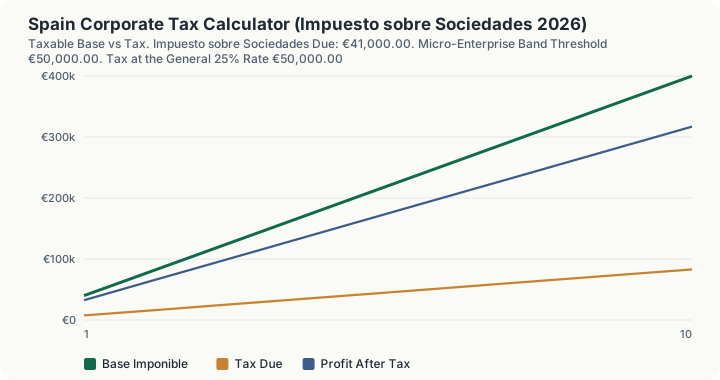
Quick Answer: A micro-enterprise with a €200,000 taxable base pays €41,000.00 in Impuesto sobre Sociedades for periods beginning in 2026: 19% on the first €50,000 and 21% on the rest, an effective rate of 20.50%. That is €9,000 less than the general 25% rate. Which regime applies depends on your turnover, not your profit.
What does this calculator do?
Spain has three corporate rate structures for 2026, and the one you fall into is determined by net turnover (importe neto de la cifra de negocios) rather than by how much profit you make.
- General rate: 25%
- Entidades de reducida dimensión (article 101 LIS): 23%
- Micro-enterprises, turnover under €1 million: 19% on the first €50,000 of taxable base, 21% above
The micro-enterprise structure is banded, so its effective rate sits between 19% and 21% and never reaches the 23% reduced-dimension rate. A micro-enterprise therefore always pays less than a reduced-dimension company on the same taxable base.
How is this calculated?
For the general and reduced-dimension regimes, a single rate applies to the whole taxable base.
For micro-enterprises the base is split:
Tax = 0.19 × min(B, 50,000) + 0.21 × max(0, B − 50,000)
Because the first €50,000 is always taxed at 19%, the effective rate approaches 21% asymptotically without reaching it.
Worked Example
A Spanish SL closes a period beginning in 2026 with a €200,000 base imponible and net turnover under €1 million, so the micro-enterprise scale applies.
Step 1: The first band. min(€200,000, €50,000) x 19% = €9,500.00
Step 2: The second band. (€200,000 - €50,000) x 21% = €31,500.00
Step 3: Total tax due. €9,500.00 + €31,500.00 = €41,000.00
Step 4: The effective rate. €41,000 / €200,000 = 20.50%
Step 5: Profit after tax. €200,000 - €41,000 = €159,000.00
Step 6: The same base at the general rate. €200,000 x 25% = €50,000.00
Step 7: The saving. €50,000.00 - €41,000.00 = €9,000.00
The marginal rate at €200,000 is 21%, not 20.50%. The effective rate is lower only because the first €50,000 was charged at 19%, and that discount is a fixed €1,000 no matter how large the base grows, which is why the effective rate creeps toward 21% and never touches it.
Walking up the scale
The computed table steps the base in €40,000 increments. Four rows from it:
Step 8: Base €40,000, entirely inside the low band. €40,000 x 19% = €7,600.00, effective rate 19.00%
Step 9: Base €80,000, just across the boundary. €9,500 + (€30,000 x 21%) = €15,800.00, effective rate 19.75%
Step 10: Base €200,000. €41,000.00, effective rate 20.50%
Step 11: Base €400,000. €9,500 + (€350,000 x 21%) = €83,000.00, effective rate 20.75%
Doubling the base from €200,000 to €400,000 moved the effective rate by only a quarter of a point. The band structure matters enormously to a company earning €50,000 and almost not at all to one earning €400,000.
The same €200,000 under the other two regimes
Step 12: Entidad de reducida dimensión, article 101 LIS. €200,000 x 23% = €46,000.00, a €4,000 saving against the general rate
Step 13: General rate. €200,000 x 25% = €50,000.00, no saving by definition
Step 14: A micro-enterprise at exactly €50,000. €50,000 x 19% = €9,500.00, an effective rate of exactly 19.00% and a €3,000 saving against the general rate
The €9,000 spread between step 3 and step 13 is decided by turnover, not by the profit figure that drives the arithmetic. A company with €41,000 of tax under the micro scale and €1.1 million of turnover would owe €46,000 or €50,000 on an identical base imponible, purely because the importe neto de la cifra de negocios crossed a line the tax computation itself never looks at.
What does this calculator not account for?
- Determining the taxable base. Amortisation, provisions, non-deductible expenses and the limitation on interest deductibility all sit upstream of the figure entered here.
- Whether you qualify for a regime. Micro-enterprise and reduced-dimension status turn on net turnover and on group-level tests, not on profit.
- Newly created companies, which have their own reduced rate for the first profitable periods.
- Deductions and bonificaciones, including R&D and technological innovation credits, which reduce the final liability.
- The minimum taxation rule (tributación mínima) for larger groups, which sets a floor on the effective rate.
- The régimen de consolidación fiscal, under which a group is taxed as one entity.
- Pillar Two top-up tax for groups above €750 million of revenue.
- Pagos fraccionados, the instalment payments made during the year.
- Loss carry-forward restrictions for larger companies.
What mistakes do people make with this?
- Choosing the regime by profit rather than turnover. The tests are based on net turnover. A company with modest profit but large turnover is not a micro-enterprise.
- Applying 21% to the whole base for a micro-enterprise. The first €50,000 is at 19%, so doing so would overstate the tax by €1,000 on any base above the threshold.
- Assuming reduced dimension is the best regime. It is 23% flat, which is worse than the micro-enterprise structure at every level of taxable base.
- Ignoring the group tests. Turnover is measured at group level where a company forms part of one, so a small subsidiary of a large group will not qualify.
- Forgetting the minimum taxation floor. Deductions cannot reduce the effective rate below the statutory minimum for companies within its scope.
- Confusing the effective and marginal rates. A micro-enterprise at €200,000 has a 20.50% effective rate but a 21% marginal rate.
Frequently Asked Questions
What are the Spanish corporate tax rates for 2026?
How do I know which regime applies?
Why is my effective rate 20.50% rather than 21%?
Is the reduced-dimension rate better than the micro rate?
Does this include deductions and credits?
What about newly created companies?
Sources
- Agencia Tributaria: "Impuesto sobre Sociedades, Tipo impositivo", general 25%, reduced dimension 23%, and the micro-enterprise structure of 19% up to €50,000 and 21% above for periods beginning in 2026. sede.agenciatributaria.gob.es/Sede/impuesto-sobre-sociedades/que-base-imponible-se-determina-sociedades/tipo-impositivo.html
All figures verified on 30 August 2026
Also consulted: Ley 27/2014 del Impuesto sobre Sociedades, article 101 (entidades de reducida dimensión).