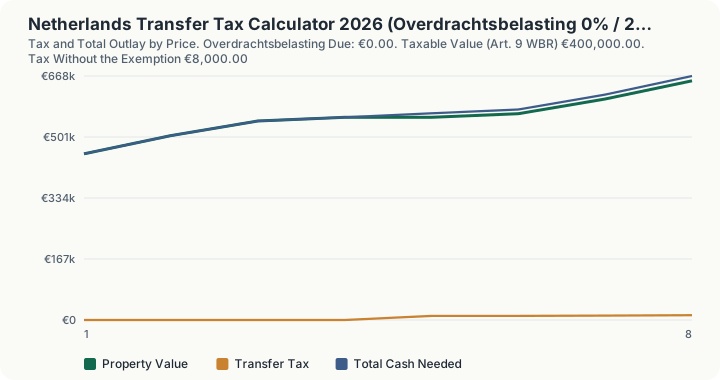
Quick Answer: A 30-year-old first-time buyer purchasing a EUR 400,000 home to live in themselves pays EUR 0 of overdrachtsbelasting, because the startersvrijstelling applies below the 2026 woningwaardegrens of EUR 555,000. Without the exemption the same purchase would cost EUR 8,000 at the 2% own-home rate. The exemption is a cliff, not a taper: at EUR 555,001 the tax is EUR 11,100.02, not two cents.
What does this calculator do?
Dutch transfer tax has four rates in 2026 and the one that applies turns on use, not on the buyer. A dwelling you will occupy yourself is 2%. The identical house bought to let or as a second home is 8%. Anything that is not a dwelling (an office, a shop, a garage, bare land) is 10.4%. And a first-time buyer under 35, buying a home to live in below the woningwaardegrens, pays 0% under the startersvrijstelling.
The startersvrijstelling is the reason this page exists, and the reason is its shape. It is not a relief that tapers away. It is a cliff. A house valued at EUR 555,000 attracts no transfer tax at all. A house valued at EUR 555,001 attracts 2% of the entire EUR 555,001, which is EUR 11,100.02. One euro of value costs EUR 11,100.02 of tax.
That would be harsh anywhere. In the Netherlands it is worse, because transfer tax cannot be financed into a Dutch mortgage. It must be paid at the notary from savings. So the cliff does not land on a monthly payment that can be stretched over thirty years. It lands entirely on the buyer's cash, which is precisely the constraint that binds a first-time buyer, and precisely the group the exemption exists to help.
The exemption is also all-or-nothing on every other condition. One failed test removes the whole of it. It is never reduced.
How is this calculated?
taxable value = max(purchase price, market value)
tax = taxable value × r, r ∈ {0%, 2%, 8%, 10.4%}
Step 1: Establish the taxable value. Article 9 WBR taxes the value of the property and never less than the consideration paid, so the base is the higher of the price and the market value. Paying under the odds in a family sale does not reduce the tax.
Step 2: Select the base rate from the use category under article 14 WBR: 2% for a dwelling you will occupy, 8% for a dwelling you will not, 10.4% for anything that is not a dwelling.
Step 3: Test the startersvrijstelling under article 15 lid 1 onderdeel p WBR, in order, stopping at the first failure:
- Is it being claimed at all? The exemption is not automatic and requires a written declaration to the notary before transfer.
- Is the property a dwelling you will occupy yourself for the long term?
- Has the exemption been used before? It is once per person, for life.
- Is the buyer an adult, 18 or over, at the moment of acquisition?
- Is the buyer under 35 at the moment of acquisition?
- Is the taxable value at or below the EUR 555,000 woningwaardegrens?
Step 4: Apply the rate. If every condition holds, 0%. Otherwise the base rate from step 2.
Step 5: Compute the tax as the taxable value multiplied by that rate.
Step 6: Compute the total cash needed at the notary as the taxable value plus the tax, because the tax cannot be borrowed.
Step 7: Compute the cliff cost, which is the tax on a property valued one euro over the grens at the ordinary 2% own-home rate: (EUR 555,000 + EUR 1) x 2%.
Step 8: Compute the budget-equivalent price. Holding your total outlay fixed, this is the most you could pay for a house if the exemption were lost and 2% applied.
Step 9: Compute the tax at all three rates so the cost of the same property under a different use can be seen directly.
Worked Example
A 30-year-old first-time buyer, EUR 400,000 purchase price, EUR 400,000 market value, buying a home to live in, claiming the exemption, never having used it.
Step 1: Taxable value. max(EUR 400,000, EUR 400,000) = EUR 400,000
Step 2: Base rate for an own-home dwelling. 2%
Step 3: Tax at the base rate, before any exemption. EUR 400,000 x 2% = EUR 8,000
Step 4: Run the exemption conditions. Claimed: yes. Own home: yes. Used before: no. Adult: yes. Under 35: yes at 30. Value at or below EUR 555,000: yes. All conditions met, so the rate applied is 0%
Step 5: Tax due. EUR 400,000 x 0% = EUR 0
Step 6: Value of the exemption. EUR 8,000 - EUR 0 = EUR 8,000
Step 7: Total cash at the notary. EUR 400,000 + EUR 0 = EUR 400,000
Step 8: Price room left under the grens. EUR 555,000 - EUR 400,000 = EUR 155,000
Step 9: The cliff at the grens. (EUR 555,000 + EUR 1) x 2% = EUR 11,100.02
Step 10: Budget-equivalent price without the exemption. EUR 400,000 / 1.02 = EUR 392,156.86
Losing the exemption on the same cash budget costs this buyer EUR 7,843.14 of purchasing power.
Step 11: The same house bought to let, at 8%. EUR 400,000 x 8% = EUR 32,000
Step 12: The buy-to-let premium. EUR 32,000 - EUR 8,000 = EUR 24,000
Step 13: The same value as a non-dwelling, at 10.4%. EUR 400,000 x 10.4% = EUR 41,600
Now watch the cliff itself, which is what the price ladder on this page is built to show.
Step 14: A EUR 555,000 purchase. At or below the grens, the exemption holds: EUR 0
Step 15: A EUR 555,001 purchase. Over the grens, the exemption is denied outright and the ordinary rate applies to the whole value. EUR 555,001 x 2% = EUR 11,100.02
Step 16: The marginal cost of that one euro. EUR 11,100.02 - EUR 0 = EUR 11,100.02
And because the tax cannot be added to a Dutch mortgage, the buyer needs EUR 11,100.02 more in the bank on the day of transfer, not EUR 11,100.02 more of borrowing. A buyer who negotiates from EUR 560,000 down to EUR 555,000 saves EUR 5,000 of price and EUR 11,200 of tax at once.
What does this calculator not account for?
- The long-term occupation requirement is not tested. Article 15 lid 1 p requires that you occupy the dwelling as your main residence for the long term, declared in writing before transfer. The calculator takes your answers at face value.
- Joint purchases are treated as a single buyer. Where two people buy together, each is tested separately and the exemption applies to that person's share. A buyer whose partner is 36, or who has used the exemption before, does not lose their own, and the partner's share is taxed at 2%. This page models a single-buyer position, so a mixed couple should treat the result as an approximation.
- The 2% own-home rate itself has conditions. It requires that you will occupy the dwelling as your main residence, again declared before transfer. Buying to let and moving in later does not retroactively earn it.
- No other transaction costs. Notary fees, kadaster registration, mortgage advice, valuation and the makelaar's commission are all outside this calculation, and they are also payable from savings.
- Article 13 WBR relief is not modelled. Where a property is resold within six months, the transfer tax already paid can reduce the tax on the second transfer.
- Anti-abuse and share-transaction rules are absent, including the treatment of onroerendezaakrechtspersonen where property is acquired through shares rather than directly.
- Value is your input, not an appraisal. Article 9 taxes the value in the economic sense, and the Belastingdienst can and does substitute its own figure in non-arm's-length transactions.
- The grens is a 2026 figure. It is indexed annually, so a purchase completing in another year needs that year's threshold.
What mistakes do people make with this?
Assuming the exemption tapers. It does not. There is no partial startersvrijstelling at EUR 560,000. It is on or off, and the whole 2% applies to the whole value the moment it is off.
Measuring your age at signature rather than at transfer. Article 15 measures the condition at the moment of acquisition, which is when the deed is passed at the notary, not when the purchase agreement was signed. Turning 35 between the two costs the entire exemption.
Forgetting the exemption must be claimed. It is not automatic. A written declaration goes to the notary before transfer under article 15a WBR. Miss it and you pay.
Thinking it is once per property or once per decade. It is once per person, for life. Buying with a partner who has already used theirs does not restore it for them, and does not cost you yours.
Budgeting the tax into the mortgage. Dutch mortgages cannot finance transfer tax. It is cash at the notary, alongside every other purchase cost.
Assuming the buyer's status sets the rate. It does not. Use sets the rate. A first-time buyer purchasing a EUR 400,000 property to let pays 8%, not 2% and certainly not 0%, because the exemption applies only to a dwelling you will occupy yourself.
Frequently Asked Questions
What happens if I buy one euro over EUR 555,000?
Can the transfer tax be added to my mortgage?
How many times can I use the startersvrijstelling?
I am 34 now but I turn 35 before completion. What happens?
Why is buy-to-let 8% and not 10.4%?
Does buying below market value from a family member reduce the tax?
Sources
- Belastingdienst, "Het tarief van de overdrachtsbelasting", "Eigen woning, u woont zelf in de woning: 2%"; "Eigen woning voor starters onder de 35 jaar, u woont zelf in de woning: 0% mits voldaan aan alle voorwaarden"; "Woning die u niet als hoofdverblijf gebruikt (2e woning, vakantiewoning, woning voor verhuur of beleggen): 8%"; "Niet woning (bedrijfspand, kantoor, garage, winkel): 10,4%". belastingdienst.nl/wps/wcm/connect/bldcontentnl/belastingdienst/prive/woning/overdrachtsbelasting/tarieven_overdrachtsbelasting
- Belastingdienst, "Wanneer kunt u de startersvrijstelling krijgen?": "Op het moment dat u de woning verkrijgt, mag de woningwaarde niet hoger zijn dan EUR 555.000"; "U bent meerderjarig en jonger dan 35 jaar op het moment dat u de woning verkrijgt." belastingdienst.nl/wps/wcm/connect/bldcontentnl/belastingdienst/prive/woning/overdrachtsbelasting/startersvrijstelling
- Wet op belastingen van rechtsverkeer, consolidated text in force 1 January 2026: wetten.overheid.nl/BWBR0002740/2026-01-01
Also consulted: Article 9, the base is the value of the property, and at least the consideration paid; Article 14, 10.4% general, 8% dwellings, 2% owner-occupied dwellings; Article 15 lid 1 onderdeel p, the startersvrijstelling: adult under 35, a written declaration that the exemption has not been used before, long-term own occupation, and the EUR 555,000 woningwaardegrens; Article 15a, the written declaration to the notary.
All read 2026-08-30. Full citations in engine/primitives/netherlands-transfer-tax.ts.
Note on the 8% rate: it is the 2026 figure. Dwellings not used as a main residence were taxed at 10.4% from 2023 to 2025, and much older guidance still says so.