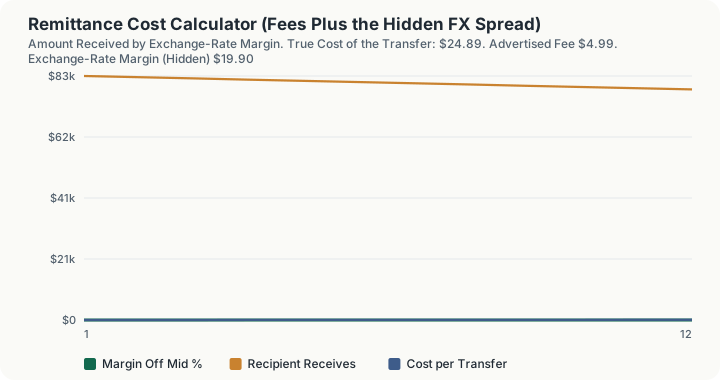
Quick Answer: Sending $1,000 at a mid-market rate of 83, through a provider charging a $4.99 fee and a 2% margin, costs $24.89, or 2.49% of the amount sent. Only $4.99 of that is the advertised fee. The other $19.90, being 79.95% of the total, is the exchange-rate margin, and it appears on no receipt. The recipient gets 80,934.11 units instead of the 83,000 that mid-market with no fees would have delivered.
What does this calculator do?
The advertised fee is the small half of what a transfer costs, and on most transfers it is much the smaller half.
The other half is the margin between the rate the provider quotes and the true mid-market rate. It shows up nowhere. The sender sees an amount sent, a fee, and an amount received, and from those three numbers alone cannot separate the fee from the spread without knowing what the mid-market rate was at the time. That asymmetry is the entire business model of a great many transfer services, and it is why a provider advertising zero fees is frequently the most expensive option on the list.
This calculator prices both halves in the sending currency, which is the only way to make them comparable, and it reports the spread separately so the invisible part becomes visible. It also runs three providers on identical assumptions and ranks them, because the comparison is where the money is.
At the defaults, the ranking inverts the advertising. The zero-fee alternative, at a 4% margin, costs $40.00. The alternative with a conspicuous $14.99 fee, at a 0.5% margin, costs $19.92 and is the cheapest of the three. The difference between best and worst is $20.08 per transfer, or $240.96 a year at twelve transfers.
Note the model here. This is not a symmetric dealer bid and ask quoted around mid. A remittance provider quotes one rate, and the margin is the full gap from mid, not half of it.
How is this calculated?
Quoted Rate = Mid × (1 − m)
Received = (Send − Fee) × Quoted − RecipientFee
Total Cost_sending = (Send × Mid − Received)/Mid
That shortfall decomposes exactly, in the sending currency, into the fee plus the spread:
Spread = (Send − Fee) × (Mid − Quoted)/Mid
Step 1: Derive the quoted rate from the margin. 83 x (1 - 2%) = 81.34 units per dollar
Step 2: Deduct the fee to find what actually gets converted. $1,000.00 - $4.99 = $995.01
Step 3: Convert at the quoted rate. $995.01 x 81.34 = 80,934.11 units received
Step 4: Compute what mid-market with no fees would have delivered. $1,000.00 x 83 = 83,000.00 units
Step 5: Take the shortfall in the receiving currency. 83,000.00 - 80,934.11 = 2,065.89 units
Step 6: Express that shortfall in the sending currency. 2,065.89 / 83 = $24.89
Step 7: Split it into its two parts. Spread: $995.01 x 2% = $19.90 Fee: $4.99 $19.90 + $4.99 = $24.89, which reconciles exactly.
Step 8: Express the invisible share. $19.90 / $24.89 = 79.95% of the cost is FX margin $24.89 / $1,000.00 = 2.49% of the amount sent
Step 9: Annualise it. $24.89 x 12 transfers = $298.68 a year
Worked Example
The comparison is where the decision is, so the worked example runs all three providers on the same $1,000 and the same mid-market rate of 83.
Step 1: Price the zero-fee provider, at a 4% margin. Fee: $0.00, so the full $1,000 converts Quoted rate: 83 x 0.96 = 79.68 Received: $1,000 x 79.68 = 79,680.00 units Cost: (83,000.00 - 79,680.00) / 83 = $40.00
Step 2: Price your current provider, at a $4.99 fee and a 2% margin. Received: 80,934.11 units Cost: $24.89
Step 3: Price the visible-fee provider, at a $14.99 fee and a 0.5% margin. Converted: $1,000.00 - $14.99 = $985.01 Quoted rate: 83 x 0.995 = 82.585 Received: $985.01 x 82.585 = 81,347.05 units Cost: (83,000.00 - 81,347.05) / 83 = $19.92
Step 4: Rank them by what the recipient actually gets. Visible-fee provider: 81,347.05 Your provider: 80,934.11 Zero-fee provider: 79,680.00
Step 5: Measure the spread between best and worst. $40.00 - $19.92 = $20.08 per transfer $20.08 x 12 = $240.96 a year
The provider charging three times the fee delivers the most money, and the provider charging no fee at all delivers the least. Every ranking on this page comes from the amount received, which is the only quantity that cannot be dressed up.
One more reading is worth taking from the table on this page, which walks the margin from 0% to 5.5% at a fixed fee. Each half point of margin costs about $4.98 on a $1,000 transfer, roughly the size of the entire advertised fee. A rate nobody quotes to you in percentage terms is worth about a fee per half point.
What does this calculator not account for?
- Rate movement between quote and settlement. The mid-market rate you enter is treated as the rate at the moment of conversion. A transfer that takes days may settle at a different rate entirely.
- Intermediary and correspondent bank charges, which on a wire can be deducted in transit by a bank neither sender nor recipient chose. Use the recipient-side fee field if you know the amount, but it is frequently not knowable in advance.
- Receiving bank fees, cash pickup fees, and card funding surcharges, unless you enter them yourself.
- Tiered pricing. Many providers vary both the fee and the margin with the amount sent, the corridor, the funding method and the payout method. One fee and one margin are applied here.
- Promotional first-transfer rates, which usually apply once and then do not.
- Any regulatory disclosure regime. In the US, remittance transfers are covered by the Remittance Transfer Rule under Regulation E, which requires disclosure of the exchange rate and the amount to be received; that regime is a reason the numbers are obtainable, not something this calculator applies.
- Speed, reliability, payout method or recipient convenience, all of which are real reasons to pay more.
- Tax or reporting obligations on either side of the transfer.
What mistakes do people make with this?
- Shopping on fee alone. The zero-fee option here costs $40.00 against $19.92 for the one with a $14.99 fee. Fee is the advertised number precisely because it is the one that can be made small.
- Comparing quoted rates without the mid-market rate. Without mid, a quoted rate is uninterpretable. Take mid from an independent reference at the moment you compare, not from a provider.
- Comparing the amount received across different times of day. Mid moves. Two providers quoted an hour apart are not being compared on margin at all.
- Assuming the margin is small because the rate looks close. Two percent of $1,000 is $19.90, four times the fee, and a rate of 81.34 against a mid of 83 does not look wrong to anybody.
- Forgetting to annualise. A $24.89 cost is trivial. The same transfer monthly is $298.68 a year, and switching to the cheapest provider here saves $240.96 of it.
- Entering the provider's rate as the mid rate. The mid field wants the true interbank mid. Putting the quoted rate there sets the computed margin to zero and hides exactly what the page exists to show.
- Reading the effective rate as the provider's quote. For your provider they coincide at 81.34 only because the fee is taken before conversion; where a fee is deducted differently, the two diverge.
Frequently Asked Questions
What is the real cost of sending money abroad?
What is an FX margin, and why is it hidden?
Are zero-fee money transfers actually free?
How do I find the mid-market rate?
How much does the exchange-rate margin cost per percentage point?
Does a bigger transfer cost proportionally more?
Sources
- In the United States, the disclosure obligations that make these figures obtainable are the Remittance Transfer Rule in Regulation E, 12 C.F.R. 1005 subpart B, administered by the Consumer Financial Protection Bureau. It requires that a sender be told the exchange rate and the amount the recipient will receive. This calculator applies none of that rule; it simply prices what those disclosures let you compute. consumerfinance.gov/rules-policy/regulations/1005/subpart-B
- World Bank, Remittance Prices Worldwide. remittanceprices.worldbank.org
This calculator uses no statutory data and no published rate tables. The mid-market rate, the provider margins, the fees and the number of transfers are all supplied by the user.
Also consulted: The mid-market rate to enter should come from an independent reference at the time you are comparing, not from a provider's own quote; The World Bank publishes the Remittance Prices Worldwide database of average corridor costs. It is a survey of provider pricing rather than a rate you can transact at, and this engine does not use it.