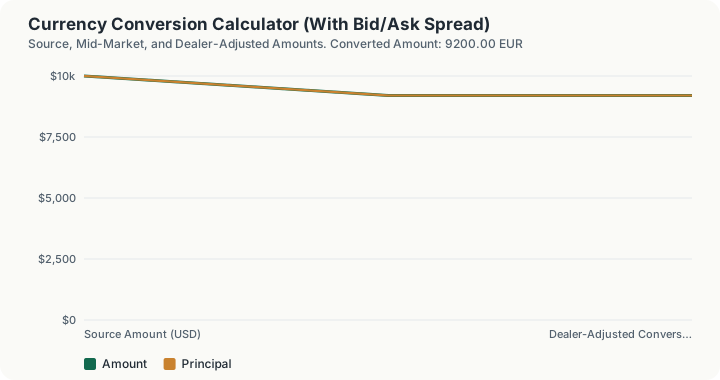
Quick Answer: Converting $10,000.00 USD to EUR at a mid-market rate of 0.92 with no dealer spread produces exactly 9,200.00 EUR. Add a typical 1.0% bank card spread and the same $10,000.00 produces only 9,154.00 EUR, a $46.00 cost that never appears as a line item on any statement.
Overview
This calculator converts an amount from one currency to another using an exchange rate you supply, and it shows what a dealer's bid/ask spread costs you compared to the ideal mid-market rate. It does not fetch a live exchange rate. There is no real-time FX feed behind this page. You must enter a current rate yourself, looked up from a bank, your card network, an FX data provider, or a currency conversion site, at or near the time you use this calculator.
That distinction matters. Exchange rates move continuously throughout the trading day, and the rate you see quoted on a financial news site (the "mid-market" or "interbank" rate) is rarely the rate you actually receive when you convert money through a bank, a currency exchange kiosk, or a card network. Those intermediaries build in a markup, commonly called a bid/ask spread, and that markup is where most of the real-world cost of currency conversion actually lives, not in a visible fee line.
How This Is Calculated
- Mid-market conversion. The source amount is multiplied by the mid-market exchange rate you entered, with no spread applied. This is the reference conversion, what you would receive with a zero-markup, purely mathematical exchange.
- Dealer-adjusted effective rate. If a dealer spread is entered, the mid-market rate is adjusted up or down by half the spread, depending on whether you are buying the target currency (converting into it) or selling the target currency (converting back out of it). This reflects how bid/ask spreads work: the dealer always profits from the spread, regardless of which direction the transaction runs.
- Dealer-adjusted amount and spread cost. The source amount is converted at the effective rate, and the spread cost is the absolute difference between the mid-market amount and the dealer-adjusted amount.
Worked Example
Using the calculator's default inputs:
- Amount to Convert: $10,000.00 USD
- Exchange Rate: 0.92 (EUR per 1 USD)
- Dealer Spread: 1.0%, buying target currency
Step by step:
- Mid-market conversion: $10,000.00 × 0.92 = 9,200.00 EUR.
- Since this is a "buying" transaction, the effective rate is reduced by half the spread: 0.92 × (1 − 0.01/2) = 0.92 × 0.995 = 0.9154.
- Dealer-adjusted conversion: $10,000.00 × 0.9154 = 9,154.00 EUR.
- Spread cost: 9,200.00 − 9,154.00 = 46.00 EUR, or about 0.50% of the mid-market value.
That 46 EUR is not a visible fee on any receipt. It is embedded entirely in the exchange rate the bank or card network applied, which is exactly why bid/ask spread costs are so easy to overlook.
Buying vs. Selling the Target Currency
The direction of a currency conversion determines which side of the bid/ask spread applies to you:
- Buying target currency: You are handing over your source currency to acquire the target currency (for example, converting USD into EUR before a trip to the Eurozone). The dealer sells you the target currency at their ask price, which is worse than mid-market from your perspective, so the effective rate you receive is lower than the mid-market rate.
- Selling target currency: You are handing over the target currency to receive your source currency back (for example, converting leftover EUR back into USD after the trip). The dealer buys the target currency from you at their bid price, which is again worse than mid-market from your perspective, so the effective rate is higher than the mid-market rate when expressed as target-per-source, meaning you receive fewer source-currency units per unit of target currency than the mid-market rate would imply.
In both directions, the dealer's spread works against the person converting currency and in favor of the dealer. That is the entire economic function of a bid/ask spread.
What This Does Not Account For
- Live exchange rates. This calculator has no connection to any real-time FX data feed. The exchange rate is exactly what you enter, and it is only as current as your own lookup. Do not treat a rate entered hours or days ago as still accurate; major currency pairs can move meaningfully within a single trading session.
- Flat fees. Many banks, wire services, and money transfer providers charge a flat transaction fee in addition to (or sometimes instead of) a percentage spread. This calculator only models a percentage-based bid/ask spread, not fixed dollar fees.
- Cross-border wire and correspondent bank fees. International wire transfers often pass through intermediary banks, each of which can deduct its own fee. Those fees are separate from, and not modeled by, the exchange rate spread calculated here.
- Card network foreign transaction fees. Many credit and debit cards charge a separate foreign transaction fee (commonly 1-3%) on top of whatever exchange rate spread the network applies. That fee is not represented in this calculator's spread input.
- Regulatory and tax treatment. Currency conversion for investment or business purposes can carry tax implications (for example, foreign currency gain/loss recognition) that are entirely outside the scope of this calculator.
Common Pitfalls
- Using a mid-market rate you saw on a financial news site as the rate you will actually receive. Mid-market rates are a reference point, not a rate available to retail consumers. The rate your bank, card, or exchange kiosk actually applies will almost always be worse.
- Forgetting that airport kiosks and cash exchange counters often carry the widest spreads. Spreads of 5-10% or more are common at convenience-driven cash exchange points, versus roughly 1-3% at most banks and card networks for electronic transactions.
- Entering a stale exchange rate. Because this calculator has no live feed, a rate looked up even a few hours earlier during a volatile trading session can already be noticeably off. Re-check your rate source close to when you actually need the figure.
- Confusing "buying" and "selling" direction. Getting the transaction direction backward flips which side of the spread you are on, which changes whether the effective rate should be above or below the mid-market rate you entered.
- Ignoring flat fees on top of the spread. A transaction can look inexpensive based on the exchange rate spread alone while still carrying a meaningful flat wire fee or foreign transaction fee that this calculator does not include.
Frequently Asked Questions
Why doesn't this calculator show a live, automatically updated exchange rate?
Where should I look up a current exchange rate?
What is a typical bid/ask spread for currency conversion?
Does this calculator support more than two currencies at once, like a cross rate through a third currency?
Is the spread cost shown here exactly what I will be charged?
Sources
- Consumer Financial Protection Bureau: guidance on international money transfer costs, including the distinction between exchange rate markup and flat transfer fees. consumerfinance.gov
- Board of Governors of the Federal Reserve System, Foreign Exchange Rates (H.10). federalreserve.gov/releases/h10
Also consulted: This calculator's methodology follows this platform's fx.ts foreign-exchange primitive, which models bid/ask dealer spreads as a symmetric percentage markup applied against a mid-market rate, consistent with standard treatment of currency dealer spreads in financial economics; Bank for International Settlements: background on foreign exchange market structure and bid/ask spread conventions.