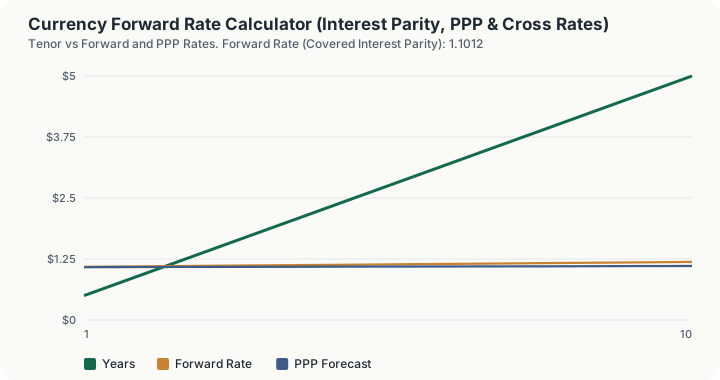
Quick Answer: With EUR/USD at 1.0800, a 4% dollar rate and a 2% euro rate, the one-year forward is 1.1012: a premium of 212 pips. That is not a forecast. It is an arbitrage-enforced price you could trade today. The purchasing power parity estimate, by contrast, is 1.0853, and it is a theory about long-run drift that you cannot trade at all.
What does this calculator do?
This page computes three different things that get confused with one another constantly.
The forward rate comes from covered interest rate parity. It is set entirely by the interest rate differential between the two currencies, enforced by arbitrage, and it is a real price available in the market. It embeds no view whatsoever about where the currency is going.
The PPP forecast comes from relative inflation. It is a long-run theory about where spot might drift, it holds poorly over anything under a decade, and it is not tradeable.
The cross rate simply derives a third pair from two quotes against a common currency.
The most consequential misunderstanding in FX is treating the forward as a prediction. A currency at a forward premium is not expected to appreciate; it is a currency whose interest rate is lower.
How is this calculated?
Covered interest rate parity:
F = S × ((1 + r_quote)/(1 + r_base))ᵗ
If this did not hold, you could borrow in one currency, convert, deposit in the other and lock in the forward for a risk-free profit. Arbitrage closes the gap, which is why the forward is a price rather than an opinion.
Purchasing power parity:
E[Sₜ] = S × ((1 + π_quote)/(1 + π_base))ᵗ
Structurally similar, but driven by inflation rather than interest rates, and carrying no arbitrage enforcement at all.
Cross rate, from two quotes against a common currency:
EUR/GBP = (EUR/USD)/(GBP/USD)
Worked Example
A treasurer with a euro receivable landing in twelve months wants to know what the bank should quote. EUR/USD spot is 1.0800, USD one-year money pays 4% and euro money pays 2%.
Step 1: The interest rate differential. 4% - 2% = 2.00 points
Step 2: The parity ratio. 1.04 / 1.02 = 1.019608
Step 3: The one-year forward rate. 1.0800 x 1.019608 = 1.1012
Step 4: Forward points. (1.1012 - 1.0800) x 10,000 = 212 pips
Step 5: The annualised move. (1.1012 / 1.0800 - 1) / 1 year = 1.96%
Step 6: Direction. The base currency trades at a forward premium, because it is the lower-yielding of the pair
Step 5 landing on 1.96% against the 2.00-point differential in step 1 is not a coincidence or an approximation error: it is the compounding correction, and it is the whole content of covered interest parity. The forward is not a forecast. It is the only rate at which borrowing in one currency, converting, and lending in the other cannot produce a riskless profit.
Reversing the differential (USD 2%, EUR 4%): the forward becomes 1.0592, a discount. Nothing about either economy changed; only which one pays more.
A five-year tenor: the differential compounds to 1.1901, over 1,100 pips from spot.
Purchasing power parity instead. With 6% domestic and 2% foreign inflation, the PPP forecast is 1.1224, well away from the 1.1012 forward. Both numbers are correct and they answer different questions: the forward is an arbitrage-free price you can trade today, and PPP is a long-run guess about where the rate ought to settle. Treating the forward as a forecast, or PPP as tradeable, is the standard error.
Cross rate: with GBP/USD at 1.2800, EUR/GBP = 1.0800 / 1.2800 = 0.8438.
What does this calculator not account for?
- Bid-offer spreads. Real forwards are quoted two-way, and the tradeable rate differs from this mid.
- Credit and counterparty terms, including collateral, which move real forward pricing away from textbook parity.
- Cross-currency basis. Since 2008 covered interest parity has persistently failed by measurable amounts in several pairs, particularly at longer tenors. This calculates textbook parity, not the observed basis.
- Day count and settlement conventions. Real forwards use specific day counts and value dates rather than clean year fractions.
- Capital controls and non-deliverable forwards in restricted currencies.
- Which rate is genuinely risk-free. Reference rates differ by currency and tenor, and the choice moves the answer.
- Whether PPP holds at all. Empirically it has very little predictive power over horizons under five to ten years.
- Central bank intervention and regime shifts.
What mistakes do people make with this?
- Reading the forward as a forecast. It is not. A forward premium reflects a lower interest rate, not an expectation of appreciation. Systematically betting against forwards is the carry trade, and its long history of profits followed by sharp losses is precisely because forwards are not predictions.
- Mixing up base and quote. In EUR/USD the base is the euro and the quote is the dollar. Swapping the two interest rates inverts the premium, as the second scenario shows.
- Using PPP for short horizons. It has almost no explanatory power under five years. It is a long-run anchor, not a trading signal.
- Ignoring the cross-currency basis. Textbook parity has not held exactly since 2008, and the deviation is large enough to matter at longer tenors.
- Comparing a forward with an unhedged forecast. The forward is contractual; a forecast is not. They are not alternatives to be picked between on which number you prefer.
- Applying a cross rate across inconsistent quote conventions. Both legs must be quoted against the same currency in the same direction.
Frequently Asked Questions
Is the forward rate a prediction of the future spot rate?
Why is the lower-yielding currency at a premium?
What are forward points?
How is PPP different from the forward?
Does covered interest parity actually hold?
How do I get a cross rate?
Sources
- U.S. Securities and Exchange Commission, Investor.gov, the official authority for the investing this calculator relates to. investor.gov
Also consulted: Covered interest rate parity and relative purchasing power parity are standard international finance relationships with no jurisdictional content; The persistent post-2008 deviation from covered interest parity, known as the cross-currency basis, is documented in central bank and BIS research and is noted here rather than modelled.