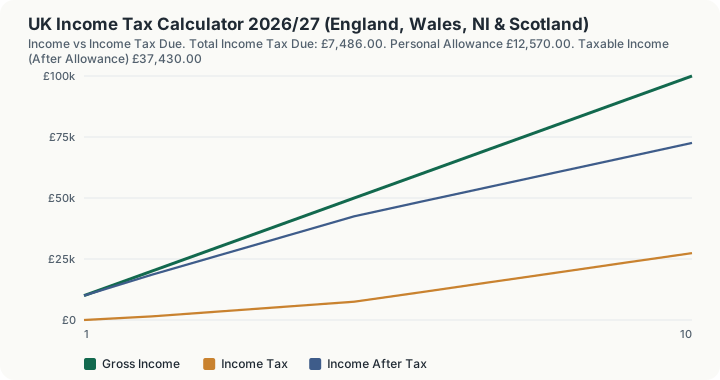
Quick Answer: A £50,000 salary in England, Wales or Northern Ireland attracts £7,486.00 of Income Tax in 2026/27: the £12,570 Personal Allowance is tax free, and the remaining £37,430 falls entirely within the 20% basic rate band. The same salary in Scotland costs £8,982.05, because Scottish taxpayers cross into the 42% higher rate at £43,663 rather than £50,270.
What does this calculator do?
This calculator works out UK Income Tax for the 2026/27 tax year, which runs from 6 April 2026 to 5 April 2027. It handles the two rate ladders that exist in the UK: the three-band structure used in England, Wales and Northern Ireland, and the six-band structure Scotland sets for itself.
It also handles the three types of income that are taxed at different rates: ordinary income such as salary, savings interest, and dividends. These are not interchangeable. Savings interest carries its own starting rate band and Personal Savings Allowance, and dividends have a separate allowance and their own three rates, which rose by two percentage points on 6 April 2026.
Income Tax is only one deduction from a salary. National Insurance and student loan repayments are charged separately on their own thresholds, and this calculator does not include them.
How is this calculated?
The calculator follows the statutory order of taxation, and each step below corresponds to a step the engine actually performs.
Step 1: Adjusted net income. Salary, savings interest and dividends are added together, then gross pension contributions are subtracted. The result is adjusted net income, which is what the Personal Allowance taper is measured against.
Step 2: Personal Allowance. The allowance is £12,570. Above £100,000 of adjusted net income it is reduced by £1 for every £2 of excess, reaching nil at £125,140:
PA = max(0, 12,570 − (max(0, ANI − 100,000))/2)
Step 3: Allocating the allowance. The allowance is set against non-savings income first, then against savings, then against dividends.
Step 4: Non-savings income. What remains is charged across the bands for the selected region. For England, Wales and Northern Ireland: 20% on the first £37,700 of taxable income, 40% from £37,701 to £125,140, and 45% above that. For Scotland: 19% starter, 20% basic, 21% intermediate, 42% higher, 45% advanced and 48% top, across the bands gov.scot publishes as totals of £16,537, £29,526, £43,662, £75,000 and £125,140.
Step 5: Savings interest. The £5,000 starting rate band is reduced pound for pound by taxable non-savings income, so it is only available to people with little or no other income. Whatever survives is taxed at 0%. The Personal Savings Allowance then covers a further £1,000 for basic rate taxpayers, £500 for higher rate, and nothing for additional rate. Any remaining interest is taxed at 20%, 40% or 45% according to where it falls.
Step 6: Dividends. The first £500 is taxed at 0% but still occupies band space, which is why a dividend allowance can push later income into a higher band. The balance is charged at 10.75%, 35.75% or 39.35%.
A note on Scotland. Scottish rates apply to non-savings, non-dividend income only. Savings interest and dividends are reserved to Westminster and are charged at the same rates everywhere in the UK. A Scottish taxpayer does not pay 42% on dividends.
Worked Example
£50,000 salary, England:
- Personal Allowance: £12,570, untapered, because income is below £100,000
- Taxable income: £50,000 − £12,570 = £37,430
- All of it sits inside the £37,700 basic rate band: £37,430 × 20% = £7,486.00
- Effective rate 14.97%; the next £1 earned is taxed at 20%
£50,000 salary, Scotland:
- Starter: £3,967 × 19% = £753.73
- Basic: £12,989 × 20% = £2,597.80
- Intermediate: £14,136 × 21% = £2,968.56
- Higher: £6,338 × 42% = £2,661.96
- Total: £8,982.05, or £1,496.05 more than the same salary in England
£120,000 salary, England (the 60% trap):
- Adjusted net income £120,000 is £20,000 above £100,000, so £10,000 of allowance is lost
- Personal Allowance: £12,570 − £10,000 = £2,570
- Taxable income: £117,430 → £37,700 × 20% = £7,540, plus £79,730 × 40% = £31,892
- Total: £39,432. Between £100,000 and £125,140 each extra £1 earned costs 40p in tax and withdraws 50p of allowance, which is itself then taxed at 40%: an effective marginal rate of 60%.
£50,000 salary plus £10,000 dividends, England:
- Salary taxable £37,430 × 20% = £7,486, leaving only £270 of basic rate band unused
- The £500 dividend allowance is taxed at 0% but consumes that remaining £270 of band
- The other £9,500 of dividends is taxed at the 35.75% upper rate = £3,396.25
- Total: £10,882.25
What does this calculator not account for?
- National Insurance and student loan repayments. Both are charged separately on their own thresholds. Use the UK National Insurance calculator alongside this one.
- Welsh rates. Wales can set its own rates and currently sets them equal to the rest of the UK. This calculator applies the rUK ladder to Wales, which is correct today but would need revisiting if that changes.
- Gift Aid and pension relief extending the basic rate band. Relief-at-source pension contributions and Gift Aid donations widen the basic rate band for higher rate taxpayers. The calculator applies pension contributions to adjusted net income, which restores tapered allowance, but does not extend the band.
- Blind Person's Allowance and Married Couple's Allowance (the latter for couples where one spouse was born before 6 April 1935).
- Marriage Allowance, which lets a non-taxpayer transfer £1,260 of allowance to a basic rate paying spouse.
- Top-slicing relief on chargeable event gains from investment bonds.
- The remittance basis for non-domiciled individuals.
- Tax already deducted through PAYE. This shows the liability for the year, not any balance owing or repayable.
What mistakes do people make with this?
- Treating the Scottish higher rate threshold as £50,270. It is £43,663. A Scottish taxpayer on £50,000 has already paid 42% on more than £6,000 of income that an English taxpayer on the same salary is still paying 20% on. This single threshold difference accounts for most of the £1,496.05 gap.
- Assuming Scottish rates apply to everything. They do not apply to savings interest or dividends, which are reserved to Westminster. A Scottish higher rate taxpayer pays 42% on salary but 35.75% on dividends, and mixing the two produces a materially wrong answer.
- Calling the dividend allowance tax free and stopping there. The first £500 is taxed at 0%, but it still consumes band space. If you are near a band boundary the allowance can push later income up into the next band, so it is worth less than £500 multiplied by your marginal rate.
- Using last year's dividend rates. The ordinary and upper rates rose by two percentage points on 6 April 2026, to 10.75% and 35.75%. The additional rate did not move. Many published calculators still show 8.75% and 33.75%.
- Missing the 60% band between £100,000 and £125,140. The headline rate there is 40%, but each extra £1 also withdraws 50p of Personal Allowance, which is then taxed. Pension contributions are the usual remedy because they reduce adjusted net income, which is what the taper measures.
- Expecting the savings starting rate band to apply to a normal salary. The £5,000 band is reduced pound for pound by taxable non-savings income, so anyone earning more than £17,570 gets none of it.
Frequently Asked Questions
Why do I pay more tax in Scotland on the same salary?
Does the Personal Allowance really create a 60% tax rate?
How much savings interest can I receive tax free?
Are the new 22%, 42% and 47% rates on savings and rental income included?
Does this include National Insurance?
Do Wales and Northern Ireland have their own rates?
Sources
- HM Revenue and Customs (HMRC), the official authority for the national tax authority this calculator relates to. gov.uk/government/organisations/hm-revenue-customs
All figures verified against these sources on 30 August 2026 and mirrored in engine/tables/2026/uk-2026-27.json
Also consulted: GOV.UK: "Income Tax rates and allowances for current and previous tax years", gov.uk/government/publications/rates-and-allowances-income-tax; gov.scot: "Scottish Income Tax: rates and bands, 2026 to 2027", gov.scot/publications/scottish-income-tax-rates-and-bands; GOV.UK: "Change to tax rates for property, savings and dividend income, technical note", dividend ordinary and upper rates raised by 2 percentage points from 6 April 2026; savings and property rates rise from 6 April 2027; GOV.UK: "Tax on savings interest", starting rate for savings of £5,000 and the Personal Savings Allowance.