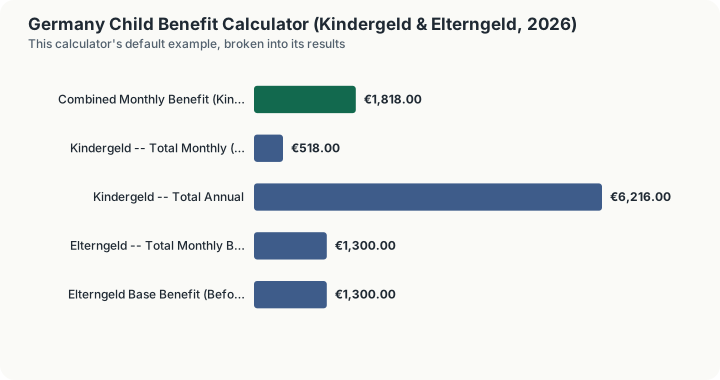
Quick Answer: A family with 2 children receives €518.00 per month in Kindergeld (€6,216.00/year); a parent earning €2,000.00 net per month before the birth qualifies for €1,300.00 per month in Elterngeld -- a combined €1,818.00 per month in family benefits.
Overview
Germany runs two separate, unrelated-but-complementary family benefit programs. Kindergeld (child benefit) is a flat monthly payment for every child, paid continuously from birth until at least age 18 (longer if the child is in education or training, up to age 25). Elterngeld (parental allowance) is a temporary, income-replacement benefit paid to a parent who reduces or stops working to care for a newborn, calculated as a percentage of that parent's pre-birth net income, typically for up to 12-14 months (extendable via ElterngeldPlus and partner-months mechanics not modeled in this simplified calculator).
The two programs answer different questions: Kindergeld asks "how many children do you have," full stop, regardless of income; Elterngeld asks "how much income are you replacing by taking parental leave," and scales with your prior earnings within a defined band. This calculator computes both together, since most new and expecting parents in Germany want to see their combined monthly family benefit picture at a glance, along with the two per-child/per-birth top-ups (Geschwisterbonus and Mehrlingszuschlag) that many parents overlook when budgeting for parental leave.
Germany's currency is the euro (€); every figure in this calculator is denominated in euros.
How This Is Calculated
Kindergeld:
A flat €259/month per child in 2026, with no variation by birth order (the old tiered system, which paid more for a 3rd or 4th child, was abolished in January 2023).
Elterngeld:
- Base replacement rate, a sliding scale based on average net monthly income in the 12 months before the birth: - Income at or below €340/month: 100% replacement (the statutory ceiling of the low-income boost). - Income between €340 and €1,000/month: rate rises smoothly from 67% toward 100% as income falls (0.1 percentage points per €2 below €1,000). - Income between €1,000 and €1,200/month: flat 67%. - Income between €1,200 and €1,240/month: rate falls from 67% toward 65% as income rises (0.1 percentage points per €2 above €1,200). - Income at or above €1,240/month: floored at 65% replacement.
- Apply the floor and cap. The computed benefit (rate × income) is floored at €300/month (paid even with zero prior income) and capped at €1,800/month.
- Add the Geschwisterbonus (sibling bonus) if the household has 2 or more children under 3, or 3 or more children under 6: +10% of the benefit, minimum +€75/month.
- Add the Mehrlingszuschlag (multiple-birth supplement) for twins, triplets, etc.: +€300/month for each additional child from the same birth.
- Check the income eligibility cap. If the claimant's (or, for a couple, the couple's combined) taxable income in the last full tax year before the birth exceeded €175,000, no Elterngeld is payable at all for that birth.
Worked Example
Using the calculator's default inputs:
- Number of Children (Kindergeld): 2
- Pre-Birth Net Monthly Income: €2,000.00
- Combined Taxable Income Last Year: €80,000.00
- Geschwisterbonus / Mehrlingszuschlag: None
Step by step:
- Kindergeld: 2 × €259.00 = €518.00/month (€6,216.00/year).
- Elterngeld eligibility: €80,000.00 combined taxable income is well under the €175,000 cap -- eligible.
- Elterngeld replacement rate: €2,000.00/month is above the €1,240 ceiling, so the rate is floored at 65%.
- Elterngeld benefit: 65% × €2,000.00 = €1,300.00, which sits within the €300-€1,800 band, so no floor/cap adjustment applies. €1,300.00/month.
- Combined family benefit: €518.00 + €1,300.00 = €1,818.00/month.
A lower-earning parent making €500.00/month before the birth instead gets a boosted 92% replacement rate (67% + 0.1 points per €2 under €1,000 = 67% + 25 points), for a benefit of 92% × €500.00 = €460.00/month.
What This Does Not Account For
- ElterngeldPlus and partner-months. The standard Basiselterngeld modeled here is paid for up to 12 months (14 if both parents take at least 2 months each, the "Partnerschaftsbonus" mechanic). ElterngeldPlus instead halves the monthly amount but doubles the payment period, useful for parents returning to part-time work sooner -- not modeled in this calculator.
- The exact statutory step-function. The law technically increases/decreases the replacement rate in discrete 0.1-percentage-point steps for every full €2 of income above/below the thresholds; this calculator uses a mathematically equivalent continuous approximation that differs from the exact step function by at most a fraction of a percentage point.
- Kindergeld phase-out for very high earners' Kinderfreibetrag interaction. German tax law runs a "Günstigerprüfung" (more-favorable check) comparing Kindergeld against the alternative Kinderfreibetrag (child tax allowance) at annual tax filing; very high earners may find the Kinderfreibetrag more valuable, in which case Kindergeld already received is effectively clawed back via the tax assessment. This calculator shows the Kindergeld cash payment only.
- Elterngeld's Anrechnung (offsetting) against other benefits. Elterngeld can interact with other benefits (unemployment benefit, Bürgergeld) in ways not modeled here.
- Self-employed and non-standard income patterns. The Elterngeld income calculation for self-employed parents uses the prior tax assessment rather than the last-12-months payroll average modeled here.
Common Pitfalls
- Assuming Elterngeld and Kindergeld are the same program. They have entirely different eligibility rules, payment durations, and calculation methods -- Kindergeld continues for many years regardless of income, while Elterngeld is a short-term, income-scaled benefit tied specifically to the period around a birth.
- Missing the narrow phase-down window for higher earners. The Elterngeld replacement rate only falls from 67% to 65% between €1,200 and €1,240 of pre-birth income -- a narrow €40 band -- so most moderate-to-high earners simply see the flat 65% floor, not a continuously declining rate.
- Forgetting the €175,000 income cap disqualifies Elterngeld entirely, not partially. Exceeding the combined taxable-income threshold removes the entire benefit for that birth, not just the amount above the threshold.
- Overlooking the Geschwisterbonus's minimum floor. For lower Elterngeld amounts, the €75 minimum bonus can exceed a literal 10% calculation -- always the higher of the two applies.
- Assuming Mehrlingszuschlag replaces the need for separate Kindergeld per child. Both apply independently: twins receive the €300/month Mehrlingszuschlag on top of Elterngeld, and Kindergeld separately for each child.
Frequently Asked Questions
How much is Kindergeld per child in 2026?
How long is Elterngeld paid?
Can both parents claim Elterngeld at the same time?
What happens if our combined income is just over €175,000?
Does Kindergeld count as taxable income?
Do both parents have to be German citizens or residents to qualify?
What if I'm self-employed or have irregular income before the birth?
Sources
- Federal Ministry of Finance (Germany), the official authority for the national tax authority this calculator relates to. bundesfinanzministerium.de
Also consulted: Einkommensteuergesetz (EStG) §66 -- current consolidated text (gesetze-im-internet.de): "Das Kindergeld beträgt monatlich für jedes Kind 259 Euro."; Bundeselterngeld- und Elternzeitgesetz (BEEG) §1 -- income eligibility cap (€175,000, combined for couples), current consolidated text; Bundeselterngeld- und Elternzeitgesetz (BEEG) §2 -- Elterngeld replacement-rate sliding scale, floor (€300), and cap (€1,800), current consolidated text; Bundeselterngeld- und Elternzeitgesetz (BEEG) §2a -- Geschwisterbonus (10%/€75 minimum) and Mehrlingszuschlag (€300 per additional child), current consolidated text.