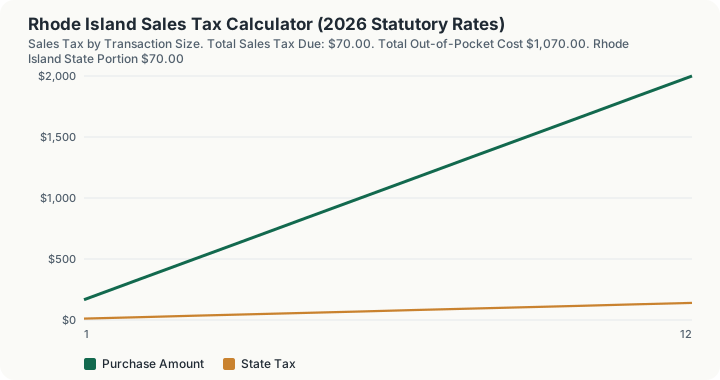
Quick Answer: A $1,000 taxable purchase in Rhode Island costs $70.00 in combined state and local sales tax, for a total of $1,070.00 out the door.
How This Is Calculated
Rhode Island charges a flat 7.00% and no Rhode Island city, town or county is permitted to stack a local option sales tax on top of it. The rate table this calculator reads carries avgLocalRate: 0 for Rhode Island, so a $1,000 purchase produces $70.00 of tax in Providence, in Newport and in every town in between.
The calculator runs:
- Establish the taxable base. The calculator uses the pre-tax price exactly as entered, with no floor, cap or rounding applied to it first.
- No item-level exemption filtering. The partial clothing exemption, which taxes only the excess above a per-item threshold, the grocery exemption and the prescription drug exemption are not applied here. Enter a $1,200 coat and the engine taxes all $1,200 at $84.00, not the excess over the threshold.
- Apply the state rate to the base. That gives the state share of the tax, which on the default $1,000 is $70.00.
- Apply the local surcharge. Rhode Island's local rate is zero in the table, so this term returns $0.00 at every purchase amount.
- Combine into a total. State and local tax are added, then the combined tax is added to the purchase price for the final transaction amount.
Worked Example
For a $1,000 taxable purchase in Rhode Island:
- Starting purchase price. The buyer rings up a $1,000.00 taxable retail purchase in Rhode Island, the baseline amount before any tax is applied.
- State portion. Rhode Island's statutory state sales tax rate of 7.00% applies to the full purchase amount: $1,000.00 × 7.00% = $70.00 owed to the state.
- Local portion. Local municipal, county, and special-district surcharges add an average of 0.00% on top of that: $1,000.00 × 0.00% = $0.00 more.
- Combined tax due. Summing the two pieces, $70.00 in state tax plus $0.00 in local surcharge comes to $70.00 in total sales tax owed on the transaction.
- Total out-of-pocket cost. Adding that $70.00 in tax to the $1,000.00 purchase price brings the buyer's total out-of-pocket cost to $1,070.00.
Why the Local Surcharge Toggle Changes Nothing Here
Every other state page in this family has an "Include Average Local / County Surcharge" switch that moves the answer. On Rhode Island it moves nothing, and that is worth proving rather than asserting. Sweeping the purchase amount from $900 to $1,300 with the toggle on returns $63.00, $70.00, $77.00, $84.00 and $91.00. Sweeping the identical range with the toggle off returns $63.00, $70.00, $77.00, $84.00 and $91.00. The two runs are equal at every point because the local term is multiplied by a rate of zero.
That holds at scale as well. A $25,000 vehicle purchase returns $1,750.00 of tax with local included and $1,750.00 with it excluded, against $26,750.00 out the door either way. The state portion is the whole tax: $1,750.00 of the $1,750.00.
Each additional $100 of taxable purchase costs exactly $7.00 in Rhode Island tax. The step from $1,000 to $1,100 raises the tax from $70.00 to $77.00; the step from $1,200 to $1,300 raises it from $84.00 to $91.00. The increment never changes, because there is no bracket, no exemption floor and no cap anywhere in this calculation. The rate is flat from the first cent, and a page that promised you a threshold to plan around would be inventing one.
The consequence for a Rhode Island shopper is that the usual cross-town arbitrage does not exist. There is no municipality inside the state charging less than 7.00% and none charging more, so the combined rate the calculator reports is the rate at every Rhode Island register rather than a statewide average that happens to sit near it.
The Reverse Question, and the Receipt-Total Trap
Working backwards from a budget. If the money available is $500 out the door rather than $500 before tax, the largest taxable purchase is $467.29, which carries $32.71 of tax for a total of exactly $500.00. One cent more of purchase price, at $467.30, tips the total to $500.01. The gap between shelf price and out-the-door price at 7.00% is $32.71 on a $500 budget.
The receipt-total trap, priced. The most common arithmetic error on a Rhode Island receipt is treating a tax-inclusive total as if it were the taxable base. A buyer holding a $1,070.00 receipt and wanting to recover the tax multiplies $1,070.00 by 7.00%. Run that through this calculator by entering $1,070 as the purchase amount and it returns $74.90. The tax actually charged was $70.00. The shortcut overstates it by $4.90 on a single $1,070 receipt, and it compounds: taking that wrong figure forward as a base, the engine reports a total cost of $1,144.90 rather than $1,070.00.
The correct extraction is the tax fraction, 7/107, or 6.54% of the gross, not 7.00% of the gross. The round trip confirms it: $1,000 net at 7.00% gives $70.00 of tax and a $1,070.00 total, which is where the receipt came from. Note that this calculator only runs the forward direction. It takes a pre-tax price and adds tax; it has no reverse input, so recovering a base from a gross receipt has to be done by entering candidate net prices until the total matches, exactly as the $467.29 figure above was found.
What This Does Not Account For
- Any local rate at all, because the table carries none. This is correct for Rhode Island specifically, but it means the calculator cannot model a hypothetical local surcharge if one were ever authorised.
- Statutory exemptions on unprepared groceries, prescription medications, or manufacturing equipment.
- The partial clothing exemption, which taxes only the portion of an item's price above a per-item threshold. The engine taxes the full price.
- Special industry excise taxes (lodging hotel taxes, vehicle rental fees, alcohol/tobacco excise).
- Use tax compliance on out-of-state untaxed online purchases.
- B2B resale certificate exemptions or direct pay permit programs.
Common Pitfalls
- Multiplying the tax-inclusive total by 7.00%. On a $1,070.00 receipt this returns $74.90 instead of the $70.00 actually charged, a $4.90 overstatement.
- Assuming a Rhode Island local rate exists to look up. It does not. The state-only and state-plus-local runs return the same $70.00 on $1,000 and the same $1,750.00 on $25,000.
- Budgeting the shelf price rather than the out-the-door price. A $500 budget buys $467.29 of goods, not $500.00.
- Applying the general rate to clothing. The engine taxes a $1,200 coat at the full $84.00; the statutory per-item exemption threshold is not modelled.
- Overlooking consumer use tax on untaxed out-of-state purchases, which this calculator does not compute.
Frequently Asked Questions
What is the sales tax rate in Rhode Island?
How much tax on a $1,000 purchase in Rhode Island?
How do I work out the pre-tax price from a Rhode Island receipt?
Does any Rhode Island city charge extra sales tax?
Are groceries taxed in Rhode Island?
Sources
- Streamlined Sales Tax Governing Board (SSTGB): State Taxability Matrix. streamlinedsalestax.org/for-businesses/taxability-matrix
Also consulted: Rhode Island Department of Revenue: 2026 Sales and Use Tax Rate Schedules.