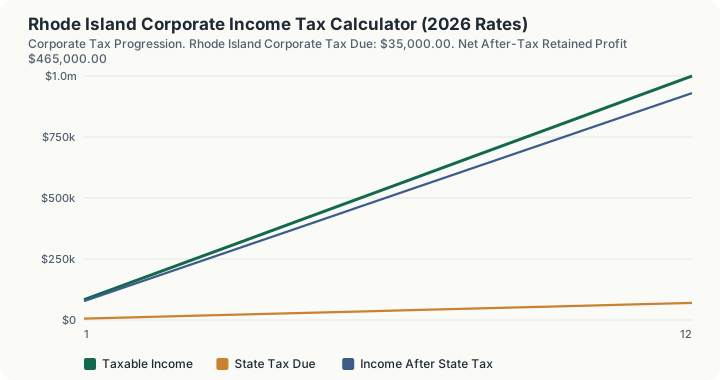
Quick Answer: On $500,000 of pre-apportioned taxable income, Rhode Island's flat 7.00% corporate income tax rate produces $35,000.00 in state tax due and $465,000.00 in net after-tax profit.
How This Is Calculated
This calculator takes two numbers you supply, apportioned Rhode Island taxable income and state tax credits, and does four things with them: applies one flat rate, subtracts the credits from the tax, floors the result at zero, and reports two rates. Everything upstream of the income figure happens before you type it in. The engine performs no federal-to-state reconciliation, no addbacks, no apportionment and no NOL computation.
- Apportioned income is taken as given. The input is labelled "Net apportioned taxable income in Rhode Island" and is used exactly as entered. If you enter book income instead of apportioned taxable income, every figure below is wrong by whatever the difference is, and nothing in the engine will flag it.
- One rate, applied from the first dollar. The rate table holds a single Rhode Island bracket running from $0 to no upper limit at 7.00%. There is no bracket lookup because there is nothing to look up. At $10,000 of income the tax is $700.00; at $100,000 it is $7,000.00; the sweep step is $700.00 per $10,000 at every one of those points, with no change in step size anywhere on the range.
- Credits are subtracted from the tax, not from the base. The credit input reduces the computed 7.00% liability dollar for dollar. It does not reduce apportioned income first.
- The result is floored at zero, and stops there. Credits in excess of the tax are discarded. The engine models no carryforward, no carryback and no refundable credit.
- Two rates are reported and they are not the same thing. The effective rate divides the tax after credits by income. The marginal rate reports the statutory 7.00% regardless of credits. On $500,000 with $20,000 of credits the engine returns $15,000.00 of tax, an effective rate of 3.00% and a marginal rate of 7.00%.
- The tier schedule scales income, not time. Row i of the 12-row table is income multiplied by i and divided by 6, so row 6 is the income you entered and row 12 is double it. On the $500,000 default, row 12 shows $1,000,000 of income and $70,000.00 of tax. The rows are income scenarios, not tax years.
Worked Example
Using this calculator's baseline scenario: a corporation with $500,000 in taxable income apportioned to Rhode Island.
- Start with apportioned taxable income. The corporation has already apportioned $500,000 of its total taxable income to Rhode Island, before any state-level tax is applied.
- Apply Rhode Island's flat statutory rate. $500,000 × 7.00% = $35,000.00. No bracket lookup is required.
- Subtract credits. The default credit entry is $0, so the tax stands at $35,000.00.
- Net retained profit. $500,000 − $35,000.00 = $465,000.00 retained by the corporation, before any separate federal liability.
Because Rhode Island uses a single flat rate, the marginal rate is 7.00% at every income level the engine will accept, from $0 to the $1,000,000,000 input ceiling. A corporation with $50,000 of apportioned income and one with $50,000,000 face the same rate on the next dollar.
Walking the Credit Cliff, Which Is the Only Edge on This Page
Rhode Island has no graduated schedule, so there is no bracket threshold to cross. The one genuine discontinuity this calculator contains is on the credit input, and it is sharp.
At $34,999 of credits. Against the default $35,000.00 of tax, the engine returns $1.00 of Rhode Island tax due.
At $35,000 of credits, one dollar later. The engine returns $0.00. That dollar of credit was worth a full dollar.
At $35,001 of credits. The engine still returns $0.00. That dollar of credit was worth nothing at all.
Between $34,000 and $35,000 of credits the tax falls by exactly $500.00 for each $500 of credit claimed, a one-for-one exchange. Above $35,000 the sweep flattens to a delta of $0.00 and stays there: $35,500 of credits and $36,000 of credits both produce $0.00, identical to $35,000. On this input set the last useful credit dollar is the 35,000th, and it is worth exactly as much as the first.
That behaviour is a modelling choice, not a statement about Rhode Island law. The engine computes max(0, tax - credits) and nothing else, so it cannot express a credit that survives the year in which it was earned. If a real credit carries forward, this calculator will understate its value by the whole excess.
The Reverse Question: How Much Income a Credit Shelters
Turn the cliff around and it answers a more useful question. Holding credits at $20,000 and sweeping income instead, the engine returns $0.00 of tax at $285,700 of apportioned income and $6.00 at $285,800. The shelter runs out between those two points. Above it the tax climbs at $7.00 per $100 of additional income: $13.00 at $285,900, $20.00 at $286,000.
Push further out and the same $20,000 of credits buys progressively less relief in percentage terms. At $300,000 of income the tax is $1,000.00, at $325,000 it is $2,750.00, at $350,000 it is $4,500.00, a constant $1,750.00 per $25,000 step, which is the flat 7.00% reasserting itself once the credit is fully absorbed.
Marginal Cost of the Next Dollar of Rhode Island Income
Each additional $1,000 of apportioned Rhode Island income costs $70.00 in state tax. The sweep confirms it holds without variation: $35,000.00 at $500,000, $35,070.00 at $501,000, $35,140.00 at $502,000, $35,210.00 at $503,000, $35,280.00 at $504,000. Four consecutive steps, four identical deltas of $70.00.
Right Method Against Wrong Method, Priced
The common error on a page like this is applying the credit to the wrong base: subtracting credits from income and then taxing the remainder, rather than taxing income and then subtracting credits from the tax.
Correct, as the engine computes it. $500,000 of income with $20,000 of credits: 7.00% of $500,000 is $35,000.00, less $20,000 of credits, leaves $15,000.00.
Incorrect, credits netted against income first. $500,000 less $20,000 is $480,000; the engine returns $33,600.00 of tax on that income.
The mistake costs $18,600.00 on a single return, because a credit applied against the base is worth only 7 cents on the dollar while a credit applied against the tax is worth a full dollar. On these inputs the wrong method overstates the liability by more than the credit itself is worth.
What This Does Not Account For
- Rhode Island's statutory minimum corporate tax. The engine applies no floor other than zero.
calculateStateCorporateTaxmultiplies apportioned income by the rate and returns the product, so a Rhode Island entity with no income returns $0.00 here and a real minimum tax would not appear. - Credit carryforward, carryback or refundability. Excess credits are discarded at the
max(0, ...)step, as the sweep above shows. - Federal corporate income tax (21% under IRC § 11).
- Specialized gross receipts taxes (e.g. Ohio CAT, Washington B&O, Texas Franchise Tax) where applicable.
- Annual report and entity filing charges.
- Base Erosion and Anti-Abuse Tax (BEAT) or Global Intangible Low-Taxed Income (GILTI) provisions.
- Local municipal corporate earnings taxes (e.g. NYC General Corporation Tax).
Common Pitfalls
- Mistaking the Flat Rate for the Final Bill: Assuming Rhode Island's 7.00% rate applies directly to book income rather than to apportioned taxable income after state additions, subtractions, and NOL adjustments, none of which this calculator performs.
- Reading the Effective Rate as the Statutory Rate: With credits entered, the two outputs diverge. At $500,000 with $20,000 of credits the effective rate reads 3.00% while the statutory rate is still 7.00%, and it is the 7.00% that prices the next dollar of income.
- Over-Claiming Credits Into the Zero Zone: Any credit above $35,000 on the default income returns exactly $0.00, indistinguishable from claiming exactly $35,000.
- Reading the Tier Table as a Timeline: The 12 rows scale income from one sixth of the entered figure to double it. Row 12 on the default is $1,000,000 of income and $70,000.00 of tax, not a twelfth year.
Frequently Asked Questions
Does Rhode Island have a corporate income tax?
What does one more dollar of Rhode Island income cost?
How many credits does it take to zero out the tax?
When are Rhode Island corporate tax returns due?
Does Rhode Island tax S-corporations and LLCs?
Sources
- Multistate Tax Commission (MTC): Uniform Apportionment and Allocation Guidelines. mtc.gov
Also consulted: Rhode Island Department of Revenue: Corporate Tax Statutes and Guidance (2026).