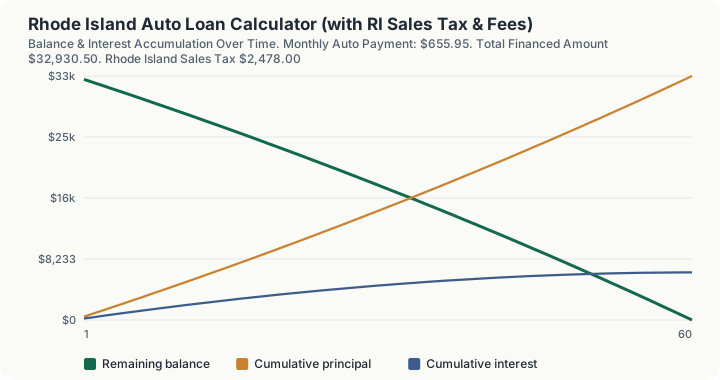
Quick Answer: A $35,000 vehicle in Rhode Island with $5,000 cash down, a $400 documentary preparation fee, a 60-month term, and a 7.25% APR carries a $655.95 monthly payment. That includes $2,478.00 of sales tax at the flat 7% state rate and the $52.50 title fee, financing $32,930.50. Rhode Island has no local sales tax, so this is the rate everywhere in the state.
Overview
Rhode Island is the rare state where the rate question has one answer. The sales tax on a vehicle is 7%, imposed under R.I. Gen. Laws Chapters 44-18 and 44-19 and administered for vehicles by 280-RICR-20-70-28. There are no county rates, no city rates, and no special automotive rate. Whether you register in Providence, Woonsocket, or Westerly, the number is 7%.
The complication in Rhode Island is not the rate. It is the trade-in credit, which is narrower here than in most states and is the single place where a generic calculator will give you the wrong answer.
The regulation excludes from the tax base "the amount of the trade in allowance of a private passenger automobile when given in trade toward the purchase of a new or used private passenger automobile." Read that literally, because the Division of Taxation does. Both sides of the exchange have to be private passenger automobiles. Trading a pickup toward a sedan does not qualify. Trading a sedan toward a pickup does not qualify. Motor homes count as private passenger vehicles, which is the one surprising inclusion. If your trade does not meet the condition, enter zero in the trade-in field and let it reduce your loan without reducing your tax.
The second Rhode Island specific worth knowing before you sign is the doc fee rule, which is unusually protective. 280-RICR-30-20-1.6 lets a dealer charge a documentary preparation fee only on transactions above $10,000, and caps it at $400. On a $9,500 car the fee is not negotiable, it is prohibited, and charging it exposes the dealer to a fine or license suspension.
Auto Loan APR by Credit Score
The APR columns below are national averages, not Rhode Island figures. No primary source publishes average auto loan APR by state: Experian's report has no geographic cut, the CFPB publishes state origination volume but no rates, and the New York Fed publishes state delinquency only. The payment column is the part that is specific to Rhode Island, because it runs this calculator's own Rhode Island tax and fee rules at each tier's rate.
| Credit Tier | VantageScore 4.0 | Avg New APR | Avg Used APR | Est. Payment in Rhode Island |
|---|---|---|---|---|
| Super prime | 781-850 | 4.55% | 6.30% | $614.67 |
| Prime | 661-780 | 6.23% | 8.77% | $640.17 |
| Nonprime | 601-660 | 9.67% | 14.03% | $694.34 |
| Subprime | 501-600 | 13.44% | 19.42% | $756.71 |
| Deep subprime | 300-500 | 16.01% | 21.77% | $800.98 |
Payment assumptions: $35,000 vehicle price, $0 trade-in, $5,000 cash down, $400 dealer documentation fee, 60-month term, new-vehicle APR applied to the Rhode Island delivered price including tax and statutory fees. At the 6.39% overall new-car average the same purchase costs $642.63 a month.
The score bands are VantageScore 4.0, not FICO. The same borrower can land in a different tier under each model, so a FICO score pulled from a card issuer will not always match the band here. Source: Experian, State of the Automotive Finance Market, Q1 2026, slide 45.
What Moves Your Payment
Each row changes one input and leaves the rest at the baseline below. The dollar effects are this calculator's own output for Rhode Island, not a rule of thumb.
| Factor | What Changes | Effect on Monthly Payment | Effect on Total Interest |
|---|---|---|---|
| Vehicle Price | Each extra $1,000 of price raises both the amount financed and the sales tax base, so the tax rises with it. | +$21.32 | +$208.82 |
| Trade-In Allowance | A $1,000 allowance cuts the amount financed by $1,000 and reduces the sales tax base by the same amount, so it saves tax as well as principal. | -$21.31 | -$208.82 |
| Cash Down Payment | A $1,000 larger down payment cuts the amount financed by $1,000. It never reduces the sales tax, which is assessed on the price, not on what you borrow. | -$19.91 | -$195.16 |
| Dealer Doc Fee | A $100 higher documentation fee adds $100 to the amount financed and is inside the sales tax base, so it is taxed on top of itself. Rhode Island caps the fee at $400. | +$2.14 | +$20.88 |
| Longer Term | Stretching the same balance from 60 months to 72 months spreads the principal over twelve more payments at the same rate. | -$90.56 | +$1,351.09 |
Baseline: $35,000 vehicle price, $0 trade-in, $5,000 cash down, $400 documentation fee, 60 months at 7.25% APR, giving a $655.95 payment and $6,426.85 of total interest.
How This Is Calculated
Rhode Island applies a single 7% rate with no local layer anywhere in the state. Four steps.
1. Net taxable base. A qualifying trade-in allowance comes out of the base. The doc fee is treated as part of the purchase price.
The allowance is capped at the price of the vehicle being bought, so an oversized trade cannot drive the base below zero.
2. Sales tax. One rate, one layer.
3. Title fee. A fixed $52.50, separately stated and outside the tax base. Registration is deliberately excluded from this figure. See the omissions section below.
4. Amount financed and amortization.
where $P$ is the financed amount, $i$ is the monthly rate (APR ÷ 12), and $n$ is the term in months. Interest each period is the outstanding balance times $i$, the remainder reduces principal, and the schedule closes at zero.
Worked Example
Rhode Island's trade-in exclusion is category specific in an unusual way: it covers a private passenger automobile traded toward another private passenger automobile. Trade a work truck toward a sedan and the credit below is not available to you.
- Vehicle price: $35,000
- Trade-in allowance: $0
- Cash down: $5,000
- Documentary preparation fee: $400
- Term: 60 months at 7.25% APR
Step 1 -- The taxable base. Sale price including the capped preparation fee, less a qualifying passenger-car trade: $35,000 + $400 - $0 = $35,400.00
Step 2 -- Rhode Island sales tax at 7%. $35,400.00 x 7% = $2,478.00
Step 3 -- The title fee, outside the base. $52.50
Step 4 -- Total delivered price. $35,000 + $400.00 + $2,478.00 + $52.50 = $37,930.50
Step 5 -- Amount financed. $37,930.50 - $0 trade-in - $5,000 cash down = $32,930.50
Step 6 -- The monthly payment. $32,930.50 at 7.25% over 60 months = $655.95
Step 7 -- Month 1. $32,930.50 x (7.25% / 12) = $198.96 interest, $456.99 principal, balance $32,473.51
Step 8 -- Month 2. $32,473.51 x (7.25% / 12) = $196.19 interest, $459.76 principal, balance $32,013.75. Cumulative interest: $395.15
Step 9 -- The accumulation. Interest through month 12 is $2,201.51, balance $27,260.61. Over 60 months, $6,426.85
Now add a $10,000 trade-in, assuming a passenger car traded toward a passenger car. The base falls to $25,400, tax falls to $1,778.00, and the payment drops to $442.82. The trade-in saved $700.00 in tax on its own, which is 7% of the allowance.
That $700 is exactly what you forfeit if the trade does not qualify. Someone trading a work truck toward a family sedan pays the full $2,478 and gets the $10,000 only as a reduction of the loan. It is worth asking the dealer to confirm in writing how the trade is being classified before the paperwork is finalized, because the difference is real money and it is not obvious from the buyer's order.
What This Does Not Account For
- Registration fees. Rhode Island registers passenger vehicles biennially on a weight-based schedule, with a Highway Maintenance surcharge and a technology surcharge on top. The RI DMV fee page and the governing statute both refuse automated retrieval, so no verified figure exists here and none has been invented. Expect roughly $100 or more for a two-year term on a light passenger car, and confirm with the DMV. Your real out-the-door cost is above the figure this calculator shows by that amount.
- The trade-in classification itself. The calculator applies the credit to whatever allowance you enter. It cannot tell whether your trade is a private passenger automobile. That determination is yours and the dealer's.
- Separate sales dressed up as trades. Selling your old car to a third party and applying the proceeds is not a trade-in, even if the money moves at the same moment.
- Doc fee taxability. Rhode Island's treatment of the documentary preparation fee inside the sales tax base was not confirmed against a primary source. This calculator includes it, which is the conservative direction. If the Division of Taxation excludes it, the tax figure here is $28.00 high at 7%.
- The repealed municipal excise tax. Rhode Island's annual municipal motor vehicle excise tax was phased out and eliminated for tax year 2022 and after, so this calculator shows no recurring vehicle tax. Repeal-reversal proposals surface periodically in the General Assembly, so check the current budget act if you are planning several years ahead.
- The title fee source. The $52.50 figure comes from secondary aggregation of the RI DMV schedule rather than a direct fetch, because the DMV page returned an access error.
- GAP insurance, extended warranties, and aftermarket add-ons, unless you fold them into the vehicle price.
Common Pitfalls
- Assuming any trade-in earns the credit. The passenger-auto-for-passenger-auto condition is the most commonly missed rule in Rhode Island vehicle tax, and it is worth $700 on a $10,000 allowance.
- Looking up a local rate. There is not one. Any Rhode Island tool that offers a county selector is modeling a state it is not describing.
- Paying a doc fee on a cheap car. Below $10,001 the fee is prohibited outright, not merely capped.
- Paying more than $400. The cap is absolute, and there is no electronic-versus-paper split as in some neighboring states.
- Budgeting only the calculator's total. Registration is genuinely missing from this figure, not folded in silently. Add the DMV's biennial charge before you decide what you can afford.
- Judging the loan by payment alone. Stretching this $32,930.50 balance from 60 to 72 months cuts the payment to $565.39 and raises total finance charges from $6,426.85 to $7,777.88.
Frequently Asked Questions
What is Rhode Island's sales tax rate on cars?
Does a trade-in reduce sales tax in Rhode Island?
How much tax will I pay on a $35,000 car in Rhode Island?
Can a Rhode Island dealer charge me a doc fee on a $9,000 car?
Does Rhode Island still have the annual car tax?
Why does this calculator not include a registration fee?
Sources
- Consumer Financial Protection Bureau, Truth in Lending Act (Regulation Z, 12 CFR § 1026.22) disclosure requirements for installment credit. ecfr.gov/current/title-12/chapter-X/part-1026
Also consulted: R.I. Gen. Laws Chapter 44-18 (sales and use tax) and Chapter 44-19 (assessment and collection); 280-RICR-20-70-28, Motor Vehicle and Non-Motorized Vehicle Taxes (7% rate applied to vehicles; private passenger automobile trade-in exclusion); 280-RICR-30-20-1.6 (documentary preparation fee: permitted only above $10,000, capped at $400); Rhode Island DMV, Sales Tax and Registration & Title Fees pages ($52.50 title fee, taken from secondary aggregation because the DMV pages refuse automated retrieval); Rhode Island municipal motor vehicle excise tax phase-out, complete for tax year 2022 and after; Experian, State of the Automotive Finance Market, Q1 2026, slide 45 (average new and used auto loan APR by VantageScore 4.0 credit tier; national, no state level cut published).