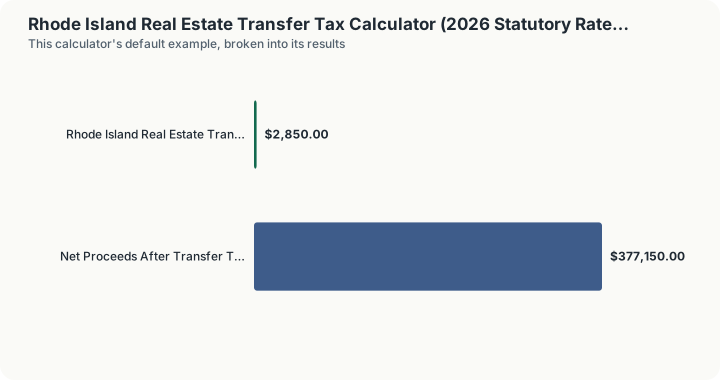
Quick Answer: A $380,000 home sale in Rhode Island owes $2,850.00 in real estate conveyance tax, a flat 0.75% rate that applies the entire way up to $824,000, above which a second marginal tier adds another 0.75% on the excess.
Overview
Rhode Island's real estate conveyance tax under R.I.G.L. Section 44-25-1 is a two-tier bracket: 0.75% on the full consideration up to a CPI-adjusted threshold, set at $824,000 for 2026, and an additional 0.75% (1.5% combined) on the portion above that line. That structure means most Rhode Island home sales, priced well under the threshold, face a simple flat 0.75%, while only higher-value sales encounter the second tier at all.
The conveyance tax is customarily paid by the seller at closing, though the specific allocation between buyer and seller can be addressed in the purchase contract. Because the threshold adjusts annually for inflation rather than staying fixed like New York's $1 million mansion tax line, the exact dollar point where Rhode Island's second tier kicks in shifts slightly from year to year.
On the calculator's $380,000 baseline, the entire sale price falls under the $824,000 threshold, so the full amount is taxed at the single 0.75% first-tier rate with no portion reaching the second, higher tier at all.
How This Is Calculated
Rhode Island added a second tier to its conveyance tax that kicks in above a threshold the state adjusts for inflation every year. For 2026 that threshold is $824,000.
| Portion of Consideration | Marginal Rate |
|---|---|
| $0 to $824,000 | 0.75% |
| Above $824,000 | 1.5% |
The tax is marginal, so the higher rate never reaches back over the first $824,000. The statute expresses it as a base tier of $3.75 per $500 on the whole consideration plus an additional $3.75 per $500 on the portion above the threshold, which sums to the same thing: the 1.5% top tier is the base 0.75% plus a second 0.75%. The engine walks both tiers and sums them.
Worked Example
Rhode Island's conveyance tax is two tiers, and the baseline sale sits below the boundary.
Step 1 -- The consideration. Contract sale price = $380,000
Step 2 -- Tier 1, the first $824,000 at 0.75%. $380,000 x 0.0075 = $2,850.00
Step 3 -- Total conveyance tax due. The price never reaches the tier 2 threshold, so the tax is $2,850.00
Step 4 -- Net proceeds after tax. $380,000.00 - $2,850.00 = $377,150.00
Step 5 -- The effective rate. $2,850.00 / $380,000 = 0.750%
The calculator's $1,500,000 scenario crosses the $824,000 threshold.
Step 6 -- Tier 1 filled to its ceiling. $824,000 x 0.0075 = $6,180.00
Step 7 -- Tier 2, the portion above $824,000 at the combined 1.5%. $676,000 x 0.015 = $10,140.00
Step 8 -- Total conveyance tax due. $6,180.00 + $10,140.00 = $16,320.00
Step 9 -- The effective rate at $1.5M. $16,320.00 / $1,500,000 = 1.088%
The $824,000 line is a marginal boundary, not a cliff, and it is worth seeing the two prices side by side. A $823,000 sale owes $6,172.50. An $825,000 sale owes $6,195.00. Two thousand dollars of price buys $22.50 of tax, because only the $1,000 above the threshold is exposed to the higher rate. That threshold is CPI-adjusted annually and stands at $824,000 for 2026, so a sale priced near the line this year may fall on the other side of it next year without anything about the property changing. The effective rate in Step 9 rises toward the 1.5% ceiling as the price climbs, but by construction it can never reach it: the first $824,000 always keeps the 0.75% rate.
What This Does Not Account For
- Future CPI adjustments to the $824,000 threshold. Rhode Island's second-tier threshold adjusts periodically for inflation under Notice 2025-05 and future Division of Taxation notices; this calculator uses the 2026 threshold and would need updating if the state issues a new figure in a later year.
- Exemptions for certain transfer types. Rhode Island exempts certain transfers, including those between spouses, into revocable trusts, and by operation of law, from the conveyance tax. This calculator assumes a standard taxable arm's-length sale.
- Municipal recording fees. Rhode Island city and town clerks charge separate flat recording fees per document, unrelated to the value-based conveyance tax calculated here.
- The additional documentary stamp requirement mechanics. Rhode Island's conveyance tax is collected through documentary stamps affixed to the deed rather than a separate cash payment in some administrative contexts; this calculator computes the tax amount itself, not the stamp-purchase logistics.
Common Pitfalls
- Applying 1.5% to the entire sale price on a high-value transaction. Rhode Island's second tier is marginal, so only the portion above $824,000 is taxed at the combined 1.5% rate; applying that rate to the full price of a $1,200,000 sale instead of just the excess overstates the tax.
- Assuming the threshold is a fixed number that never changes. Because the second-tier threshold is CPI-adjusted periodically, using an outdated threshold from a prior year can produce a slightly wrong split between the two tiers on a sale near the boundary.
- Forgetting who customarily pays. Rhode Island's conveyance tax is customarily paid by the seller at closing, though this is ultimately addressed in the purchase contract and can be negotiated.
- Confusing the two-tier structure with a cliff-style mansion tax. Unlike a cliff structure where crossing a threshold applies a rate to the entire price, Rhode Island's second tier only taxes the amount above $824,000, so there is no sudden jump in liability at the threshold itself, just a change in the marginal rate going forward.
Frequently Asked Questions
What is Rhode Island's real estate transfer tax rate?
Who pays the conveyance tax in Rhode Island?
Does Rhode Island's second tier apply to the whole price once a sale crosses $824,000?
Why does the $824,000 threshold change from year to year?
How does the effective rate change as sale price increases in Rhode Island?
Sources
- Rhode Island Division of Taxation, Notice 2025-05; R.I.G.L. 44-25-1. tax.ri.gov