Quick Answer: A six-month break on $4,200 a month of living costs, plus $8,000 of one-off costs and $500 a month still coming in, needs a headline fund of $33,200.00, or $30,200 net of the income you keep earning. The true cost, once the $110,000 salary and the retirement saving it carries are counted, is $50,650.00 today, 1.53 times the headline, and $217,383.25 measured at retirement 25 years out at a 6% return, or $36,230.54 for every month of the break.
What does this calculator do?
The savings target for a career break is the easy part of the arithmetic, and it is the part everyone does. Monthly living costs times months, plus whatever the break itself costs in travel, tuition, equipment or insurance. At the defaults that is $33,200.
The true cost is larger, and none of the extra pieces look like money leaving an account. Four distinct amounts are lost, and they are disjoint by construction so nothing is double counted:
The fund itself, drawn down while you are not earning. The surplus saving that would have happened anyway, being the part of take-home pay above your living costs. The employer pension or 401(k) match, which stops when the salary stops. And your own pension contributions, which are deducted before take-home pay and are therefore not already inside the surplus figure.
Only the first of those four is visible. The other three total $17,450 here, which is why the true cost is more than half again the headline.
Then all four would have compounded until retirement, and that is the number worth confronting before signing anything. Compounded at 6% for 25 years, $50,650 becomes $217,383.25. Divided by the six months of the break, that is $36,230.54 a month, against a headline monthly cost of $5,533.33.
None of this argues against the break. It argues for pricing it correctly, which is a different thing.
How is this calculated?
F = Eₘ × m + K; F_net = max(0, F − Yₘ × m)
True Cost = F_net + ((S × h)/12 − Eₘ)m + (S × g × m)/12 + (S × o × m)/12
Cost at Retirement = True Cost × (1 + r)ⁿ
Step 1: Compute the headline fund. $4,200 x 6 months = $25,200 $25,200 + $8,000 of one-off costs = $33,200.00
Step 2: Offset the income still arriving. $500 x 6 = $3,000 $33,200.00 - $3,000.00 = $30,200.00 net fund needed
Step 3: Compute monthly take-home pay. $110,000 x 72% = $79,200 a year $79,200 / 12 = $6,600.00 a month
Step 4: Compute the take-home pay forgone over the break. $6,600 x 6 = $39,600.00 This figure is reported for context but is not added to the true cost, because the part of it that covered living expenses is already represented by the fund being drawn down.
Step 5: Isolate the surplus saving that is genuinely lost. $6,600.00 - $4,200.00 = $2,400.00 a month of surplus $2,400 x 6 = $14,400.00
Step 6: Compute the employer match forgone. $110,000 x 5% = $5,500 a year $5,500 x 6/12 = $2,750.00
Step 7: Compute your own pension contributions forgone. $110,000 x 6% = $6,600 a year $6,600 x 6/12 = $3,300.00 These are deducted before take-home pay, so they are not inside the surplus figure in step 5 and adding them counts nothing twice.
Step 8: Sum the four disjoint losses. $30,200.00 + $14,400.00 + $2,750.00 + $3,300.00 = $50,650.00 of true cost today
Step 9: Measure the hidden portion. $50,650.00 - $33,200.00 = $17,450.00, which is 1.53 times the headline fund
Step 10: Compound the whole thing to retirement. $50,650.00 x 1.06^25 = $217,383.25 $217,383.25 / 6 months = $36,230.54 per month of break
Step 11: Compute how long the fund takes to rebuild. $30,200.00 / $2,400.00 a month of surplus = 12.6 months Six months off takes a bit over a year of ordinary saving to replace, before any of the pension losses are addressed at all.
Worked Example
The gap between the headline and the true cost is the entire subject, so it is worth setting the two out side by side.
Step 1: What most people budget. $4,200 a month for six months plus $8,000 of one-off costs: $33,200.00
Step 2: What the break actually costs today. $30,200.00 of fund drawn down, plus $14,400.00 of saving that would have happened, plus $2,750.00 of employer match, plus $3,300.00 of your own contributions: $50,650.00
Step 3: The multiple. $50,650.00 / $33,200.00 = 1.53x
Step 4: What it costs measured at retirement. $50,650.00 compounded at 6% for 25 years: $217,383.25
Step 5: Per month of freedom. $217,383.25 / 6 = $36,230.54 a month
Step 6: Against the headline per month. $33,200.00 / 6 = $5,533.33 a month
The headline says a month of sabbatical costs $5,533. Measured at retirement it costs $36,230.54. Both are true, and they are answers to different questions: the first is what you need in the account, the second is what the decision is worth at the point you would have spent it.
Two levers change the second number sharply. Bring the break closer to retirement and the compounding has less time to run. And keep earning during it: the $500 a month here reduces the net fund by $3,000, and every extra dollar of it comes off the top of the true cost as well.
Drawing the Fund Down, Month by Month
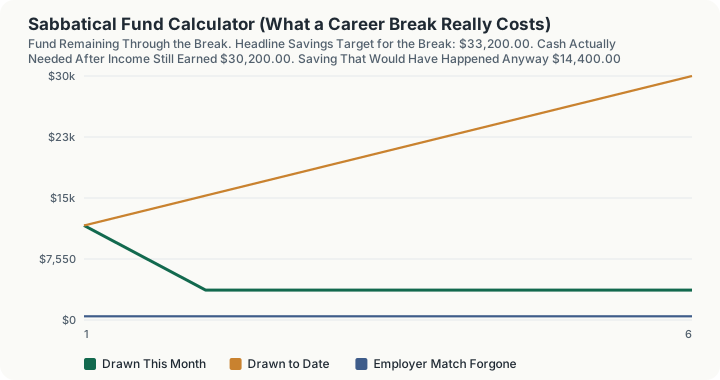
Step 7: Month one. Drawn: $11,700.00, the $8,000.00 of one-off costs plus the first month's net living cost. Fund remaining: $18,500.00
Step 8: Month two. Drawn $3,700.00, drawn to date $15,400.00, fund remaining $14,800.00
Step 9: Month three, the halfway point. Drawn to date $19,100.00, fund remaining $11,100.00
Step 10: Month six, the last row. Drawn to date $30,200.00, fund remaining $0.00
Step 11: What ran alongside it. The schedule carries $458.33 of forgone employer match in every one of those six months, which is the $2,750.00 in Step 2.
The shape of the drawdown is the practical warning. More than a third of the fund is gone in month one, before a single month of rest has been taken, because the one-off costs land first. A fund sized for six months of living expenses that has not separately provided for the flights, the deposit and the equipment is a fund that runs out in month five.
What does this calculator not account for?
- Salary growth during the break. Salary is held flat, so the analysis does not capture the raise you did not receive while away, nor its effect on everything after.
- Any pay penalty on returning, which for some careers is the largest cost of a break and is entirely absent here.
- The value of the break. Rest, retraining, a business started, a language learned, a child's early years. None of it is priced, and for many people it is the whole reason.
- Health insurance continuation, COBRA premiums or equivalent, unless you fold them into the one-off costs or the monthly living costs yourself.
- Tax. The take-home rate is a single percentage you supply, and no bracket, credit or effect of a partial year of earnings is modelled. A year with six months of income is often taxed at a materially lower effective rate, which this model does not capture and which works in your favour.
- Vesting schedules on the employer match, which can mean the forgone match figure understates or overstates what you actually lose.
- Sequence-of-returns risk or any variability in the 6% return, which is applied as a flat annual rate for the whole 25 years.
- Inflation, except through whatever return you choose to enter. Enter a real return if you want the retirement figure in today's money.
- Catch-up contributions or any contribution limit, which may make the forgone pension saving partly recoverable, or may not.
What mistakes do people make with this?
- Budgeting the fund and calling it the cost. The fund is $33,200 and the cost is $50,650. The difference is entirely invisible on a bank statement.
- Counting the whole forgone take-home pay as a loss. It is $39,600, but most of it was going to be spent on living, and that spending is already inside the fund. Adding both double counts. This engine adds only the surplus, which is $14,400.
- Forgetting your own pension contributions. They come out before take-home pay, so they are not in the surplus figure. At $3,300 they are easy to miss and they are a real loss.
- Ignoring the employer match. It is the closest thing to free money most people receive, and six months off costs $2,750 of it here.
- Assuming the fund rebuilds quickly. At the current surplus, replacing the $30,200 takes 12.6 months. A six-month break has an eighteen-month financial footprint before anything else is considered.
- Compounding to retirement and then despairing. $217,383.25 sounds decisive, but it is a comparison against a counterfactual where nothing else changes. If the break leads to higher earnings afterwards, the sign can flip entirely, and that possibility is not modelled here.
- Using a nominal return and reading the retirement figure as today's money. At 6% nominal over 25 years, a substantial part of the $217,383.25 is inflation.
Frequently Asked Questions
How much should I save for a sabbatical?
Why is the true cost more than the fund I need?
Does the calculator double count the salary I give up?
What does a six-month career break cost at retirement?
How long will it take to rebuild the fund afterwards?
Does this calculator say whether the sabbatical is worth it?
Sources
- FDIC, Money Smart financial education program. fdic.gov/consumer-resource-center/money-smart
This calculator uses no statutory data and no published tables. Every input, including the take-home rate, the match rate and the expected return, is supplied by the user.
Also consulted: The compounding to retirement is delegated to the shared future-value solver in engine/primitives/tvm.ts under the standard outflow-negative sign convention; There is no authority that publishes what a career break costs, and no benchmark for any of these inputs. Your own pay statement is the source for the take-home rate, the match rate and the contribution rate; your plan documents are the source for vesting.