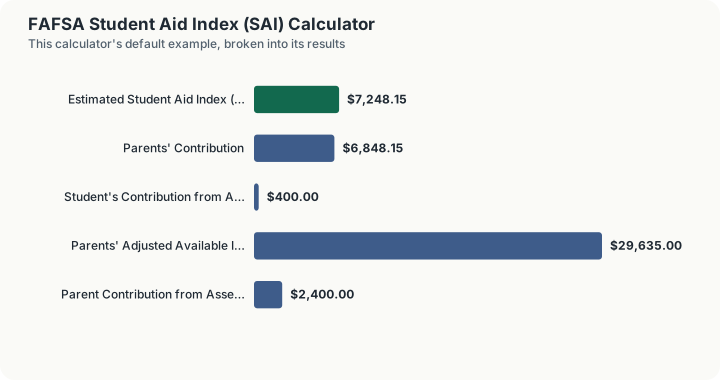
Quick Answer: A dependent student with $90,000 combined parent AGI (married filing jointly), $6,000 in parent income tax paid, a household of 4, $20,000 in parent assets, $3,000 of student income, and $2,000 of student assets has an estimated Student Aid Index of $7,248.15, made up of a $6,848.15 Parents' Contribution and a $400.00 Student Contribution from Assets, with the Student Contribution from Income floored at $0.
Overview
The Student Aid Index, or SAI, is the number that now drives federal financial aid eligibility on the FAFSA. It replaced the Expected Family Contribution (EFC) starting with the 2024-25 award year under the FAFSA Simplification Act, and it is not just a renamed EFC. The underlying formula changed in ways that matter, most notably that the parent contribution is no longer divided by the number of household members enrolled in college at the same time, and that the asset protection allowance, which used to shelter a meaningful chunk of parent net worth based on the older parent's age, is now $0 for every parent regardless of age or marital status.
This calculator estimates SAI using Formula A, the version of the official methodology that applies to dependent students, meaning students who report parent information on the FAFSA. It is built directly from the U.S. Department of Education's own worksheet and rate tables for the 2026-27 award year, not from older EFC-era assumptions carried forward from memory. The output is an estimate for planning purposes. Your school's financial aid office and the Department of Education's own FAFSA processing determine your actual, official SAI.
How This Is Calculated
The official formula is: SAI = Parents' Contribution + Student's Contribution from Income + Student's Contribution from Assets.
Parents' Contribution from Income. Starting from parent AGI, the formula subtracts four allowances: income tax paid, a payroll tax allowance (Medicare Hospital Insurance plus Social Security OASDI, calculated at the current statutory rates and wage bases), an Income Protection Allowance that scales with household size, and an Employment Expense Allowance equal to the lesser of 35% of parent income or a fixed dollar cap. What's left is Parents' Available Income, which can be negative.
Parents' Contribution from Assets. Reportable parent assets (cash, savings, checking, and net investments) are reduced by the Asset Protection Allowance, which is $0 under current law for every parent age and marital status, then multiplied by a 12% asset conversion rate. Available Income and the asset contribution are added together to form the Parents' Adjusted Available Income (PAAI), which is run through a marginal-bracket schedule (22% at the low end, rising to 47% for the highest incomes) to produce the final Parents' Contribution. A PAAI below -$8,500 produces a flat -$1,870 contribution rather than going more negative.
Student's Contribution from Income. The student's own AGI is reduced by income tax paid, the same payroll tax allowance, a flat Income Protection Allowance, and, if the Parents' Adjusted Available Income came out negative, an offsetting allowance equal to that negative amount. Half of whatever income remains becomes the Student's Contribution from Income, floored at $0.
Student's Contribution from Assets. Student assets get no protection allowance at all and are assessed at a flat 20%, higher than the 12% rate applied to parent assets.
All three pieces are added together, then floored at -$1,500 and capped at 999,999 to produce the final SAI.
Worked Example
The SAI worksheet is long, but it is only ever doing three things: strip allowances off parent income, add a slice of parent assets, then run the total through a bracket table. Here is the full path for the Quick Answer family -- $90,000 of parent AGI, married filing jointly, $6,000 of parent income tax paid, a household of four, $20,000 of parent assets, $3,000 of student income, no student tax paid, and $2,000 of student assets.
The parent income side
Step 1 -- Medicare portion of the payroll tax allowance. $90,000 x 1.45% = $1,305.00
Step 2 -- Social Security portion. $90,000 x 6.2% = $5,580.00
Step 3 -- Total payroll tax allowance. $1,305.00 + $5,580.00 = $6,885.00
Step 4 -- Income Protection Allowance for a household of four. $44,880.00
Step 5 -- Employment Expense Allowance. The lesser of 35% of parent income or the fixed cap, so $5,000.00
Step 6 -- Total parent allowances. $6,000.00 + $6,885.00 + $44,880.00 + $5,000.00 = $62,765.00
Step 7 -- Parents' Available Income. $90,000.00 - $62,765.00 = $27,235.00
Two thirds of this family's income is protected before the formula assesses anything. That is why AGI alone is a poor predictor of SAI, and why families are so often surprised by the result in either direction.
The parent asset side
Step 8 -- Asset Protection Allowance under current law. $0.00, for every parent age and marital status
Step 9 -- Parent Contribution from Assets. ($20,000.00 - $0.00) x 12% = $2,400.00
Step 10 -- Parents' Adjusted Available Income. $27,235.00 + $2,400.00 = $29,635.00
The bracket lookup
Step 11 -- Locate the PAAI bracket. $29,635.00 falls in the $27,301 to $32,800 band, which charges a $6,171 base plus 29% of the excess
Step 12 -- Excess over the bracket floor. $29,635.00 - $27,300.00 = $2,335.00
Step 13 -- Marginal portion. $2,335.00 x 29% = $677.15
Step 14 -- Parents' Contribution. $6,171.00 + $677.15 = $6,848.15
The student side
Step 15 -- Student payroll tax allowance. $3,000.00 x (1.45% + 6.2%) = $229.50
Step 16 -- Total student allowances. $229.50 + $11,770.00 flat Income Protection Allowance = $11,999.50
Step 17 -- Student's Contribution from Income. Allowances of $11,999.50 exceed the $3,000.00 of student income, so the result floors at $0.00
Step 18 -- Student's Contribution from Assets. $2,000.00 x 20% = $400.00
Student assets receive no protection allowance and are assessed at 20% against the parents' 12%. A dollar parked in the student's own name therefore costs this family 20 cents of aid eligibility, against 12 cents in a parent account.
Step 19 -- The Student Aid Index. $6,848.15 + $0.00 + $400.00 = $7,248.15
What moves the number
Step 20 -- Move $10,000 of savings into the student's name. Student assets of $12,000 produce a contribution of $12,000 x 20% = $2,400.00 SAI rises from $7,248.15 to $9,248.15
Step 21 -- Add the same $10,000 to the parents' account instead. Parent assets of $30,000 give a contribution of $30,000 x 12% = $3,600.00 SAI rises to $7,596.15
The identical $10,000 costs $2,000 of aid eligibility in the student's name and $348 in the parents'. Titling is the single cheapest lever a family has, and it has to be pulled well before the FAFSA looks at the prior-prior tax year.
Step 22 -- Add one more person to the household. A family of five raises the Income Protection Allowance, pushing total allowances to $70,835.00 and Available Income down to $19,165.00 SAI falls to $5,144.30, low enough that a partial Pell Grant becomes plausible
Step 23 -- The low-income end of the range. Parent AGI of $28,000 with no tax paid and $1,000 of assets gives Available Income of -$24,022.00 and a Parents' Contribution that hits the flat floor of -$1,870.00 The SAI itself floors at -$1,500.00, the strongest Maximum Pell signal the index can produce
Step 24 -- The high-income end. Parent AGI of $350,000 with $65,000 of tax paid and $400,000 of assets gives a PAAI of $256,238.60 and a Parents' Contribution of $111,669.14 SAI: $112,069.14
Across steps 19 to 24 the same formula produces an SAI anywhere from -$1,500 to $112,069.14. Note what did not change any of it: the number of children the family has in college at the same time. That divisor existed under the old EFC and does not appear anywhere in Formula A.
The Simplification Act Changes This Calculator Reflects
- No more "number in college" divisor. Before 2024-25, a family with two children in college at once split the parent contribution between them, effectively cutting each student's assigned share. The current Formula A worksheet has no such division anywhere. A family with three kids in college simultaneously no longer gets that multiplier benefit; each child's SAI is calculated independently from the same full parent contribution.
- A near-zero Asset Protection Allowance. The pre-2024-25 formula sheltered a meaningful slice of parent net worth on a sliding scale tied to the older parent's age, sometimes tens of thousands of dollars for parents near retirement. That allowance is now $0 across the board, so parent savings and investments are assessed dollar-for-dollar (net of the flat allowance) at the 12% rate.
- SAI can go negative, unlike the old EFC, which floored at $0. A negative SAI (down to the -$1,500 floor) is used by financial aid offices to identify students with the greatest need for a Maximum Pell Grant.
What This Does Not Account For
- This is an estimate, not your official SAI. The real FAFSA form and its underlying processing system, not this calculator, produce the number your school actually uses. Verify your real SAI with the FAFSA Submission Summary you receive after filing.
- Several official worksheet line items are simplified into AGI. The full Department of Education worksheet separately adds back untaxed IRA and pension distributions, tax-exempt interest, deductible IRA/Keogh contributions, and a foreign income exclusion, and separately subtracts taxable grant and scholarship aid, education credits, and federal work-study earnings. This calculator assumes AGI already represents total income.
- "Income earned from work" is assumed to equal AGI for the payroll tax allowance and the parent Employment Expense Allowance. The real FAFSA form collects wage income separately from AGI.
- Businesses, investment farms, and child support received are not modeled. The official formula applies a separate net worth adjustment schedule to business and farm assets and adds annual child support received to reportable assets; this calculator omits both.
- Independent students (Formula B and C) are not covered. This calculator only implements Formula A, for dependent students who report parent information.
- Maximum and Minimum Pell Grant eligibility tests are not evaluated. The eligibility signal shown is directional only; it does not check the separate poverty-guideline and non-filer tests the Department of Education uses to assign automatic Maximum or Minimum Pell Grants.
Common Pitfalls
- Assuming a second child in college automatically lowers the family's total contribution. Under the current formula it doesn't; each dependent student's SAI is calculated from the same full parent contribution, independently.
- Believing parent retirement savings and home equity count as reportable assets. They generally don't; the FAFSA excludes qualified retirement accounts and the family's primary residence from reportable net worth, though this calculator's "parent assets" input should reflect that same exclusion.
- Confusing SAI with the dollar amount of aid you'll receive. SAI is an index used in aid-eligibility formulas, not a bill or a guaranteed award; a $0 SAI does not mean a $0 cost to attend.
- Not realizing SAI can be negative. A very low-income family can have an SAI as low as -$1,500, which is a strong signal of Maximum Pell Grant eligibility, not an error in the calculation.
Frequently Asked Questions
Is the Student Aid Index the same thing as the old Expected Family Contribution?
Can my SAI really be negative?
Does having two kids in college at the same time still lower my SAI?
Why did the Asset Protection Allowance drop to $0?
Does this calculator give me my real SAI?
Sources
- U.S. Department of Education, Federal Student Aid, "2026-27 Student Aid Index (SAI) and Pell Grant Eligibility Guide," Version 1.1 (updated August 25, 2025), Formula A worksheet and Tables A1, A2, A4, A5. studentaid.gov
Also consulted: FAFSA Simplification Act (title VII of the FUTURE Act, as amended by the Consolidated Appropriations Act, 2021), which replaced the Expected Family Contribution with the Student Aid Index effective the 2024-25 award year; studentaid.gov, Federal Student Aid's official consumer site, for general SAI and Pell Grant program background.