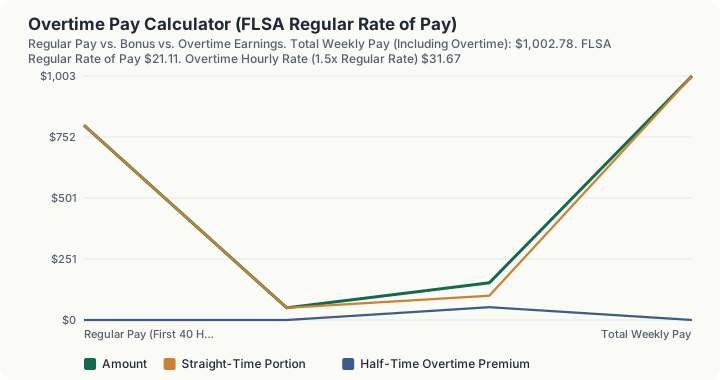
Quick Answer: A non-exempt employee earning $20.00/hr who works 45 hours in a week and earns a $50.00 non-discretionary bonus that week has an FLSA "regular rate of pay" of $21.11/hr, not $20.00/hr. Overtime premium on the 5 overtime hours is $52.78, for total weekly pay of $1,002.78, or $52,144.56 annualized.
Overview
Under the federal Fair Labor Standards Act (FLSA), a non-exempt employee must be paid at least 1.5 times their "regular rate of pay" for every hour worked over 40 in a single workweek. Most people, and unfortunately a fair number of employers, assume the "regular rate" is just the posted hourly wage. It usually is not.
FLSA § 207(e) and the Department of Labor's implementing regulations (29 C.F.R. §§ 778.108-778.113) define the regular rate as total non-excludable compensation earned in the workweek, divided by total hours actually worked. That includes the base hourly wage, but it also includes non-discretionary bonuses, commissions, shift differentials, and most other incentive pay tied to a formula or promised in advance. Only truly discretionary bonuses, where both the fact and amount of payment are decided at the employer's sole discretion near the end of the period, with no prior promise or formula, are excluded. This distinction is one of the most common FLSA compliance mistakes: employers often compute overtime on the base hourly wage alone and simply forget to fold in a production bonus, attendance bonus, or commission earned that same week, systematically underpaying overtime as a result.
This calculator implements the Department of Labor's own method (DOL Fact Sheet #23): it computes the regular rate by including any non-discretionary bonus you enter, then applies the correct "half-time premium" formula to the overtime hours, and reports the full weekly and annualized totals.
How This Is Calculated
- Straight-time earnings. Base hourly rate multiplied by all hours actually worked in the week, including the overtime hours themselves.
- Regular rate of pay. Straight-time earnings plus any non-discretionary bonus or commission earned that week, divided by total hours worked. This is the true FLSA regular rate, and it is only equal to the base hourly wage when there is no bonus.
- Overtime premium. Because straight-time pay for the overtime hours is already included in step 1, only an additional half-time premium is owed on top of it for each hour over 40.
- Total weekly pay. Straight-time earnings plus bonus, plus the overtime premium.
This "half-time premium" method and the equivalent framing of paying overtime hours at "1.5x the regular rate" produce identical totals; this calculator reports both the regular rate and the derived 1.5x overtime hourly rate for clarity.
Worked Example
Using the calculator's default inputs:
- Base Hourly Rate: $20.00/hr
- Hours Worked This Week: 45
- Non-Discretionary Bonus / Commission This Week: $50.00
- Weeks Worked Per Year: 52
Step by step:
- Overtime hours: 45 − 40 = 5 hours. Regular hours: 40.
- Straight-time earnings for all 45 hours: 45 × $20.00 = $900.00.
- Total regular-rate compensation: $900.00 + $50.00 bonus = $950.00.
- Regular rate of pay: $950.00 ÷ 45 hours = $21.11/hr (not $20.00/hr, because the bonus is folded in).
- Overtime hourly rate at 1.5x the regular rate: $21.11 × 1.5 = $31.67/hr.
- Overtime premium: 0.5 × $21.11 × 5 hours = $52.78.
- Total weekly pay: $950.00 + $52.78 = $1,002.78.
- Annualized at 52 weeks: $1,002.78 × 52 = $52,144.56.
Compare this against a naive calculation that ignores the bonus: $20.00/hr regular pay for 40 hours ($800.00) plus $20.00 × 1.5 × 5 overtime hours ($150.00) plus the $50.00 bonus paid separately would total only $1,000.00, exactly $2.78 short of the FLSA-correct figure. That shortfall, repeated across every overtime week for every affected employee, is exactly the kind of systematic underpayment DOL wage-and-hour audits and opinion letters (including 2026 guidance reaffirming the rule) are aimed at catching.
What Counts as a Non-Discretionary Bonus
- Included in the regular rate (non-discretionary): production bonuses, attendance bonuses, safety bonuses, quality bonuses, sales commissions, and any bonus promised in advance or paid according to a predetermined formula, even if the employer retains some judgment about the exact amount.
- Excluded from the regular rate (discretionary or statutorily excluded): true discretionary bonuses where both the decision to pay and the amount are made at the employer's sole discretion at or near the end of the period, with no prior contract, agreement, or promise; gifts for occasions like holidays; reimbursed business expenses; and most employer contributions to bona fide benefit plans.
- The test is substance, not label. Calling a bonus "discretionary" in a handbook does not make it so under the FLSA; if the bonus is tied to a formula, hours, sales targets, or is announced in advance to encourage performance, it is non-discretionary regardless of what it is called.
What This Does Not Account For
- State daily overtime rules. Some states (notably California and Alaska) require overtime after 8 hours in a single day, in addition to the federal 40-hour weekly threshold. This calculator applies only the federal FLSA weekly standard.
- Double-time requirements. A handful of states require double-time pay after a certain number of daily or weekly hours; this calculator computes only the federal 1.5x overtime premium.
- Multiple pay rates in one workweek. If an employee works at two different hourly rates in the same workweek (e.g., different roles or shifts), the regular rate calculation uses a weighted average of both rates; this calculator assumes a single hourly rate for the entire week.
- Exempt employee status. This calculator assumes the employee is properly classified as non-exempt under the FLSA. Executive, administrative, professional, and certain other exemptions remove the overtime requirement entirely regardless of hours worked; misclassification is a separate legal question this tool does not evaluate.
- Taxes and deductions. All figures are gross pay. Use a paycheck calculator for the after-tax take-home amount.
- Piece-rate, day-rate, or salaried non-exempt pay structures. The regular-rate formula differs for these pay methods; this calculator assumes a straightforward hourly-plus-bonus structure.
Common Pitfalls
- Computing overtime on the base wage only. The single most common FLSA violation identified in DOL wage-and-hour investigations is failing to fold non-discretionary bonuses and commissions into the regular rate before calculating the overtime premium, exactly the gap this calculator is built to close.
- Mislabeling a formulaic bonus as "discretionary." A bonus tied to sales targets, output, or a schedule announced in advance is non-discretionary under the FLSA regardless of internal paperwork calling it otherwise.
- Assuming salaried employees are automatically exempt from overtime. Salary alone does not create an FLSA exemption; the employee's actual job duties (and, for some exemptions, a minimum salary threshold) determine exempt status. Many salaried workers are legally non-exempt and owed overtime.
- Ignoring state-level daily overtime or double-time rules. In states with daily overtime thresholds, an employee can be owed overtime for a single long day even in a week that totals fewer than 40 hours; this calculator's federal-only weekly model will understate pay owed in those states.
- Averaging hours across pay periods to avoid overtime. Overtime is calculated on a workweek-by-workweek basis under the FLSA; an employer cannot average 30 hours one week and 50 hours the next to avoid paying overtime for the 50-hour week.
Frequently Asked Questions
Does every bonus have to be included in the regular rate?
What if I work at two different hourly rates during the same week?
Is overtime based on hours worked or hours paid?
Why does the calculator show an "overtime hourly rate" different from 1.5x my base wage?
Does this apply to salaried employees too?
Sources
- U.S. Department of Labor, Wage and Hour Division: Fact Sheet #23, Overtime Pay Requirements of the FLSA. dol.gov/agencies/whd/overtime
Also consulted: 29 U.S.C. § 207, Fair Labor Standards Act, Maximum Hours; 29 C.F.R. §§ 778.108-778.113, Regular Rate of Pay regulations; U.S. Department of Labor, Wage and Hour Division, Opinion Letters FLSA2026-2 and FLSA2026-6, non-discretionary bonus inclusion in the regular rate.