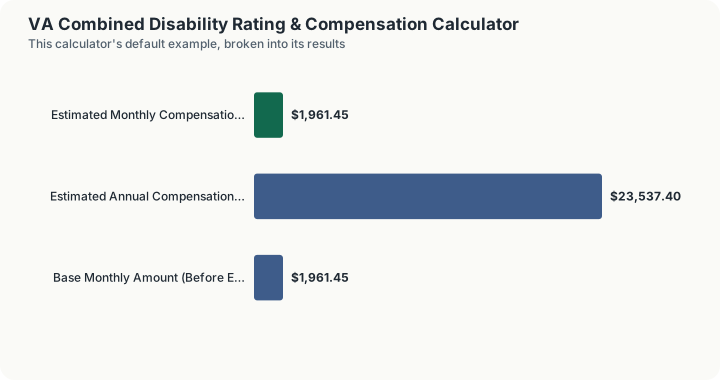
Quick Answer: A veteran with individual disability ratings of 50%, 30%, and 10%, married with no dependent children, has a combined VA disability rating of 70%, not 90% from simple addition, and an estimated 2026 monthly compensation of $1,961.45 ($23,537.40 per year).
Overview
The VA does not add up multiple disability ratings the way most people expect. A veteran with a 60% rating and a 20% rating is not 80% disabled in the VA's math. Instead, the VA treats each additional disability as applying to whatever "efficiency" the veteran has left after the ratings already combined, a method laid out in 38 CFR 4.25, the regulation titled "Combined ratings table." This calculator reproduces that exact method, then looks up the estimated 2026 monthly compensation amount that corresponds to the resulting combined rating and dependent status.
This is an estimate for planning purposes. Your actual combined rating and monthly payment are determined by the Department of Veterans Affairs based on your full claims file, not by this calculator.
How This Is Calculated
Step 1: Combine the ratings using "remaining efficiency." Arrange every individual rating from highest to lowest. Starting with the two highest, combine them using the formula combined = a + b x (100 - a) / 100, where a is the higher rating and b is the next one. The logic is that a veteran already rated a% disabled is only (100 - a)% efficient, so the next disability, b%, is applied against that remaining efficiency rather than against a full, undiminished 100%.
Step 2: Round to a whole percentage after every step. The actual regulation publishes this combination as a two-dimensional lookup table (38 CFR 4.25's "Table I"), where every cell is a whole number. That means each pairwise combination is rounded to the nearest whole percentage point before it's combined with the next rating, if there is one.
Step 3: Repeat for every additional rating, in descending order. Each subsequent rating combines against the running whole-number result from the previous step, not against the original ratings again.
Step 4: Round only the very final combined value to the nearest 10. This is the step people most often confuse with rounding at every stage. Only after all disabilities have been combined does the VA round the result to the nearest number divisible by 10, and a value ending in exactly 5 rounds up, not down. A 65% combined value becomes 70%, not 60%.
Step 5: Look up 2026 monthly compensation. The final, rounded combined rating and your dependent status (whether you have a spouse and how many dependent children under 18 you have) determine your monthly payment from the VA's published 2026 compensation rate table, effective December 1, 2025.
Worked Example
Using the Quick Answer's ratings of 50%, 30%, and 10%, married with no dependent children:
Combine the two highest ratings. 50% and 30%: 50 + 30 x (100 - 50) / 100 = 50 + 15 = 65%. This happens to land on a whole number already, so no rounding is needed yet.
Combine that result with the third rating. 65% and 10%: 65 + 10 x (100 - 65) / 100 = 65 + 3.5 = 68.5%, which rounds to the whole-number table value of 69%.
Round to the nearest 10. 69% rounds to 70%, since 69 is closer to 70 than to 60.
Look up compensation. A 70% combined rating with a spouse and no dependent children pays an estimated $1,961.45 per month under the 2026 rate table, or $23,537.40 per year.
Notice that simple addition (50 + 30 + 10 = 90%) would have overstated the combined rating by a full 20 percentage points, which would have implied a materially higher monthly payment than the veteran actually receives.
The Combined Ratings Table Method, In Plain Terms
- It is never simple addition, except for a single rated condition. Two or more ratings always combine to something less than their sum, because each additional disability is applied to the veteran's remaining, undamaged capacity rather than stacking on top of the prior ratings directly.
- Order matters procedurally, not numerically. You always combine starting from the highest rating and work down, but the final combined value is the same regardless of the order you happen to enter the ratings in, since the underlying math is commutative once sorted.
- The nearest-10 rounding only happens once, at the very end. Every intermediate pairwise combination rounds to the nearest whole percentage point (matching the government's own published lookup table), but none of those intermediate steps get rounded to the nearest 10. Only the final combined value does.
- A rating exactly ending in 5, at the final step, rounds up. 65% becomes 70%, 45% becomes 50%, and so on. This is explicitly called out in 38 CFR 4.25 itself.
What This Does Not Account For
- This is an estimate, not your official combined rating or payment. The Department of Veterans Affairs determines your actual combined rating and compensation based on your complete claims file, including any bilateral factor adjustments, special monthly compensation, or other case-specific rules this calculator does not model. Confirm your real rating and payment through va.gov or your VA regional office.
- Special Monthly Compensation (SMC) is not modeled. Veterans with specific severe disabilities, such as loss of use of a limb or the need for aid and attendance, may qualify for SMC add-ons well above the standard compensation table this calculator uses.
- Dependent parents and a spouse's Aid & Attendance add-on are not modeled. The official 2026 rate table includes additional amounts for one or two dependent parents and for a spouse who requires Aid & Attendance; this calculator omits both to keep the input set focused.
- Children over 18 who are still in school are not modeled separately. The official table pays a higher add-on for a dependent child over 18 still in school than for a child under 18; this calculator applies only the under-18 child rate.
- The bilateral factor and other rating-stage adjustments are not modeled. Some combinations of disabilities affecting paired limbs get an additional adjustment before the standard combined-ratings math applies; this calculator assumes the ratings you enter are already each condition's own final individual rating.
Common Pitfalls
- Simply adding up individual ratings. This is the single most common mistake veterans make when estimating their own combined rating, and it almost always overstates the true combined percentage.
- Rounding each pairwise combination to the nearest 10 instead of the nearest whole number. Only the very last combination gets rounded to the nearest 10; every step before that rounds to the nearest whole percent.
- Forgetting that combining order (by severity) doesn't change the outcome, but skipping the "highest first" sorting step while hand-calculating often introduces arithmetic errors anyway. Always sort from highest to lowest before working through the table by hand.
- Assuming a 10% or 20% rating changes your monthly payment for dependents. It doesn't. VA compensation only pays extra for dependents once your combined rating reaches 30% or higher.
Frequently Asked Questions
Why isn't my combined rating just the sum of my individual ratings?
Why does a 65% combined value round up to 70% instead of down to 60%?
Does the order I combine my ratings in change my final combined rating?
Will I actually receive the monthly amount this calculator shows me?
Is the 2026 compensation rate the same as last year's?
Sources
- 38 CFR 4.25, "Combined ratings table," U.S. Code of Federal Regulations, Title 38 (Pensions, Bonuses, and Veterans' Relief), Department of Veterans Affairs. benefits.va.gov/homeloans
- va.gov, "2026 VA Disability Compensation Rates," effective December 1, 2025: va.gov/disability/compensation-rates/veteran-rates
Also consulted: va.gov, "About VA Disability Ratings," for the Department's own published combined-ratings worked example.