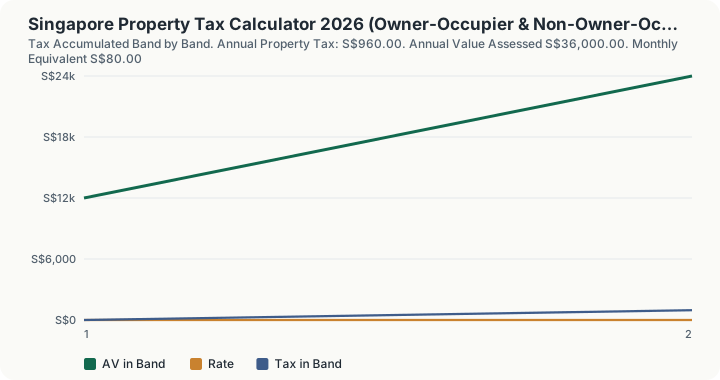
Quick Answer: An owner-occupied home with an Annual Value of S$36,000 is taxed S$960.00 a year, or S$80 a month. That is an effective rate of 2.67% of Annual Value, with the top band reached being 4%. The identical Annual Value on a property that is let out or left vacant is taxed under a completely separate schedule and produces S$4,800.00, five times as much.
What does this calculator do?
Singapore property tax is the simplest property tax in the developed world to compute and the easiest one to get wrong for the wrong reason.
It is simple because the whole formula is one multiplication: annual property tax is the Annual Value of the property multiplied by the property tax rates that apply to you. There is no assessed-value ratio, no millage, no local authority, no county, no school district, and no separate levies. IRAS assesses the Annual Value and IRAS applies the rates.
It is easy to get wrong because of what Annual Value is. AV is the estimated gross annual rent the property would fetch if it were let, unfurnished and excluding furniture and maintenance fees. It is not your purchase price, not a percentage of your purchase price, and not your actual rent. There is no published formula converting a purchase price, a floor area or an actual rent into an AV, which is why this calculator takes AV as an input and refuses to estimate it. Your AV is on your property tax bill and in your account at mytax.iras.gov.sg.
The second thing this calculator exists to make visible is that the two residential schedules are not one schedule with a penalty attached. They are two entirely different tables with different band widths, different rates and different starting points, and the gap between them is the single largest number in most Singapore rental yield calculations.
How is this calculated?
Tax = ∑_b (AV within band b) × r_b
Three schedules exist, and exactly one applies to a given property.
Owner-occupier residential, effective from 1 January 2025: first S$12,000 at 0%, next S$28,000 at 4%, next S$10,000 at 6%, next S$25,000 at 10%, next S$10,000 at 14%, next S$15,000 at 20%, next S$40,000 at 26%, and everything above S$140,000 at 32%.
Non-owner-occupier residential, effective 1 January 2024 and not revised since: first S$30,000 at 12%, next S$15,000 at 20%, next S$15,000 at 28%, and everything above S$60,000 at 36%. Note the shape difference an owner-occupier never sees: there is no zero-rate band at all. The first dollar of Annual Value is taxed at 12%.
Non-residential, commercial and industrial: a flat 10% of Annual Value with no bands whatsoever, and no owner-occupier relief even if you occupy the premises yourself.
Step 1: Take the Annual Value assessed by IRAS. AV = S$36,000.00
Step 2: Tax the first S$12,000 at 0% under the owner-occupier schedule. S$12,000 x 0% = S$0.00
Step 3: The remaining AV falls into the 4% band, which runs from S$12,000 to S$40,000. S$36,000 - S$12,000 = S$24,000.00 in the 4% band
Step 4: Tax that slice at 4%. S$24,000 x 4% = S$960.00
Step 5: Total the bands. S$0.00 + S$960.00 = S$960.00
Step 6: Divide by twelve for a monthly budgeting figure. S$960.00 / 12 = S$80.00 per month
Step 7: Express the bill as a percentage of Annual Value. S$960.00 / S$36,000 = 2.67%
Step 8: Apply your ownership share for budgeting between co-owners. S$960.00 x 100% = S$960.00
Step 8 needs a caveat the output repeats: IRAS assesses the property, not the owners. Co-owners are jointly and severally liable for the entire bill. The share figure apportions it for budgeting, and it does not reduce the assessment or your legal exposure to the whole of it.
Worked Example
Now take the identical flat with the identical Annual Value of S$36,000 and let it out. Nothing about the property has changed; only the schedule that applies to it.
Step 1: The first band of the let-out schedule starts at the first dollar, at 12%. S$30,000 x 12% = S$3,600.00
Step 2: The remaining AV falls into the 20% band, which runs from S$30,000 to S$45,000. S$36,000 - S$30,000 = S$6,000.00 in the 20% band
Step 3: Tax that slice at 20%. S$6,000 x 20% = S$1,200.00
Step 4: Total the bands. S$3,600.00 + S$1,200.00 = S$4,800.00
Step 5: Compare with the owner-occupier bill on the same AV. S$4,800.00 - S$960.00 = S$3,840.00 more
Step 6: Express that as a multiple. S$4,800.00 / S$960.00 = 5 times the owner-occupier bill
Both schedules are evaluated on every calculation here, whichever class you select, precisely because step 6 is the decision most owners actually face and it is invisible if only one schedule is computed. On a property yielding, say, S$40,000 of gross rent, the S$3,840 difference is nearly ten percent of gross rent gone before income tax is considered at all.
Note carefully what is not happening in the worked example. There is no surcharge, no multiplier and no penalty rate applied on top of an owner-occupier calculation. The let-out figure is computed from its own table, from the first dollar, and the S$3,840 difference is simply the arithmetic consequence of two different tables producing two different answers.
What does this calculator not account for?
- It does not estimate Annual Value. No published formula converts purchase price, rent or floor area into AV. You must supply the AV that IRAS has assessed.
- It does not model owner-occupier eligibility. The concessionary rates are granted only where you actually live in the property and only for one property at a time. This calculator applies whichever schedule you select and does not test whether you qualify.
- It does not apply any vacancy relief, because none exists. A vacant residential property is taxed at the non-owner-occupier rates exactly as a let one is.
- It does not model the property tax rebates announced in some Budgets for owner-occupied residential properties, which are one-off measures rather than standing features of the rate schedule.
- It does not compute penalties or the instalment arrangement. Property tax is billed annually and payable by 31 January; GIRO instalments are available but change only the timing.
- It does not apply the mixed-use apportionment where part of a property is owner-occupied and part let out, which IRAS assesses on a case-by-case basis.
- It does not include Additional Buyer's Stamp Duty, Seller's Stamp Duty, or income tax on rent. Those are separate charges with their own calculators.
- It does not model land, which has its own assessment basis distinct from a built property's estimated rent.
What mistakes do people make with this?
- Confusing Annual Value with property value. This is by far the commonest error. A S$2 million condominium does not have a S$2 million Annual Value; it has an AV in the tens of thousands, reflecting a year's rent. Entering a purchase price here will produce an absurd figure.
- Assuming the let-out rate is the owner-occupier rate plus a surcharge. It is not. They are separate tables. The let-out table has no zero-rate band, its first band is four times wider than the owner-occupier zero band, and its rates are higher throughout.
- Believing a vacant property is taxed lightly. Vacancy attracts the non-owner-occupier schedule in full. Leaving a property empty between tenants costs you rent and saves you nothing on property tax.
- Forgetting AV is reviewed. IRAS revises Annual Values as market rents move, and a revision can raise your bill without any change to the rate schedule at all.
- Assuming owner-occupier rates apply to a second home. They apply to one property at a time, the one you actually live in.
- Expecting owner-occupier relief on commercial property. IRAS states explicitly that owner-occupier rates do not apply to non-residential properties even where you have bought them for your own use.
- Splitting the bill between co-owners and assuming each is liable for only their share. The apportionment output here is for budgeting. Liability is joint and several for the whole amount.
Frequently Asked Questions
What exactly is Annual Value in Singapore?
How much property tax will I pay on an HDB flat?
Why is my property tax so much higher now that I rent it out?
Do I pay property tax if my flat is empty?
Is commercial property taxed at the same rates?
Sources
- Inland Revenue Authority of Singapore, "Property Tax Rates", iras.gov.sg: read 2026-08-30. Source of all three schedules and of the formula itself: "Annual property tax is calculated by multiplying the Annual Value (AV) of the property with the Property Tax Rates that apply to you." Owner-occupier bands are taken from the "Tax rate effective from 1 Jan 2025" column; non-owner-occupier bands from the "Effective 1 Jan 2024" column, which was not revised in 2025 and remains in force for 2026. The same page states that non-residential properties "are taxed at 10% of the Annual Value" and that "Owner-occupier tax rates do not apply to non-residential properties even if you have bought the properties for your own use/occupation." iras.gov.sg/taxes/property-tax/property-owners/property-tax-rates
Also consulted: Inland Revenue Authority of Singapore, mytax.iras.gov.sg, where your own Annual Value is published. IRAS is the sole assessor of Annual Value; no third party can compute it; Band arithmetic implemented in engine/primitives/singapore-property-tax.ts, which evaluates both residential schedules on every call so the owner-occupier and let-out figures can be compared directly.