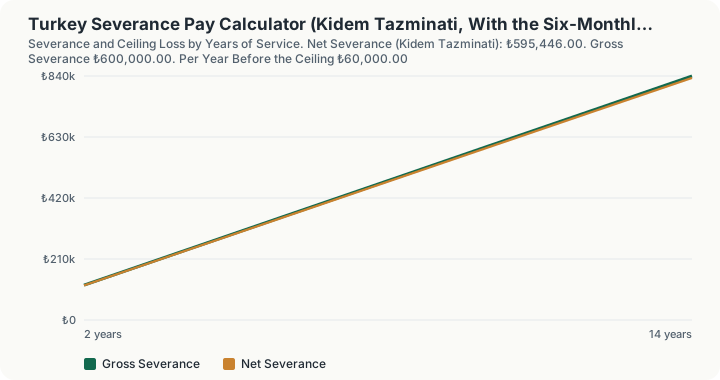
Quick Answer: An employee on 60,000 TL gross a month with ten years of service receives 595,446.00 TL net severance. That is 600,000 TL gross, being thirty days of wage for each of ten years, less 4,554.00 TL of stamp duty. No income tax and no social security premium are deducted, because the payment sits within the statutory ceiling.
What does this calculator do?
Turkish severance, kıdem tazminatı, is generous in principle and capped in practice. The entitlement under Article 14 of the old Labour Law 1475, which survives for this purpose, is thirty days of gross wage for each full year of service, with remainders pro-rated rather than discarded. There is no maximum number of years: the entitlement keeps accruing for a whole career.
What limits it is the tavan, a ceiling on the amount of wage that can be counted for each year of service. That ceiling is reset every six months, each January and July, by a Treasury circular tied to civil service pay. For the second half of 2026 it stands at 73,729.87 TL. Because it applies per year of service rather than to the total, its effect scales with tenure: an employee on double the ceiling loses half the entitlement, and loses it twenty times over across a twenty-year career.
Two further features are worth understanding before reading the result.
First, the wage used is the giydirilmiş gross wage, not the bare contractual salary. It includes regularly provided money and money-measurable benefits such as meal, transport and fuel allowances and bonus entitlements spread over the year. Using the bare salary understates the entitlement, sometimes substantially.
Second, the deductions are unusual. A statutory kıdem tazminatı carries no social security premium at all, and it is exempt from income tax up to the ceiling. The only deduction is stamp duty at 7.59 per mille, and that is charged on the whole payment including the income-tax-exempt part. Where a contract pays more than the ceiling allows, the excess loses the income tax exemption and is taxed as ordinary wage income.
How is this calculated?
Step one, service length. Full years count in full, and the remainder is pro-rated:
Service Years = Full Years + (Remainder Days)/365
Months are converted at thirty days each.
Step two, the per-year entitlement. Thirty days of wage is one month of wage, and a contract may raise the day count:
Per Year = Monthly Gross Wage × (Days per Year)/30
Step three, the ceiling, applied per year of service:
Per Year After Ceiling = min(Per Year, Tavan)
Step four, the gross payment:
Gross Severance = Per Year After Ceiling × Service Years
Step five, the tax treatment. The income-tax-exempt amount is the ceiling multiplied by service years. Anything above it is taxed as wage income under the ordinary tariff:
Exempt = min(Gross, Tavan × Service Years)
Taxable Excess = Gross − Exempt
Where the ceiling has been applied, the exempt amount equals the gross and there is no taxable excess by construction.
Step six, stamp duty on the whole amount:
Stamp Duty = Gross Severance × 0.759%
Step seven, the net:
Net = Gross − Stamp Duty − Income Tax on the Excess
Worked Example
An employee with a giydirilmiş gross wage of 60,000 TL a month and exactly ten years of service, terminated in the second half of 2026.
Step 1: Establish service length. Ten full years, no remainder.
Service = 10 years
Step 2: Compute the per-year entitlement at the statutory thirty days.
60,000 × 30/30 = 60,000
Per year before the ceiling = 60,000.00 TL
Step 3: Compare it with the ceiling of 73,729.87 TL. The wage is below it, so nothing is capped away.
Per year after the ceiling = 60,000.00 TL
Step 4: Multiply by service years.
60,000 × 10 = 600,000
Gross severance = 600,000.00 TL
Step 5: Compute the income-tax-exempt amount.
73,729.87 × 10 = 737,298.70
The gross of 600,000.00 TL is below that, so the whole payment is exempt.
Taxable excess = 0.00 TL, income tax = 0.00 TL
Step 6: Apply stamp duty at 7.59 per mille to the whole amount.
600,000 × 0.759% = 4,554
Stamp duty = 4,554.00 TL
Step 7: Arrive at the net.
600,000 − 4,554 = 595,446
Net severance = 595,446.00 TL, an effective deduction rate of just 0.759%.
Now raise the wage to 120,000 TL a month, above the ceiling. Step 3 now bites:
Per year after the ceiling = 73,729.87 TL, against 120,000.00 TL before it.
73,729.87 × 10 = 737,298.70
Gross severance = 737,298.70 TL, where an uncapped entitlement would have been 1,200,000.00 TL. The ceiling has removed 462,701.30 TL, nearly 40% of the entitlement. Stretch the same wage over twenty-five years and the per-year shortfall of 46,270.13 TL is suffered twenty-five times, removing 1,156,753.25 TL.
What does this calculator not account for?
- Whether the ceiling shown is the right one. It is reset every January and July. The default here is the figure for 1 July to 31 December 2026. For a termination in a different period you must enter the ceiling in force on that date, and the calculator cannot know it.
- Whether you qualify at all. Kıdem tazminatı requires at least one year of service and a qualifying reason for termination. Resignation without cause, and dismissal for conduct falling within the employer's immediate-termination rights, generally forfeit it. The calculator computes an amount and does not test entitlement.
- What belongs in the giydirilmiş wage. Which allowances are regular enough to count is a frequent source of dispute. The calculator uses whatever figure you enter.
- Notice pay (ihbar tazminatı), annual leave pay and other termination entitlements, which are separate from severance and not computed here.
- Cumulative income tax interaction. Where a taxable excess arises, it is taxed here in isolation. In practice it stacks on the employee's cumulative annual base, which can push it into a higher band than shown.
- The minimum wage stamp duty exemption. That relief is drafted for a monthly wage, and no primary authority was found extending it to a lump-sum severance payment, so stamp duty is charged here on the whole amount.
- The separate 24-month rule for journalists under Law 5953, whose severance exemption works differently.
- Interest for late payment, which accrues where severance is not paid on time.
- Employer insolvency and the wage guarantee fund.
What mistakes do people make with this?
- Using a stale ceiling. It changes twice a year, every year. A figure six months out of date understates severance for every capped employee, and the gap is large in an inflationary environment.
- Applying the ceiling to the total rather than per year. It caps the wage counted for each year of service. Applying it once to the whole payment produces a far smaller and quite wrong answer.
- Using the bare salary instead of the giydirilmiş wage. Regular allowances and spread bonuses count, and omitting them can understate the entitlement by a wide margin.
- Discarding the part-year remainder. Remainders beyond full years are pro-rated, not rounded down. Six extra months on a ten-year tenure is worth half a month of wage.
- Expecting SGK to be deducted. It is not. Severance carries no social security premium at all.
- Assuming the whole payment is always tax free. It is exempt only up to the ceiling per year of service. A contractual payment above that loses the exemption on the excess.
- Forgetting stamp duty on the exempt part. Stamp duty is charged on the entire payment, including the portion that bears no income tax.
- Assuming thirty days is fixed. It is a statutory floor that a contract or collective agreement may raise, and many collective agreements do.
Frequently Asked Questions
How is severance pay calculated in Turkey?
What is the kidem tazminati ceiling?
Is severance pay taxed in Turkey?
Is there a maximum number of years?
What counts as the wage for severance purposes?
Can I get more than thirty days per year?
Sources
- İş Kanunu 1475, Article 14, as quoted by the Ministry of Labour and Social Security's own frequently asked questions on the Labour Law. csgb.gov.tr/sikca-sorulan-sorular/calisma-genel-mudurlugu/%C4%B1s-kanunu (read 31 August 2026). Verbatim: "her geçen tam yıl için işverence işçiye 30 günlük ücreti tutarında kıdem tazminatı ödeneceği"; "Bir yıldan artan süreler de oranlanarak hesaplamaya dahil edilmektedir"; and on the thirty days being improvable by contract or collective agreement. The same source states that only stamp duty is deducted: "Kıdem tazminatından sadece damga vergisi kesilmektedir, başka kesinti yapılmamaktadır."
- T.C. Hazine ve Maliye Bakanlığı, Kamu Mali Yönetim ve Dönüşüm Genel Müdürlüğü, Genelge (Sıra No: 5), 3 July 2026. ms.hmb.gov.tr/uploads/2026/07/2026-Yili-Temmuz-Ayina-Ait-Mali-ve-Sosyal-Haklara-Iliskin-Genelge-9b5304ed658d77cb.pdf (read 31 August 2026). Verbatim: "1/7/2026 tarihinden itibaren işçilere ödenecek kıdem tazminatının yıllık tavan tutarı 73.729,87 TL'dir."
- Gelir İdaresi Başkanlığı, 488 sayılı Kanuna ekli (1) Sayılı Tablo, entry IV/1/b, which names "tazminat" expressly and sets the rate at binde 7,59 (consolidated text, 1 October 2025). cdn.gib.gov.tr/api/gibportal-file/file/getFile
Also consulted: Gelir Vergisi Kanunu Article 25/7, as set out in the Revenue Administration's guide for wage earners. The exemption covers severance up to the maximum retirement bonus payable to the highest-ranking civil servant for one year of service, with the excess taxed as wage income; Gelir İdaresi Başkanlığı, "Gelir Vergisi Tarifesi 2026", used for the tax on any excess above the ceiling.