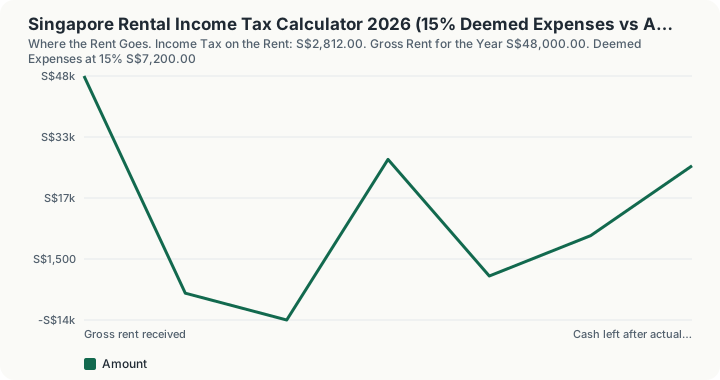
Quick Answer: S$4,000 a month let for twelve months, against S$14,000 of mortgage interest and S$6,000 of actual non-interest expenses, attracts S$2,812.00 of income tax for a landlord with S$96,000 of other income and S$22,000 of reliefs. The 15% deemed claim deducts S$7,200 against real expenses of S$6,000, so it wins by S$1,200. A separate property tax bill of S$7,440 falls at non-owner-occupier rates.
What does this calculator do?
Singapore taxes rental income by adding it to everything else you earn. There is no separate rental schedule, no flat rate, and no withholding for a resident landlord. Net rent joins your assessable income, personal reliefs are deducted, and the resident progressive scale applies to the total. That is why the same S$10,000 of net rent costs a modest earner a few hundred dollars and a high earner more than two thousand.
What makes the Singapore calculation distinctive is the deemed expense election. Instead of itemising, a residential landlord may claim a deemed rental expense of 15% of gross rent, which IRAS pre-fills in the online form. The crucial detail, and the one that changes the answer for most landlords, is that mortgage interest is claimable in addition to the 15%, under both branches.
That means the 15% deemed figure is not competing with your total costs. It is competing only with your non-interest costs: property tax, agent commission on renewals, repairs, fire insurance and maintenance fees. For a leveraged landlord whose largest expense is interest, and whose remaining costs are modest, the deemed claim frequently wins outright while eliminating the need to keep receipts at all.
The second thing this page insists on is that income tax is not the only tax on a let property. Letting it out moves it onto the non-owner-occupier property tax schedule, which starts at 12% of Annual Value with no zero-rate band. That bill is computed and displayed here alongside the income tax, because a yield calculation that omits it is wrong by thousands of dollars a year.
How is this calculated?
Net rent = max(0, G − (E + I)); E = 0.15G, deemed; E_actual, actual
Tax on rent = T(other income + net rent − reliefs) − T(other income − reliefs)
where $G$ is gross rent, $I$ is mortgage interest and $T$ is the resident progressive scale for YA 2024 onwards.
Step 1: Compute gross rent for the year. S$4,000 x 12 months = S$48,000.00
Step 2: Compute the deemed expense claim at 15% of gross rent. S$48,000 x 15% = S$7,200.00
Step 3: Add mortgage interest, which is deductible on top of the 15%. S$7,200.00 + S$14,000.00 = S$21,200.00 total deduction
Step 4: Net rent is gross rent less the total deduction. S$48,000.00 - S$21,200.00 = S$26,800.00
Step 5: Compute the counterfactual under the actual branch, for comparison. S$6,000.00 + S$14,000.00 = S$20,000.00 deducted, leaving net rent of S$28,000.00
Step 6: The deemed branch's advantage is the difference in deductions. S$7,200.00 - S$6,000.00 = S$1,200.00
Step 7: Compute chargeable income without the rent. S$96,000 - S$22,000 of reliefs = S$74,000.00
Step 8: Tax that on the resident scale: S$550 on the first S$40,000, then 7% on the rest. S$550 + (S$34,000 x 7%) = S$2,930.00
Step 9: Compute chargeable income with the rent. S$96,000 + S$26,800 - S$22,000 = S$100,800.00
Step 10: Tax that: S$3,350 on the first S$80,000, then 11.5% on the rest. S$3,350 + (S$20,800 x 11.5%) = S$5,742.00
Step 11: The tax attributable to the rent is the difference. S$5,742.00 - S$2,930.00 = S$2,812.00
Step 12: Compute property tax on the let property at the non-owner-occupier rates, on an AV of S$48,000. (S$30,000 x 12%) + (S$15,000 x 20%) + (S$3,000 x 28%) = S$3,600 + S$3,000 + S$840 = S$7,440.00
Step 13: Compare with what the same AV would cost if you lived there. (S$12,000 x 0%) + (S$28,000 x 4%) + (S$8,000 x 6%) = S$1,600.00, a letting premium of S$5,840.00
Step 14: Compute cash left after real costs and income tax. S$48,000.00 - S$6,000.00 - S$14,000.00 - S$2,812.00 = S$25,188.00
Step 15: Express both taxes as a share of gross rent. (S$2,812.00 + S$7,440.00) / S$48,000.00 = 21.36%
Step 14 deducts the actual expenses, not the deemed figure, even though the deemed branch was elected. That is deliberate: the 15% is a tax fiction that never leaves your bank account. It reduces the tax bill and nothing else. Note also that if you are claiming under the actual branch, the property tax in step 12 must be included in the actual expenses figure you enter: the engine does not add it in for you, and it will be double-counted or omitted if you are careless.
Worked Example
Take the same property in a year with heavy repairs: S$20,000 of real non-interest expenses instead of S$6,000, with everything else unchanged.
Step 1: The deemed claim is unchanged, because it depends only on gross rent. S$48,000 x 15% = S$7,200.00
Step 2: The actual claim is now far larger. S$20,000.00 versus S$7,200.00 = S$12,800.00 more deduction under the actual branch
Step 3: Net rent under the actual branch. S$48,000.00 - S$20,000.00 - S$14,000.00 = S$14,000.00
Step 4: Net rent under the deemed branch, for contrast. S$48,000.00 - S$7,200.00 - S$14,000.00 = S$26,800.00
Step 5: The break-even level of non-interest expenses is simply the deemed figure. 15% x S$48,000 = S$7,200.00
Step 5 is the whole decision rule, and it is easier than most landlords expect. If your non-interest expenses for the year come to less than 15% of gross rent, take the deemed claim and stop keeping receipts. If they exceed it, itemise. Interest sits outside the comparison entirely because it is deductible either way.
One constraint the calculator cannot enforce: IRAS requires the election to be applied consistently across every tenanted residential property you own. This calculator models one property, so a portfolio owner has to make the choice at portfolio level and then run each property on the chosen branch.
What does this calculator not account for?
- It models one property. The deemed-versus-actual election must be applied consistently to every tenanted residential property you own, and that portfolio-level choice is outside this calculator's scope.
- It does not test your eligibility for the deemed option. The 15% claim is residential-only and is unavailable if you incurred no deductible expense other than interest, or if you hold the property through a partnership or a trust.
- It does not add property tax to your actual expenses. Under the actual branch you must include property tax in the expenses figure you enter. The property tax shown is a memo item computed separately.
- It does not apply any personal income tax rebate, because none was announced for YA 2026 as at the time of writing. Rebates are announced Budget by Budget and are not standing features of the Act.
- It does not cap or validate your reliefs. The personal income tax relief cap is S$80,000 for a Year of Assessment; enter a figure at or below it.
- It does not distinguish repairs from improvements. Capital improvements are not deductible against rental income and would be wrongly claimed if entered as expenses.
- It does not model non-resident landlords, who are taxed on rental income at a flat 24% with no personal reliefs, nor withholding obligations on rent paid to non-residents.
- It excludes mortgage principal entirely. Only interest is deductible; principal repayment is neither an expense nor a deduction.
What mistakes do people make with this?
- Thinking the 15% has to beat all your costs. It only has to beat your non-interest costs, because interest is deductible under both branches. This is the single most valuable fact on this page.
- Claiming both the deemed 15% and your actual expenses. You choose one. IRAS is explicit: either select actual allowable expenses and claim the actual expenses, or claim the deemed rental expenses plus mortgage interest.
- Deducting mortgage principal. Only the interest portion of the instalment is deductible.
- Forgetting property tax entirely. At the defaults it is S$7,440, more than twice the income tax on the same rent. Letting the property out also raises the property tax by S$5,840 relative to living in it.
- Assuming vacant months save property tax. They do not. Property tax runs at the non-owner-occupier rates whether or not there is a tenant, so a partial year cuts your rent without cutting that bill.
- Applying an average tax rate to rent. Rent stacks on top of your other income, so it is taxed at your marginal band. The calculator computes tax with and without the rent and takes the difference for exactly this reason.
- Deducting the agent's commission on a first letting. Commission to secure the first tenant is generally not deductible; commission on renewal generally is.
Frequently Asked Questions
Should I claim the 15% deemed rental expenses or my actual expenses?
Is mortgage interest deductible in addition to the 15%?
How much tax will I pay on rental income in Singapore?
Do I still pay property tax while the flat is empty between tenants?
Can a company or trust claim the 15%?
Sources
- Inland Revenue Authority of Singapore, "Income from property rented out", iras.gov.sg: read 2026-08-30. Source of the 15% deemed rental expenses ("an amount of deemed rental expenses calculated based on 15% of the gross rent will be pre-filled in the online tax form") and of the interest rule ("In addition to the 15% deemed rental expenses, property owners may still claim mortgage interest on the loan taken to purchase the tenanted property"), and of the either/or election. iras.gov.sg/taxes/individual-income-tax/basics-of-individual-income-tax/what-is-taxable-what-is-not/income-from-property-rented-out
- Inland Revenue Authority of Singapore, "Individual Income Tax rates", iras.gov.sg: read 2026-08-30. Source of the resident progressive scale for YA 2024 onwards used to stack the rent: nil to S$20,000, then 2%, 3.5%, 7%, 11.5%, 15%, 18%, 19%, 19.5%, 20%, 22%, 23% and 24% above S$1,000,000. No personal income tax rebate is listed for YA 2026. iras.gov.sg/taxes/individual-income-tax/basics-of-individual-income-tax/tax-residency-and-tax-rates/individual-income-tax-rates
- Inland Revenue Authority of Singapore, "Property Tax Rates", iras.gov.sg: read 2026-08-30. Source of the non-owner-occupier bands effective 1 January 2024 used for the property tax figure: 12% on the first S$30,000, 20% on the next S$15,000, 28% on the next S$15,000 and 36% above S$60,000. iras.gov.sg/taxes/property-tax/property-owners/property-tax-rates
Also consulted: Inland Revenue Authority of Singapore, "Tax reliefs", iras.gov.sg, read 2026-08-30: "A personal income tax relief cap of $80,000 applies to the total amount of all tax reliefs claimed for each Year of Assessment (YA).".