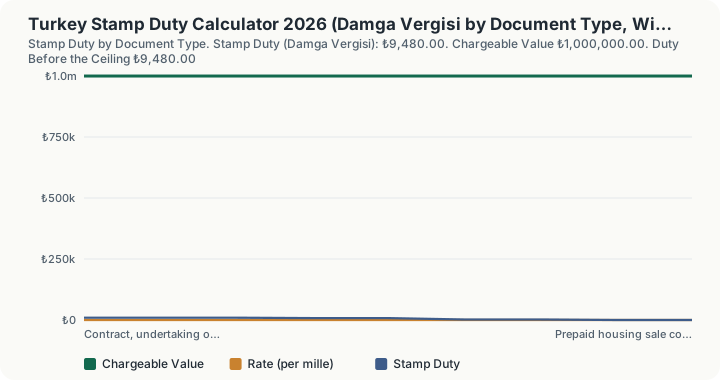
Quick Answer: A commercial contract with a stated value of 1,000,000 TL attracts 9,480.00 TL of stamp duty, at the rate of 9.48 per mille. The same value written as a lease would attract 1,890.00 TL, and as a notarised property sale undertaking it would attract nothing at all. The document type, not the amount, is what determines the rate.
What does this calculator do?
Turkish stamp duty is charged on documents rather than on transactions, and the rate depends entirely on which entry of the schedule to Law 488 the document falls under. That range is wide: from zero to 9.48 per mille. There is no such thing as a general contract stamp duty rate, and treating one figure as universal is the most expensive mistake available here.
The main proportional rates work out as follows. Contracts, undertakings and assignments containing a stated sum are charged at 9.48 per mille, and so are guarantee and pledge deeds and public procurement contracts. Leases are charged at 1.89 per mille, a fifth as much, as are sales of registered second-hand vehicles. Wage and compensation payments, including severance, are charged at 7.59 per mille. And two categories are expressly charged at zero: notarised property sale undertakings and prepaid housing sale contracts.
Sitting above all of it is the ceiling in Article 14, a maximum amount of duty chargeable on any single document. For 2026 it is 29,115,961.10 TL. On a contract at 9.48 per mille that ceiling only starts to bind above roughly 3.07 billion lira, so for ordinary commercial documents it never matters. For large infrastructure and finance documents it is the whole point of the tax, and it is why the duty on a very large contract is a fixed cap rather than a proportion.
Two figures on this page age differently and it is worth knowing which is which. The proportional rates are set by the law and by amending decrees, and are not touched by the annual revaluation. The ceiling is revalued every year by a General Communiqué, so it is the figure most likely to be stale.
How is this calculated?
Step one, the chargeable value. Any exempt portion is removed first:
Chargeable Value = Document Value − Exempt Portion
Step two, the proportional duty:
Duty Before Cap = Chargeable Value × Rate
where the rate is the per-mille figure for the document type.
Step three, the Article 14 ceiling, applied after the rate and per document:
Stamp Duty = min(Duty Before Cap, Ceiling)
The value at which the ceiling starts to bind is simply the ceiling divided by the rate, and the calculator reports it so you can see how far away it is.
The everyday case for an exempt portion is wages. The exemption added by Law 7349 covers the part of a wage matching the gross monthly minimum wage. Note that this base is the gross minimum wage, which is a different figure from the income tax exemption base under Article 23/18 of the Income Tax Law, that one being the minimum wage net of the employee social security premiums. Using one number for both is a real and material error.
Worked Example
A supply contract between two companies with a stated value of 1,000,000 TL.
Step 1: Identify the document type. A contract containing a stated sum falls under entry I.A.1 of the schedule.
Rate = 9.48 per mille, or 0.948%
Step 2: Establish the chargeable value. There is no exemption here.
Chargeable value = 1,000,000.00 TL
Step 3: Apply the rate.
1,000,000 × 0.948% = 9,480
Duty before the ceiling = 9,480.00 TL
Step 4: Compare against the Article 14 ceiling of 29,115,961.10 TL. The duty is far below it, so the ceiling does not bind.
Stamp duty = 9,480.00 TL
Step 5: Work out where the ceiling would start to bind.
29,115,961.10/0.00948 = 3,071,303,913.50
The ceiling binds only above 3,071,303,913.50 TL of contract value.
Now write the same 1,000,000 TL as a lease instead. Entry I.A.2 applies:
1,000,000 × 0.189% = 1,890
Stamp duty = 1,890.00 TL, a fifth of the contract figure, on an identical amount of money.
And as a notarised property sale undertaking, entry I.A.8 charges zero.
Finally, a case where the ceiling does bite. A four billion lira contract:
4,000,000,000 × 0.948% = 37,920,000
Duty before the ceiling = 37,920,000.00 TL
but the ceiling limits it:
min(37,920,000, 29,115,961.10) = 29,115,961.10
Stamp duty = 29,115,961.10 TL, with 8,804,038.90 TL removed by the cap.
What does this calculator not account for?
- Classifying your document. The rate follows from which entry of the schedule applies, and the schedule is long and specific. The calculator applies the rate for the type you select and cannot tell you which entry your document falls under. The nine types offered here are the common ones, not the whole schedule.
- Multiple copies (nüsha). The rules on how many copies of a document are taxable were changed materially in 2016, and are not modelled. Duty is computed here per document.
- Documents containing several distinct transactions, where separate duty can arise for each.
- Fixed (maktu) duties. Many documents, including tax returns and various declarations, carry a fixed lira amount rather than a proportional rate. Those amounts are revalued annually and are not modelled here.
- Exemptions in the second schedule. Law 488 has an extensive list of exempt documents covering, among other things, certain export, investment incentive, agricultural and public interest transactions. Only a user-supplied exempt amount is applied.
- Who is liable and joint liability. Stamp duty is generally owed by the signatories jointly, and where a public body is a party the private party usually bears it. The calculator does not allocate it.
- Timing and payment method, including the difference between the declaration regime and the fixed-payer regime.
- Whether the ceiling shown is current. It is revalued every year by a General Communiqué and is an editable input for that reason.
- Penalties and late payment interest.
What mistakes do people make with this?
- Assuming a single contract rate. A commercial contract, a lease and a notarised property sale undertaking are all contracts, and are charged at 9.48 per mille, 1.89 per mille and zero respectively. The classification is the whole exercise.
- Deriving the ceiling from the revaluation rate. For 2026 the general revaluation rate was 25.49%, but the uplift applied to the stamp duty ceiling was 18.95%, set by a separate Presidential Decision. The ceiling cannot be calculated from the revaluation rate and must be read from the Communiqué.
- Applying the ceiling to a portfolio of documents. It is a per-document maximum, not an annual cap on a taxpayer.
- Using the wrong exemption base for wages. The stamp duty exemption uses the gross minimum wage. The income tax exemption uses the minimum wage net of social security premiums. They are different amounts.
- Forgetting stamp duty on severance. Entry IV/1/b names "tazminat" expressly, so severance carries duty at 7.59 per mille on the whole amount, including the part exempt from income tax.
- Charging duty on a document with no stated sum. Proportional duty applies to documents containing a definite amount. A document without one may carry a fixed duty or none.
- Carrying last year's ceiling. It is revalued annually, and Turkish revaluation rates have been large.
Frequently Asked Questions
What is the stamp duty rate in Turkey?
What is the maximum stamp duty on a single document?
At what contract value does the ceiling start to matter?
Is stamp duty charged on salaries?
Is severance pay subject to stamp duty?
Why is the ceiling not simply last year's figure uprated by the revaluation rate?
Sources
- Damga Vergisi Kanunu 488, and the (1) Sayılı Tablo attached to it, as published by the Gelir İdaresi Başkanlığı. cdn.gib.gov.tr/api/gibportal-file/file/getFile (read 31 August 2026). Verbatim entries relied on: I.A.1 "Mukavelenameler, taahhütnameler ve temliknameler (Binde 9,48)"; I.A.2 "Kira mukavelenameleri ... (Binde 1,89)"; I.A.3 "Kefalet, teminat ve rehin senetleri (Binde 9,48)"; I.A.6 second-hand registered vehicle sales "(Binde 1,89)"; I.A.8 "Resmî şekilde düzenlenen gayrimenkul satış vaadi sözleşmeleri (Binde 0)"; I.A.9 public procurement contracts "(Binde 9,48)"; I.A.10.b "Ön ödemeli konut satış sözleşmeleri (Binde 0)"; IV.1.b "Maaş, ücret, gündelik, huzur hakkı, aidat, ihtisas zammı, ikramiye, yemek ve mesken bedeli, harcırah, tazminat ve benzeri her ne adla olursa olsun hizmet karşılığı alınan paralar ... (Binde 7,59)"; IV.1.c receipts for borrowed money "(Binde 7,59)".
- Damga Vergisi Kanunu Genel Tebliği (Seri No: 71), Resmî Gazete 31 December 2025, sayı 33124 (5. Mükerrer). resmigazete.gov.tr/eskiler/2025/12/20251231M5-25.pdf. Source for the Article 14 ceiling of 29,115,961.10 TL applying from 1 January 2026, and for the 18.95% uplift applied to it as distinct from the 25.49% general revaluation rate.
- Law 7349, Resmî Gazete 25 December 2021, sayı 31700, amending the (2) Sayılı Tablo entry IV/34 so that the wage stamp duty exemption covers the portion corresponding to the gross monthly minimum wage. dol.gov/agencies/whd/minimum-wage/state