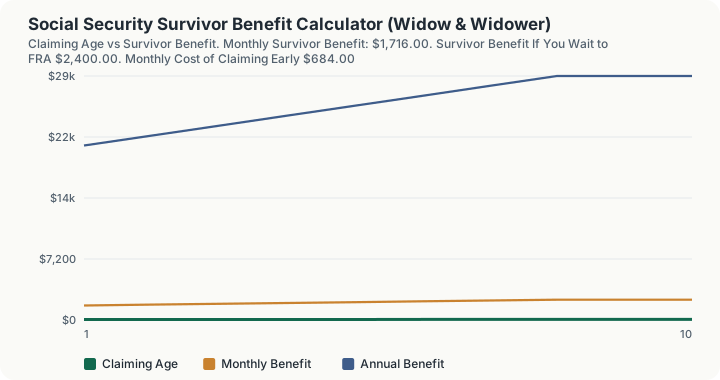
Quick Answer: A widow or widower born in 1962 claiming at 60 on a deceased spouse's $2,400 benefit receives $1,716.00 a month: 71.5%, the maximum reduction of 28.5%. Waiting to their Full Retirement Age of 67 would pay the full $2,400. The survivor benefit and their own benefit are separate claims: taking one early does not stop the other growing to $1,984 by 70.
What does this calculator do?
Survivor benefits are the most misunderstood part of Social Security, and the misunderstanding is expensive.
A surviving spouse can claim from age 60, far earlier than any other benefit, but at a reduction of up to 28.5%. The reduction shrinks to nothing at the survivor's own Full Retirement Age, at which point the survivor benefit equals 100% of what the deceased was receiving or entitled to.
The point most people miss is that the survivor benefit and the survivor's own retirement benefit are independent claims. You can take one early and let the other grow. That flexibility does not exist for spousal benefits during a spouse's lifetime, and it is the single most valuable feature of the survivor rules.
How is this calculated?
The survivor factor. Claiming at Full Retirement Age or later pays 100%. Claiming earlier reduces the benefit proportionally across the window from age 60 to FRA, to a maximum reduction of 28.5%:
Factor = 1 − 0.285 × (months early)/(months from 60 to FRA)
Your own benefit follows the standard worker rules: reduced for claiming before FRA, and increased by delayed retirement credits of 8% a year up to age 70.
The two are then compared. You receive the higher of the two at any given time, and because they are separate claims you can sequence them.
Worked Example
A widow born in 1962 whose late husband was drawing $2,400 a month. Her own record would pay $1,600 at her Full Retirement Age, and she wants to know what claiming at 60 costs her.
Step 1: Her Full Retirement Age. Born 1962, so FRA is 67 years 0 months
Step 2: Months claimed early. From 60 to 67 is 84 months, and she is claiming at the very start of that window, so all 84 months are early
Step 3: The survivor reduction factor. 1 - 0.285 x (84 / 84) = 71.5%, the maximum reduction the rules allow
Step 4: The monthly survivor benefit. $2,400 x 71.5% = $1,716.00
Step 5: The annual figure. $1,716.00 x 12 = $20,592.00
Step 6: What waiting to FRA would have paid. $2,400 x 100% = $2,400.00, so claiming early costs $684.00 a month
Step 7: Her own benefit, left alone until 70. Three years of delayed retirement credits past FRA at 8% a year gives a factor of 124.0%, so $1,600 x 124% = $1,984.00
Step 8: The sequence. Draw $1,716.00 from 60, then switch to $1,984.00 at 70, an uplift of $268.00 a month
The calculator reports this as Take the survivor benefit now, switch to your own at 70. The crucial fact is that step 7 is unaffected by steps 3 through 6. The survivor claim and the worker claim are separate entitlements, so ten years of reduced survivor payments cost her nothing at all in delayed retirement credits on her own record.
The claiming ladder, year by year
The reduction unwinds in a straight line across the 84 months, which the computed schedule makes plain:
Step 9: Claiming at 60. $1,716.00 a month, $20,592.00 a year
Step 10: Claiming at 61. $1,813.71 a month, $21,764.52 a year
Step 11: Claiming at 64. $2,106.86 a month, $25,282.32 a year
Step 12: Claiming at 67, her FRA. $2,400.00 a month, $28,800.00 a year, and it stops rising after that
Each year of waiting adds $97.71 a month, or $1,172.52 a year, and the ladder flattens permanently at FRA. There are no delayed retirement credits on a survivor benefit, which is why 67 and 70 pay the same $2,400: a difference from the worker rules that catches people out.
Three variations that change the answer
Step 13: Waiting to FRA for the survivor benefit instead. $2,400.00, which beats her own maximum of $1,984.00, so the sequencing reverses: the survivor benefit becomes the permanent claim
Step 14: If her own record only paid $700 at FRA. Her own benefit at 70 is $700 x 124% = $868.00, below the reduced survivor benefit of $1,716.00, and the calculator reports that her own benefit never overtakes it
Step 15: If she claimed her own at 62 rather than 70. The worker factor falls to 70.0%, giving $1,600 x 70% = $1,120.00, again below $1,716.00
Steps 14 and 15 are the same failure from two directions. The sequencing strategy is only worth something when one claim can grow past the other; a weak own record or an early own claim both collapse that gap, and the survivor is left on the lower of the two numbers for life.
What does this calculator not account for?
- The RIB-LIM rule. If the deceased claimed before their own FRA, the survivor benefit is capped at the greater of what the deceased was actually receiving or 82.5% of their primary insurance amount. This calculator uses the benefit figure you enter.
- The earnings test. Claiming before FRA while still working can withhold benefits, though they are recomputed later.
- Disabled widows and widowers, who may claim from age 50.
- Surviving divorced spouses, generally eligible on a marriage of ten years or more.
- Child-in-care benefits, payable at any age where a child under 16 is in the survivor's care.
- The one-time $255 lump sum death payment.
- The family maximum, which caps total benefits payable on one record.
- Remarriage. Remarrying before 60 generally ends eligibility; after 60 it does not.
- The Government Pension Offset, for survivors with a non-covered government pension.
- Taxation of benefits, and cost-of-living adjustments.
What mistakes do people make with this?
- Believing you must claim both benefits together. You do not. This is the central planning opportunity, and missing it can cost tens of thousands over a retirement.
- Claiming your own benefit early out of habit. If your own record will exceed the survivor benefit by 70, taking it at 62 permanently forfeits that. Here it drops from $1,984 to $1,120.
- Assuming the survivor benefit keeps growing past FRA. It does not. Delayed retirement credits apply to your own benefit, not to survivor benefits, so there is no reason to delay a survivor claim beyond your FRA.
- Overlooking the RIB-LIM cap. If the deceased claimed early, the survivor benefit may be limited regardless of their primary insurance amount.
- Remarrying just before 60. Remarriage before 60 generally ends survivor eligibility; waiting until after preserves it.
- Forgetting the earnings test. Working while claiming before FRA can withhold benefits temporarily.
Frequently Asked Questions
When can I claim a survivor benefit?
How much is the reduction for claiming at 60?
Can I take the survivor benefit and switch to my own later?
Should I always delay the survivor benefit?
Does remarrying affect my survivor benefit?
What if the deceased claimed early?
Sources
- Social Security Administration, POMS RS 00615.301: the widow(er)'s insurance benefit reduction is limited to 28.5%, so benefits start at 71.5% at age 60 and reach 100% at the survivor's full retirement age. secure.ssa.gov/poms.nsf/lnx/0300615301
- Social Security Administration, Survivor benefits. ssa.gov/benefits/survivors
Also consulted: Full Retirement Age by birth year is read from the engine's SSA table; Delayed retirement credits of 8% a year to age 70 apply to the survivor's own retirement benefit only, not to survivor benefits.