Quick Answer: With €100,000 already accumulated in your INPS notional contribution pot and one more year of work at a €40,000 salary before retiring at 67, the 2026 GDP-linked revaluation and 33% contribution rate build the pot to €117,244.50, producing an estimated €6,575.07 annual gross pension -- about €505.77 per month, paid over 13 installments.
Overview
Since 1996, Italy's public pension system has run -- for contributions after that date -- on the metodo contributivo (contribution-based method): rather than basing your pension on your final salary, INPS tracks a personal notional account called the montante contributivo, built from a fixed percentage of your gross salary contributed every year and revalued annually at a rate tied to national economic growth. At retirement, that accumulated pot is converted into an annual pension using a coefficiente di trasformazione (transformation coefficient) that depends entirely on your age at the moment you claim -- the older you are when you retire, the higher the coefficient, because your expected remaining years of payout are shorter.
This calculator runs that exact mechanism forward, year by year, using the verified 2025-2026 transformation coefficient table and a user-adjustable assumption for the annual revaluation rate (INPS's own 2026 published rate defaults in automatically).
How This Is Calculated
Step 1 -- Annual contribution, added to the montante every year:
A private-sector employee's rate is 33% (9.19% employee + 23.81% employer, both paid into the same fund).
Step 2 -- Annual revaluation of the prior year-end montante, at INPS's published GDP-linked rate (4.0445% for 2026):
Step 3 -- Convert to a pension at retirement, using the age-specific transformation coefficient:
The verified 2025-2026 transformation coefficient table (Decreto Ministeriale n. 436/2024):
| Age | Coefficient | Age | Coefficient | Age | Coefficient |
|---|---|---|---|---|---|
| 57 | 4.204% | 62 | 4.795% | 67 | 5.608% |
| 58 | 4.308% | 63 | 4.936% | 68 | 5.808% |
| 59 | 4.419% | 64 | 5.088% | 69 | 6.024% |
| 60 | 4.536% | 65 | 5.250% | 70 | 6.258% |
| 61 | 4.661% | 66 | 5.423% | 71 | 6.510% |
Worked Example
Using a scenario with an existing €100,000 montante, one more year at a €40,000 salary, retiring at age 67:
- Contribution: €40,000 × 33% = €13,200.00.
- Revaluation: €100,000 × 4.0445% = €4,044.50.
- New montante: €100,000 + €4,044.50 + €13,200.00 = €117,244.50.
- Transformation coefficient at age 67: 5.608%.
- Annual gross pension: €117,244.50 × 5.608% = €6,575.07.
- Monthly gross pension: €6,575.07 ÷ 13 = €505.77.
Now compare a longer 3-year build-up from zero, at a flat €30,000 salary with 0% assumed revaluation (an intentionally simple case): each year contributes €9,900 (€30,000 × 33%), reaching a final montante of €29,700.00 at age 67. Applying the same 5.608% coefficient produces an annual gross pension of €1,665.58, or €128.12 per month -- illustrating just how much the size of the accumulated montante (not only the coefficient) drives the final pension.
Carrying The Montante Across A Full Career
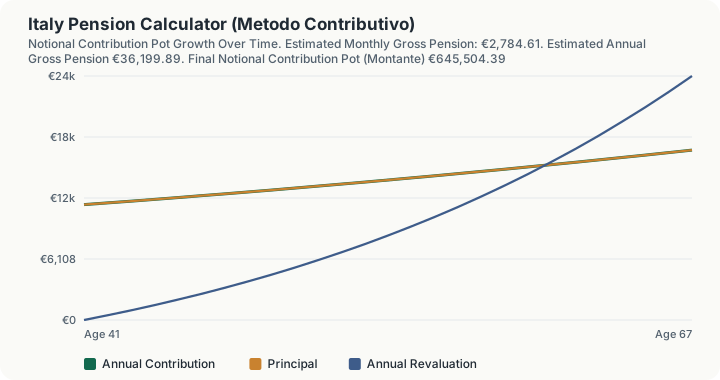
The one-year case above isolates the mechanism. Run the calculator's default instead -- a 40-year-old on €35,000 starting from zero, retiring at 67 -- and the accumulation is what the montante system actually rewards.
- Age 41: contribution €11,550.00, revaluation €0 because there is no opening balance to revalue, montante €11,550.00.
- Age 42: contribution €11,723.25, revaluation €467.14, montante €23,740.39.
- Age 61, the crossover: revaluation of €15,845.40 exceeds the €15,556.18 contributed that year for the first time.
- Age 67: revaluation in the final year alone is €24,431.34, and the montante closes at €645,504.39.
- The accumulated split: the schedule's cumulative contributions are €380,996.19, so €645,504.39 - €380,996.19 = €264,508.20 of revaluation.
Forty-one percent of the final montante was never contributed by anyone -- it is the compounded nominal GDP revaluation. That is why a career interrupted at 50 costs far more than half a career's pension, and why the revaluation rate assumption deserves as much attention as the salary path.
What This Does Not Account For
- Eligibility requirements. This calculator projects a pension AMOUNT; it does not check whether you meet INPS's minimum age and contribution-history requirements for the specific pension type you're pursuing (pensione di vecchiaia, anticipata, and others each have their own thresholds).
- The "quota retributiva" for pre-1996 contributions. Workers with contribution history before 1 January 1996 have a portion of their pension calculated under the older, more generous salary-based (retributivo) method -- this calculator is a pure metodo contributivo projection and does not blend in any retributivo component.
- IRPEF taxation of the resulting pension. Pension income is itself taxable under ordinary IRPEF rules (with some specific deductions for pensioners) -- this calculator shows the GROSS pension only, not what you'd actually receive after tax.
- Career interruptions, part-time work, or contribution gaps. This is a straight-line projection at a single (optionally growing) salary -- real careers with gaps, part-time periods, or unemployment spells will accumulate a different montante than this simplified model shows.
- Self-employed contribution-rate precision. The 24%-26% band commonly cited for Gestione Artigiani e Commercianti (self-employed artisans/traders) is exposed as an editable input rather than a hardcoded figure, given lower confidence on the exact current-year rate for that specific fund -- confirm your own rate with INPS.
- Future changes to the revaluation rate or transformation coefficients. Both are reviewed periodically (the transformation coefficients every two years, the revaluation rate annually) -- a long projection horizon assumes your input rates hold constant, which real INPS practice does not guarantee.
Common Pitfalls
- Assuming a higher retirement age always means more total pension income. A higher age gives a higher ANNUAL coefficient (rewarding a shorter expected payout period), but retiring later also means fewer total years of payments -- this calculator shows the annual/monthly amount, not lifetime total income, which depends on how long you live after claiming.
- Confusing the contribution rate with your net paycheck deduction. The 33% figure is the TOTAL rate (employee + employer combined); the amount actually withheld from your paycheck (9.19%) is only part of it -- the employer's larger 23.81% share doesn't appear on your payslip but still builds your montante.
- Using an unrealistically high revaluation-rate assumption for a decades-long projection. The rate is tied to actual 5-year average nominal GDP growth and moves year to year -- the 2026 figure (4.0445%) may not represent a reasonable multi-decade average; stress-test your projection with a lower long-run assumption too.
- Forgetting pensions are paid in 13 installments, not 12. Italian pensions include a "tredicesima" -- always divide the annual figure by 13, not 12, to get the correct monthly amount.
- Treating the coefficient table as static forever. The values shown here are specifically for the 2025-2026 biennium; INPS revises this table periodically as life-expectancy data updates, and coefficients for a future biennium will differ.
Frequently Asked Questions
How is the Italian contributory pension calculated?
What are the current INPS transformation coefficients?
Why does retiring later increase my transformation coefficient?
What contribution rate should I use if I'm self-employed?
Is the montante revaluation rate fixed?
Does this calculator account for taxes on my pension?
What if I have contribution history from before 1996?
Sources
- Italian Revenue Agency (Agenzia delle Entrate), the official authority for the national tax authority this calculator relates to. agenziaentrate.gov.it
Caveat: a fourth secondary source (miapensione.com) showed different figures for several mid-range ages that did not match the other three concordant sources and were rejected as likely stale/prior-biennium data. The exact self-employed (Gestione Artigiani e Commercianti) contribution rate, IRPEF taxation of pension income, and pre-1996 "quota retributiva" blending were not modeled and are disclosed above as out of scope.
Also consulted: Contribution rate (33% total IVS, FPLD private-sector employees): long-standing, widely-cited figure, confirmed via current 2026 coverage (funnifin.com); Revaluation of the montante contributivo for pensions taking effect in 2026: INPS messaggio Hermes n. 707 of 27 February 2026 set the capitalisation coefficient at 1.040445, a rate of 4.0445%, following ISTAT's finding that the compound average annual change in nominal GDP over the five years preceding 2025 was 0.040445. Verified 2026-08-28. An earlier 3.6622% figure carried on this page was the coefficient applying to the balance at the end of 2023, not the 2026 rate; Transformation coefficient table, 2025-2026 biennium (Decreto Ministeriale n. 436/2024, 20 November 2024): independently cross-verified across three concordant secondary sources (a 4Manager/Studio Legale Pessi e Associati slide deck, brocardi.it, centroservizipanvini.it), all reproducing an identical 15-value table for ages 57-71.