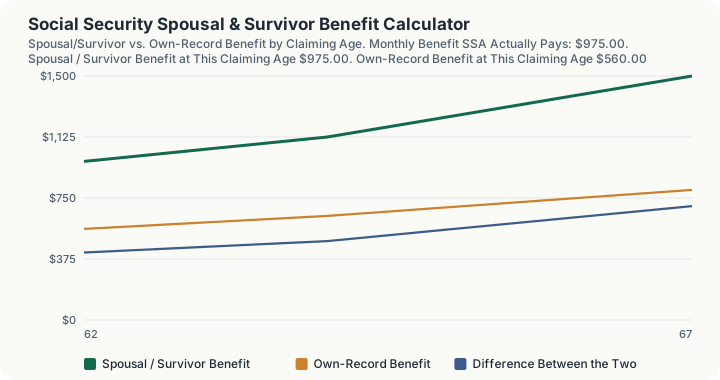
Quick Answer: A spousal benefit tops out at 50% of the higher earner's Primary Insurance Amount (PIA), and a survivor benefit tops out at 100% of it; both are reduced for claiming early, and Social Security always pays you the larger of that benefit or your own-record worker benefit, never both stacked together. On a $3,000 PIA, a non-working spouse claiming a spousal benefit at 62 receives $975.00 a month, not $1,500.
Overview
Social Security's spousal and survivor benefits exist to protect a lower-earning or non-working spouse from ending up with a much smaller retirement income than the household enjoyed while both spouses were alive and working. A spousal benefit lets the lower earner claim up to 50% of the higher earner's PIA while the higher earner is still living. A survivor (widow or widower) benefit lets a surviving spouse claim up to 100% of the deceased spouse's benefit after the higher earner has died. Both are separate from, and calculated differently than, the reduction schedule that applies to a worker's own retirement benefit.
A common misunderstanding is that these benefits stack: that a spouse could collect their own worker benefit plus the full spousal or survivor amount on top. They cannot. Social Security Administration (SSA) rules pay the larger of the two amounts, computed independently, never both in full. In practice SSA administers this as the worker's own benefit plus an "excess" top-up equal to the gap between the spousal/survivor amount and the own-record amount, which nets out to exactly the higher of the two figures, the same result this calculator reports directly.
Both benefit types are also reduced if claimed before the claiming spouse's own Full Retirement Age (FRA), and the reduction formulas are different from each other and from the worker's own-record reduction schedule. Getting the right formula matters: the spousal reduction is steeper per month than the worker reduction over the same early-claiming window, and the survivor reduction uses a completely different structure built around a fixed 28.5% maximum cut rather than fraction-per-month tiers.
How This Is Calculated
Step 1: Determine the claiming spouse's Full Retirement Age. FRA is 67 for anyone born in 1960 or later, and ranges down to 65 for those born in 1937 or earlier, based on the standard SSA birth-year schedule.
Step 2: Apply the correct early-claiming reduction for the selected benefit type.
For a spousal benefit, the reduction is 25/36 of 1% for each of the first 36 months claimed before FRA, then 5/12 of 1% for each additional month beyond that:
where m is the number of months claimed before FRA. At FRA 67, claiming at exactly 62 (60 months early) produces a 35% reduction, leaving a factor of 0.65. The spousal benefit itself is then $\text{Higher Earner's PIA} \times 0.50 \times \text{Spousal Factor}$. Spousal benefits do not earn delayed retirement credits; waiting past FRA never increases the amount above the 50% ceiling.
For a survivor benefit, the maximum reduction is a flat 28.5%, spread evenly across every month from the earliest survivor claiming age of 60 up to the survivor's own FRA:
At FRA 67 that window is 84 months, so claiming exactly at 60 produces the full 28.5% cut, leaving a factor of 0.715. The survivor benefit is $\text{Deceased Spouse's Benefit} \times \text{Survivor Factor}$, with no 50% ceiling since survivors can receive up to the full amount.
Step 3: Compute the own-record comparison and report the higher figure. The claiming spouse's own worker benefit uses the standard own-record reduction (5/9 of 1% per month for the first 36 months early, 5/12 of 1% per month beyond that, since own-record benefits cannot start before age 62). This calculator computes both amounts and reports whichever is larger as the actual benefit SSA pays.
Worked Example
A couple where the higher earner has a $3,000 PIA and the claiming (lower-earning) spouse has an $800 own PIA and was born in 1962, giving an FRA of 67.
- Scenario A, spousal benefit claimed at 62: 60 months early produces a spousal factor of 0.65. Spousal amount: $3,000 × 0.50 × 0.65 = $975.00. Own-record amount at the same age: $800 × 0.70 = $560.00. SSA pays the higher figure, $975.00, since the spousal benefit wins.
- Scenario B, same couple, spousal benefit claimed at FRA (67) instead: No reduction applies. Spousal amount: $3,000 × 0.50 = $1,500.00. Own-record amount: $800 × 1.00 = $800.00. SSA still pays the spousal figure, now the full $1,500.00, nearly 54% higher than claiming at 62.
- Scenario C, the higher earner has since died and the same spouse claims a survivor benefit at 60 instead: Survivor factor at 60/FRA67 is 0.715. Survivor amount: $3,000 × 0.715 = $2,145.00, compared to an own-record amount (priced at the earliest worker-eligible age of 62) of $800 × 0.70 = $560.00. The survivor benefit wins by a wide margin, illustrating why survivor benefits are frequently the larger of the two options even when claimed early.
Coordinating Claiming Ages Within a Household
Because spousal benefits cap at 50% of the higher earner's PIA regardless of when the higher earner claims their own benefit, and survivor benefits are based on the amount the higher earner was actually receiving (or would have received) at death, a common household strategy is for the higher earner to delay their own claim toward age 70. Doing so maximizes both the higher earner's own monthly check and the eventual survivor benefit the lower earner will fall back to, since a larger deceased-spouse benefit produces a larger survivor benefit base. The lower earner's own spousal claiming age decision is comparatively lower-stakes, since it only affects the (already capped) spousal amount, not the eventual survivor amount.
What This Does Not Account For
- The earnings test. Claiming before FRA while still working above the annual earnings limit temporarily withholds part of the benefit; this calculator does not model that withholding.
- Deemed filing rules for benefits first available after January 2, 1954. Filers born after that date are deemed to file for both their own retirement benefit and any available spousal benefit simultaneously, and cannot selectively file for one first. This calculator computes the comparison but does not model the mechanical filing-order restrictions.
- Taxation of benefits. Up to 85% of Social Security benefits, including spousal and survivor benefits, can be subject to federal income tax depending on provisional income; this calculator reports gross, pre-tax amounts.
- The disabled widow(er) benefit, available as early as age 50 at a flat 71.5% rate, which follows a different rule than the age-60-to-FRA linear reduction modeled here.
- The divorced-spouse and remarriage rules that govern eligibility for spousal or survivor benefits after a marriage of at least 10 years ends, or after a surviving spouse remarries.
- The family maximum benefit, a cap on the total amount payable to a family from one worker's earnings record, which can reduce individual spousal or survivor amounts below what this calculator computes when multiple family members claim on the same record simultaneously.
Common Pitfalls
- Assuming spousal and survivor benefits use the same reduction formula. They do not. The spousal reduction (25/36 of 1% for the first 36 months) is meaningfully steeper than the worker's own-record reduction (5/9 of 1% for the first 36 months) over the identical early-claiming window, while the survivor reduction uses an entirely different linear-spread structure.
- Believing the benefits stack. A household cannot collect a full own-record benefit plus a full spousal or survivor benefit on top; SSA pays only the higher of the two.
- Assuming a 50%-of-PIA spousal benefit is available at any claiming age. The 50% figure is the maximum, available only at FRA; claiming early always produces less than half the higher earner's PIA.
- Forgetting the survivor benefit is based on the deceased's actual benefit, not simply their PIA, if the deceased had already started claiming before their own FRA or after it with delayed credits.
- Overlooking that survivor benefits can start two full years earlier (age 60) than spousal or worker benefits (age 62), and are a meaningfully different early-claiming decision as a result.
Frequently Asked Questions
Can I claim a spousal benefit if I have never worked?
Does delaying past my FRA increase my spousal benefit?
Why is the survivor benefit reduction structured so differently from the spousal reduction?
If my own-record benefit is larger, do I lose access to the spousal or survivor benefit entirely?
Can I switch from a survivor benefit to my own worker benefit later, or vice versa?
Sources
- Social Security Administration, Handbook §724, Basic Reduction Formulas, ssa.gov/OP_Home/handbook/handbook.07/handbook-0724.html
- Social Security Administration, Handbook §407, Amount of Widow(er)'s Insurance Benefit, ssa.gov/OP_Home/handbook/handbook.04/handbook-0407.html
- Social Security Administration, Receiving Survivors Benefits Early, ssa.gov/benefits/survivors/survivorchartred.html
- Social Security Administration, Retirement Benefits: Early or Late Retirement (Full Retirement Age chart), ssa.gov/benefits/retirement/planner/agereduction.html
- Code of Federal Regulations, 20 CFR §404.410, ssa.gov/OP_Home/cfr20/404/404-0410.htm