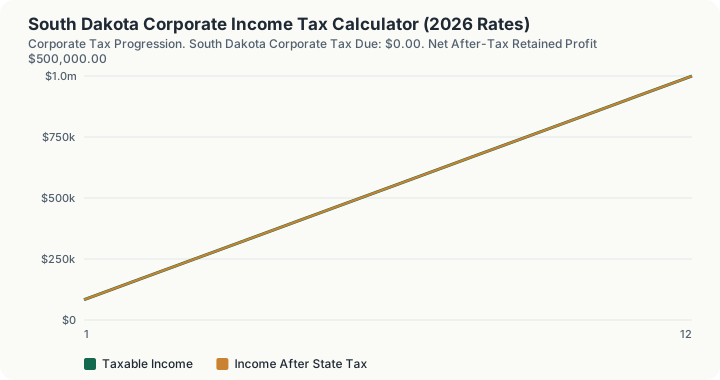
Quick Answer: On $500,000 of pre-apportioned taxable income, South Dakota imposes no general state-level corporate income tax, so state tax due is $0.00 and net after-tax profit equals the full $500,000 (before any separate federal tax liability).
How This Is Calculated
South Dakota is carried in the rate table with a type of "none", a rate of 0, an empty bracket list and a zero-tax flag set true. That flag is tested at the top of the state corporate tax routine, before any rate logic runs, and it returns immediately. Nothing on this page is multiplied by anything.
- The zero-tax branch short-circuits the calculation. The engine checks the zero-tax flag first and returns a result with tax, effective rate and marginal rate all set to zero. The flat-rate and graduated-bracket code paths are never reached for South Dakota, so there is no rate to apply and no bracket to look up.
- The income input changes nothing. Sweeping apportioned income from $0 to $50,000,000 in $10,000,000 steps returns $0.00 at every point, with a delta of $0.00 between each. The same holds at every intermediate value the input accepts, up to its $1,000,000,000 ceiling.
- The credit input is inert. Credits are subtracted from a liability that is already zero and the result is clamped at zero, so $0, $1,000, $2,000, $3,000 and $4,000 of credits all return $0.00 with a delta of $0.00. The first credit dollar is worth nothing here, not merely the last one.
- Both rate outputs read 0.00%. On the other pages in this family the effective rate and the marginal rate diverge once credits are entered. Here they cannot, because both are zero for every combination of inputs.
- Net retained profit equals apportioned income exactly. On the $500,000 default the engine returns $500,000.00 of retained profit, because the amount subtracted is $0.00.
- The 12-row table scales income and returns zero on each row. Row i is income times i over 6, so the rows run from $83,333.33 up to $1,000,000 on the default input. The tax column reads $0.00 on all twelve, and the after-tax column reproduces the income column identically.
Worked Example
Using this calculator's baseline scenario: a corporation with $500,000 in taxable income apportioned to South Dakota.
- Start with apportioned taxable income. The corporation has $500,000 of taxable business income apportioned to South Dakota.
- Look up the South Dakota entry. The zero-tax flag is set, so the engine returns before applying any rate: $500,000 with no rate applied is $0.00.
- South Dakota state corporate income tax due: $0.00.
- Net retained profit. The corporation retains the full $500,000.00 apportioned to South Dakota.
This calculator computes only the South Dakota state corporate income tax shown above. It does not compute, model or include federal corporate income tax, which remains due on these earnings independently of South Dakota's lack of a state-level tax.
There Is No Threshold Here, and the Sweep Proves It
On a graduated schedule the useful question is what happens one dollar past a bracket edge. South Dakota has no schedule at all, so the honest answer is that no such edge exists anywhere in this calculator, and the 12-row sweep is the evidence rather than an assertion.
At $10,000,000 of apportioned income. State tax due is $0.00.
At $20,000,000, ten million dollars later. State tax due is $0.00. The step cost is $0.00.
At $30,000,000, $40,000,000 and $50,000,000. State tax due is $0.00 at each, with a delta of $0.00 between every consecutive pair.
The marginal rate output holds at 0.00% throughout, and so does the effective rate. There is no income at which the two diverge, no income at which the step size changes, and no income up to the input maximum of $1,000,000,000 that produces a positive figure.
The Marginal Cost of the Next Dollar of South Dakota Income
Each additional $1,000 of apportioned South Dakota income costs $0.00 in state corporate income tax. So does each additional $1,000,000. The reverse question, how much can be earned before crossing into a taxable band, has no upper answer within this model: the ceiling is the input ceiling, not a tax threshold.
That is the whole result, and it is worth stating precisely because it is not the same claim as "South Dakota is a no-tax state". This engine models a corporate income tax and finds none. It does not model, and returns nothing for, the taxes South Dakota does levy.
What the Credit Input Is Worth Here, Which Is Nothing
On the taxing pages in this family, credits are the one real cliff: the last dollar of credit that offsets a liability is worth a full dollar and the next is worth zero. South Dakota has no such boundary because the liability starts at zero.
With $0 of credits. State tax due is $0.00.
With $1,000 of credits. State tax due is $0.00. The credit bought nothing.
With $4,000 of credits. State tax due is $0.00 still, an unchanged delta of $0.00 at every step in between.
A South Dakota credit entered into this calculator is worth $0.00 from the first dollar to the last, and the engine's zero floor means that will not change at any income level. The input is present because the calculator shares a config shape with the taxing states, not because it does anything here.
Right Method Against Wrong Method, Priced at Zero
The common error is importing a substitute levy into the income tax result. A corporation used to a state where a gross receipts tax replaces the income tax may assume this page's $0.00 is an income tax figure with a receipts figure to be added on top.
Correct reading of this output. The $0.00 returned at $500,000 of income, and at every income up to $50,000,000, is the South Dakota corporate income tax, and this engine computes no other South Dakota tax of any kind.
Incorrect reading. Treating the $0.00 as though a receipts-based liability had been netted into it, or expecting the engine to surface one. No gross receipts computation exists in this code path, so a receipts tax would not appear in the output whether or not one applied.
The dollar price of the confusion is zero here and non-zero on comparable pages, which is exactly why it matters to say which of the two you are looking at. The figure this calculator returns is a complete answer to one narrow question and silent on every other.
What This Does Not Account For
- The separate franchise tax on financial institutions. Banks doing business in South Dakota are taxed on net income under a different regime. This engine returns $0.00 for them along with everyone else, because the state lookup happens before any entity-type test and no such test exists.
- State and municipal sales and use tax. No receipts figure is an input here and no sales tax is computed at any point in the code path.
- Tax owed to other states. Income apportioned elsewhere remains taxable elsewhere. This page computes a single state's liability from a single apportioned income figure and has no visibility into the rest of the return.
- Federal corporate income tax (21% under IRC § 11).
- Entity filing and annual report charges.
- Base Erosion and Anti-Abuse Tax (BEAT) or Global Intangible Low-Taxed Income (GILTI) provisions.
- Local municipal corporate earnings taxes (e.g. NYC General Corporation Tax).
Common Pitfalls
- Reading $0.00 as the Total State Burden: The engine computes a corporate income tax only. The sales and use tax South Dakota does levy is absent from every figure on this page, at every input.
- Expecting the Credit Input to Do Something: $0, $1,000 and $4,000 of credits all return $0.00. Entering a credit here changes no output.
- Assuming the Financial Institution Exception Is Modelled: It is not. A bank entering $500,000 of apportioned income gets the same $0.00 as any other filer.
- Reading the Tier Table as a Timeline: The twelve rows scale income from $83,333.33 to $1,000,000 on the default input, all returning $0.00 of tax. They are income scenarios, not tax years.
Frequently Asked Questions
Does South Dakota have a corporate income tax?
What does an extra $1,000,000 of South Dakota income cost?
Do state tax credits reduce anything on this page?
When are South Dakota corporate tax returns due?
Does South Dakota tax S-corporations and LLCs?
Sources
- South Dakota Department of Revenue: Corporate Tax Statutes and Guidance (2026). dor.sd.gov
- Multistate Tax Commission (MTC): Uniform Apportionment and Allocation Guidelines. mtc.gov