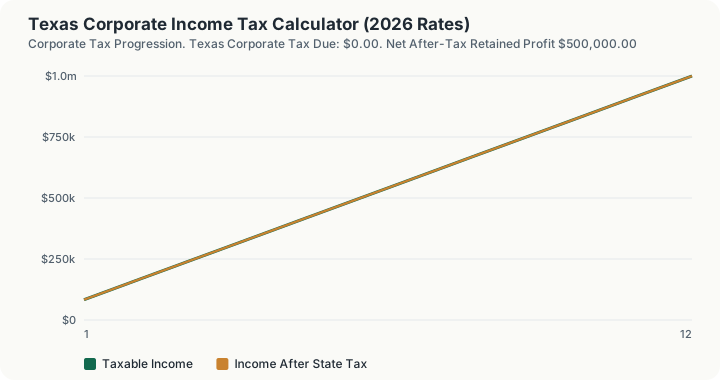
Quick Answer: On $500,000 of pre-apportioned taxable income, Texas imposes no general state-level corporate income tax, so state tax due is $0.00 and net after-tax profit equals the full $500,000 (before any separate federal tax liability).
How This Is Calculated
Texas sits in the rate table with a type of "gross_receipts", a rate of 0, an empty bracket list and a zero-tax flag set true. The engine tests that flag before it reaches any rate logic and returns immediately with tax, effective rate and marginal rate all at zero. The important consequence is stated plainly below: the type label says "gross receipts" but no gross receipts computation exists anywhere in this code path.
- The zero-tax branch returns before anything is calculated. No rate is applied, no bracket is walked, and the income you enter is never multiplied by anything.
- The income input does not move the result. Sweeping apportioned income from $0 to $50,000,000 in $10,000,000 steps returns $0.00 at every point, with a delta of $0.00 between each pair. The same holds up to the input ceiling of $1,000,000,000.
- The credit input is inert from the first dollar. Credits are netted against a zero liability and clamped at zero: $0, $1,000, $2,000, $3,000 and $4,000 of credits all return $0.00, every delta $0.00.
- Both rate outputs read 0.00% and never diverge. On the flat-rate pages in this family the effective rate drops below the marginal rate once credits are entered. Here there is nothing for a credit to reduce, so the two outputs are locked together at zero.
- Net retained profit equals apportioned income. On the $500,000 default the engine returns $500,000.00, because $0.00 was subtracted.
- The 12-row table returns zero on every row. Row i is income times i over 6, running from $83,333.33 to $1,000,000 on the default input, with $0.00 of tax on each and an after-tax column identical to the income column.
Worked Example
Using this calculator's baseline scenario: a corporation with $500,000 in taxable income apportioned to Texas.
- Start with apportioned taxable income. The corporation has $500,000 of taxable business income apportioned to Texas.
- Look up the Texas entry. The zero-tax flag is set, so the engine returns before any rate is applied: $0.00.
- Texas state corporate income tax due: $0.00.
- Net retained profit. The corporation retains the full $500,000.00 apportioned to Texas.
This calculator computes only the Texas state corporate income tax shown above. Federal corporate income tax remains due on these earnings and is computed nowhere on this page.
The Franchise Tax Is Not Modelled, and That Is the Whole Story Here
This is the most important limitation on the page and it deserves an exact statement rather than a caveat at the bottom.
Texas does tax business activity. It does so through the franchise tax, commonly called the margin tax, assessed on taxable margin rather than on net profit. This calculator does not compute it. Not partially, not approximately, not with a simplifying assumption. The engine's Texas entry carries a zero-tax flag, the flag is tested before any arithmetic runs, and the return value is $0.00 for every input combination the calculator will accept.
That means the $0.00 shown at $500,000 of income is a complete and correct answer to the question "what is the Texas corporate income tax", and it is not an answer at all to "what does this business owe Texas". A Texas entity whose real liability is entirely a margin tax liability sees $0.00 here at every income level. The output cannot distinguish a business that owes Texas nothing from one that owes a substantial franchise tax bill, because it does not model the base that distinguishes them.
The gap runs in a direction worth naming. The franchise tax is measured on margin, which does not track profit, so a business reporting a loss can owe Texas franchise tax while this calculator returns $0.00, and a profitable business below the no-tax-due revenue threshold can owe nothing while this calculator also returns $0.00. Identical output, opposite situations. No input on this page carries revenue, cost of goods sold or compensation, so there is nothing the engine could use to tell them apart even in principle.
The Sweep Has No Threshold to Walk
On a graduated page the sweep exists to expose a bracket edge. Texas has no bracket, no rate and no edge, and the computed sweep says so at every scale.
At $10,000,000 of apportioned income. Texas state corporate income tax due is $0.00.
At $20,000,000, ten million later. Still $0.00. The step cost is $0.00.
At $30,000,000, $40,000,000 and $50,000,000. $0.00 at each, with a delta of $0.00 between every consecutive pair, and a marginal rate output that never leaves 0.00%.
Each additional $1,000 of apportioned Texas income costs $0.00 in state corporate income tax, and so does each additional $10,000,000. The reverse question, how much can be earned before crossing into a taxable band, has no answer inside this model: the highest figure the input accepts, $1,000,000,000, still returns $0.00.
What the Credit Input Buys, Which Is Nothing
The taxing pages in this family have one real cliff, on the credit input, where the last dollar of credit offsetting a liability is worth a full dollar and the next is worth zero. Texas has no such boundary because there is no liability to offset.
With $0 of credits. Texas tax due is $0.00.
With $1,000 of credits. Texas tax due is $0.00, a delta of $0.00.
With $4,000 of credits. Texas tax due is $0.00, and every step between reads the same.
A Texas credit entered here is worth $0.00 from its first dollar, not merely past some threshold. The field exists because this calculator shares a configuration shape with the flat-rate states, not because it changes any output.
Right Method Against Wrong Method, and What the Mistake Hides
Correct reading of this output. The $0.00 returned at $500,000, and at every income up to $50,000,000, is the Texas corporate income tax and nothing else. It is a true figure about a narrow question.
Incorrect reading. Treating that $0.00 as the total Texas state tax on the business, or assuming the "gross_receipts" type label in the rate table means a receipts-based figure has been computed and netted into the result. It has not. The label describes how Texas raises revenue; the code below it computes zero and stops.
The error is not priced in dollars on this page, and that is precisely the problem: the unmodelled franchise tax could be any amount, and this calculator gives no signal about its size. Every other page in this family lets you price the mistake against a computed alternative. Here the correct action is to compute the margin tax elsewhere, because nothing on this page will approximate it.
What This Does Not Account For
- The Texas franchise tax (margin tax). Not computed at any input. The engine has no revenue, cost of goods sold, compensation or apportionment inputs, and returns $0.00 for every entity regardless of margin.
- The no-tax-due revenue threshold. No revenue figure is an input, so the threshold is never tested.
- Tax owed to other states. Income apportioned elsewhere remains taxable elsewhere and is invisible to this single-state computation.
- Federal corporate income tax (21% under IRC § 11).
- Entity filing and annual report charges.
- Base Erosion and Anti-Abuse Tax (BEAT) or Global Intangible Low-Taxed Income (GILTI) provisions.
- Local municipal corporate earnings taxes (e.g. NYC General Corporation Tax).
Common Pitfalls
- Assuming 0.00% Means Zero Texas Tax: The franchise tax applies to margin regardless of profit or loss and is absent from every figure this page produces, at every input.
- Reading the Rate Table Type as a Computation: Texas is typed "gross_receipts" in the data, but the zero-tax flag is tested first and no receipts arithmetic runs.
- Expecting the Credit Input to Change Anything: $0, $1,000 and $4,000 of credits all return $0.00.
- Reading the Tier Table as a Timeline: The twelve rows scale income from $83,333.33 to $1,000,000 on the default input, returning $0.00 of tax on each. They are income scenarios, not tax years.
Frequently Asked Questions
Does Texas have a corporate income tax?
Does this calculator compute the Texas franchise tax?
What does an extra $10,000,000 of Texas income cost?
When are Texas corporate tax returns due?
Does Texas tax S-corporations and LLCs?
Sources
- Texas Comptroller of Public Accounts: Corporate Tax Statutes and Guidance (2026). comptroller.texas.gov
- Multistate Tax Commission (MTC): Uniform Apportionment and Allocation Guidelines. mtc.gov