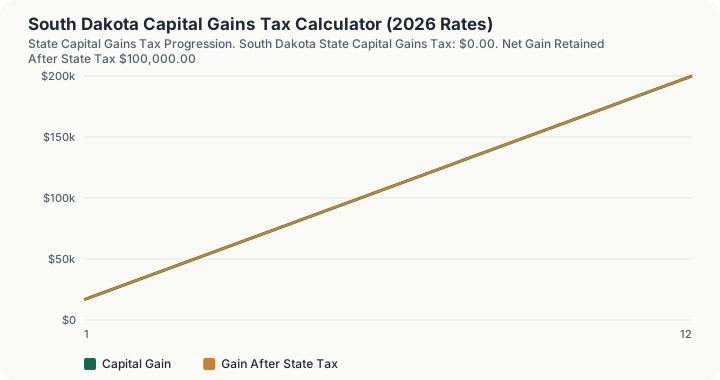
Quick Answer: South Dakota imposes no state-level tax on capital gains, so an investor realizing a $100,000 gain owes $0 in South Dakota state tax and keeps the full $100,000, subject only to federal tax.
How This Is Calculated
South Dakota has no individual income tax, so a capital gain realized by a resident is taxed only once, federally. There is no exclusion to qualify for and no percentage to look up, because there is no state rate schedule at all. The calculator returns $0 whatever you enter.
There is no rate schedule to reproduce, so the two identities the calculator applies are simply these.
What the calculator does with your inputs:
- Start with the net gain. The figure you enter is the gain left after capital losses and loss carryforwards have been netted against it.
- Look for a South Dakota rate schedule. There is none to look up, so the state line resolves to zero before any bracket arithmetic runs. The other-income field has no effect here; it is kept so the page compares cleanly against states where it does matter.
- Effective rate. Zero divided by the realized gain is 0.00%, and it stays 0.00% whether the gain is $10,000 or $10 million.
- Net proceeds. The gain passes through the state layer whole.
- What is still owed. Federal capital gains tax and the federal net investment income tax are unaffected by residence in a no-tax state and are calculated separately.
Worked Example
Consider an investor residing in South Dakota who realizes $100,000 in capital gains alongside $75,000 in ordinary income during the year.
- Check the state rate. South Dakota does not levy an individual income tax, and it does not carve out a separate tax on investment gains either, so the state rate applied to this sale is 0.00%.
- Compute the state tax. $100,000 × 0.00% = $0.00. No state return, no state estimated payments, and no state withholding apply to this capital gain.
- Net proceeds. The investor retains the full $100,000 gain after state tax, compared to an investor in a high-tax state who might lose 5% to 13% of the same gain to state liability.
- Federal liability remains. South Dakota's 0% state rate does not eliminate federal exposure: the gain is still subject to federal long-term or short-term capital gains brackets under IRC § 1(h), plus the 3.8% NIIT surtax where applicable.
The Schedule That Never Moves
Most pages in this family have a bracket edge to walk. This one has none, and saying so precisely is more useful than inventing one. The twelve-row schedule the calculator builds is the proof: it varies the gain from $16,666.67 up to $200,000 in even steps, and the State Tax Due column reads $0.00 in every one of the twelve rows. The Gain After State Tax column is identical to the Capital Gain column in all twelve, so at $16,666.67 the retained figure is $16,666.67, at $100,000 it is $100,000, and at $200,000 it is $200,000.
The marginal cost of the next dollar
The usual question on a graduated state is what the next $1,000 of gain costs. Here the sweep answers it once and for all: sweeping the gain from $0 to $100,000,000 in $20,000,000 steps returns $0.00, $0.00, $0.00, $0.00, $0.00 and $0.00, with a change of $0.00 at every step. Each additional $1,000 of gain costs $0.00, and it keeps costing $0.00 at every gain size the calculator accepts, up to its $100,000,000 input ceiling. The effective rate output reads 0.00% at every one of those points, and so does the marginal rate.
The reverse question, which has no answer here
"How much can be realised before crossing into the next band" is the most valuable question on a bracketed page, and on this one it is unbounded. There is no next band. A $100,000,000 gain returns the same $0.00 as a $1 gain. The only ceiling is the calculator's own input maximum, which is a form-validation limit rather than a tax threshold: nothing in South Dakota law puts a number there.
What a state reserve costs a seller
The practical error this page exists to prevent is a seller treating South Dakota like the state they moved from and holding back a state reserve at closing. The engine prices the correct answer at $0.00 on the $100,000 default and returns $100,000.00 of net proceeds, so a reserve set aside against South Dakota tax is returned in full whatever its size. A seller who set aside 5% of a $100,000 gain, a rate typical of the graduated states, would be sitting on $5,000 of their own money with no return to file it against and no state estimated-payment schedule to remit it under. The federal reserve is the one that matters, and nothing in South Dakota withholds toward it.
A real limitation of this calculator
The Other Taxable Income field on this page does nothing. Sweeping it from $0 to $10,000,000 leaves the answer at $0.00 at every point, with a change of $0.00 between them, because the function looks up South Dakota's rate schedule, finds the zero-tax flag set, and returns before any stacking or bracket arithmetic runs. The field is kept so the page's inputs line up with the states where income stacking genuinely changes the answer, but on this page entering a salary, changing it, or leaving it at zero produces an identical result. Nothing on this page models the interaction between a gain and other income, because in South Dakota there is none to model.
The calculator is also silent on everything that is not the South Dakota line. It returns $0.00 for the state and stops; the federal capital gains tax, the 3.8% net investment income tax, and any tax owed to the state where the asset sits are outside it entirely and are not netted out of the $100,000.00 retained figure it reports.
Federal Rules That Still Apply
South Dakota returns $0 on every gain, so the work left is federal: - Holding period first. More than a year is long-term, taxed at 0%, 15%, or 20% by taxable income. A year or less is short-term at ordinary federal rates. - NIIT. The federal 3.8% tax under IRC § 1411 applies to net investment income above $200,000 of modified AGI single, $250,000 joint. - Estimated tax. The IRS generally expects estimated payments when the year's liability after withholding and credits will reach $1,000, and generally accepts 90% of the current year or 100% of the prior year as a safe harbor. South Dakota asks for nothing alongside it. - Losses. Under IRC § 1211, losses net against gains, up to $3,000 of the excess reduces ordinary income, and the remainder carries forward.
What South Dakota Charges Instead
The state runs on consumption and property. The Department of Revenue reports a state sales and use tax rate of 4.2%, with municipalities adding their own on top, and it also collects a contractor's excise tax on construction receipts and administers property tax, which funds schools and local government. There is no individual income tax and no corporate income tax of the usual kind, which is part of why South Dakota also hosts a large bank card industry.
The distinctive point for anyone reading a capital gains page is the trust industry. South Dakota does not tax the income of trusts, allows perpetual duration, and has strong confidentiality provisions, so it has become a common situs for long-term family trusts holding appreciated assets. That matters at the state level only. A trust sited in South Dakota still faces federal tax on its capital gains, at the compressed trust rate schedule, and whether the trust's income is taxed by the grantor's home state is a question of that state's own law rather than South Dakota's. Using a South Dakota trustee is not by itself a way to make a gain disappear.
Residency and Source Rules
South Dakota is a popular domicile of convenience, including for people who travel full time, and it grants residency more easily than most states. That is exactly what makes the trap worth stating. Establishing South Dakota residency does not reach backward to a gain recognized while you lived elsewhere, and the state you left decides whether you really left, using its own day-count and domicile tests rather than South Dakota's. A mail forwarding address and a South Dakota license are the weakest form of evidence in that argument. Property is separate again: farmland in Minnesota or a rental in Colorado is generally taxed by that state on the gain sourced there, and a nonresident return follows.
What This Does Not Account For
This page is exact about the state answer, which is zero. Everything below sits outside the calculator and still has to be worked out separately: - Federal capital gains tax: long-term rates of 0%, 15%, or 20%, and short-term gains taxed at ordinary rates reaching 37%. - Net Investment Income Tax: the 3.8% federal tax under IRC § 1411 on net investment income above $200,000 of modified AGI for single filers and $250,000 for married filing jointly. - Alternative Minimum Tax: federal AMT under IRC § 55, which reaches the bargain element on an incentive stock option exercise. - Section 1031 like-kind exchanges: federal deferral for real property held for productive use in a trade or business or for investment. - Qualified Small Business Stock: the federal gain exclusion under IRC § 1202, which has its own holding period and issuer tests. - Tax owed to another state: a gain sourced to a state that does tax it, which this calculator does not model.
Common Pitfalls
- Treating South Dakota domicile as retroactive. The gain follows where you were a resident when it was recognized, and where the property sits.
- Assuming a South Dakota trust escapes tax entirely. The state does not tax the trust's income. The IRS does, on the compressed trust schedule.
- Forgetting federal quarterly payments. Nothing at the state level exists to remind you, and the federal threshold is only $1,000 of expected tax.
- Selling just under a year. Eleven months of holding costs the preferential federal rate and taxes the gain at ordinary rates.
- Unreconstructed basis on farmland or a long-held business. Improvements and depreciation change the number, and the burden of proof is the taxpayer's.
Frequently Asked Questions
Does South Dakota have a state capital gains tax?
How are short-term and long-term gains taxed in South Dakota?
Can capital losses offset capital gains in South Dakota?
Does a South Dakota trust avoid capital gains tax?
Do I need to make state estimated payments after a large sale?
Are retirement distributions taxed in South Dakota?
Sources
- South Dakota Department of Revenue, Sales and Use Tax: the state sales and use tax rate is 4.2%, with municipal tax added locally. The department administers no individual income tax. dor.sd.gov
- IRS, Topic no. 409, Capital Gains and Losses.. irs.gov
- IRS, Publication 550, Investment Income and Expenses (Including Capital Gains and Losses).. irs.gov/publications/p550
Also consulted: IRS, Estimated Taxes: the $1,000 threshold and the safe harbor percentages.