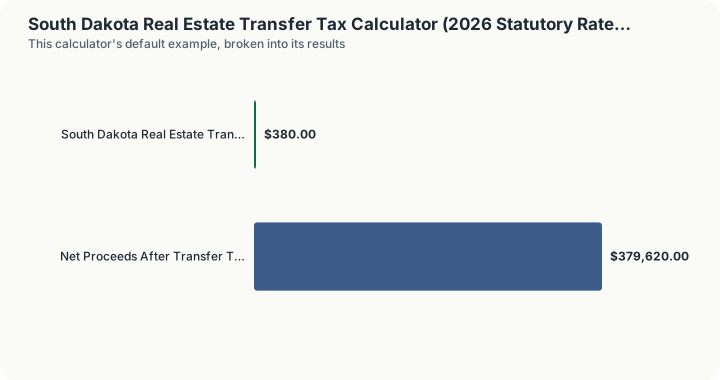
Quick Answer: A $380,000 home sale in South Dakota owes $380.00 in state real estate transfer fee, a flat 0.1% rate applied to the full sale price with no brackets or high-value surcharge.
Overview
South Dakota's real estate transfer fee under SDCL 43-4-21 works out to $0.50 per $500 of value, an even 0.1% of the sale price, tying it with Alabama, Georgia, and Kentucky for the lowest flat statutory rate among states that levy a transfer tax at all (only Colorado's nominal 0.01% documentary fee runs lower). No South Dakota county or city adds a local surcharge on top of that state figure.
State law does not mandate which party pays; it is customarily a negotiated item in the purchase contract, and local custom can vary by county. Buyers relocating from a state with no income tax, like Texas or Florida, sometimes assume South Dakota, which also has no state income tax, must likewise have no transfer tax, but the two policies are unrelated, and South Dakota's 0.1% fee is real and applies at every closing.
How This Is Calculated
South Dakota's real estate transfer fee is $0.50 per $500 of value, a flat 0.1%, and counties add nothing to it.
The engine reads the 0.001 rate under SDCL 43-4-21 and multiplies the full sale price by it, then reports fee due, effective rate, and net proceeds. With no bracket schedule and no value threshold, the effective rate reads 0.100% at every price, and a $75,000 rural parcel and a $10,000,000 commercial property are charged proportionally the same.
Worked Example
Start with the calculator's default: a $380,000 Sioux Falls sale, taken through the transfer fee in single operations.
Step 1 -- The consideration. Contract sale price = $380,000
Step 2 -- The statutory rate. SDCL 43-4-21, $0.50 per $500 of value = 0.1%
Step 3 -- Apply the rate. $380,000 x 0.001 = $380.00
Step 4 -- Net proceeds after the fee. $380,000.00 - $380.00 = $379,620.00
Step 5 -- The effective rate. $380.00 / $380,000 = 0.100%
Push the price to the calculator's $1,500,000 scenario and the schedule has nothing new to offer.
Step 6 -- The luxury sale at the same rate. $1,500,000 x 0.001 = $1,500.00
Step 7 -- The effective rate at $1.5M. $1,500.00 / $1,500,000 = 0.100%
South Dakota calls this a transfer fee rather than a transfer tax, and the naming is not merely cosmetic: it is collected by the register of deeds at recording rather than assessed by the Department of Revenue. The arithmetic, though, is the plainest in the country. There is no bracket to cross at Step 6, no cliff of the sort New York and New Jersey impose at $1,000,000, and no county add-on layered on top, so the same 0.1% carries a $40,000 farmstead transfer and a $40,000,000 commercial portfolio sale alike.
What a Tenth of a Percent Actually Moves
The transfer fee config returns an empty schedule, so this page has no tier table on it. The figures below come from sweeping the sale price input directly.
Each additional $10,000 of sale price costs $10.00. Sweeping from $350,000 to $400,000 in $10,000 steps returns $350.00, $360.00, $370.00, $380.00, $390.00 and $400.00. The step is $10.00 every time, and it remains $10.00 whether the sweep runs around a $350,000 farmstead or a $10,000,000 commercial parcel, where the fee is $10,000.00. There is no bracket edge, no exemption floor and no high-value cliff anywhere in South Dakota's schedule, so the rate is 0.1% from the first dollar of consideration and the effective rate reads 0.100% at every price the engine has been given.
The reverse question is unusually easy here. Because the rate is exactly one part in a thousand, the sale price that produces a given fee is that fee multiplied by a thousand. A $500.00 fee is a $500,000 sale; a $750.00 fee is a $750,000 sale; a $1,000.00 fee is a $1,000,000 sale. The engine rounds to the cent, so $999,999 also returns $1,000.00, and the reverse lookup picks out a narrow band of prices rather than a single one.
The mansion tax field is permanently zero. The output panel shows a "Mansion Tax / High-Value Surcharge" line because the shared primitive supports a mansion cliff for the handful of states that impose one. South Dakota does not, and the field returns $0.00 at $380,000, at $1,500,000, at $2,500,000 and at $10,000,000 alike, where the entire $10,000.00 is base fee. That zero is a consequence of a shared code path, not a South Dakota threshold lying in wait above some price.
Where the engine and the register of deeds part company, priced. SDCL 43-4-21 quotes $0.50 per $500 of value, and a register applies that per increment, rounding a partial $500 up to a whole one. This engine does not round to the increment: it multiplies a clean 0.001 against the exact price. On a $387,300 sale the engine returns $387.30, while the statutory method treats the price as 775 started increments of $500 and charges 775 x $0.50 = $387.50. The engine is $0.20 light. On any price that is an exact multiple of $500 the two agree to the cent, which is why the $380,000 default cross-checks perfectly against 760 x $0.50 = $380.00. The maximum possible divergence is one increment, so it can never exceed $0.50 on a South Dakota deed, but the page and the closing statement will not always match to the penny.
What This Does Not Account For
- County recording fees. South Dakota register of deeds offices charge separate flat recording fees per document, unrelated to sale price, which this calculator does not include.
- Exemptions for certain transfer types. Transfers between spouses, transfers into certain trusts, and transfers by operation of law, gift, or inheritance may be exempt from the transfer fee under South Dakota law. This calculator assumes a standard arm's-length sale subject to the full fee.
- Rounding up to the next $500 increment. The register charges $0.50 per started $500; the engine multiplies the exact price by 0.001. On a $387,300 sale that is $387.30 here against $387.50 at the counter, a gap bounded by $0.50.
- Title insurance and attorney or closing agent fees. The transfer fee is only one line item on a South Dakota closing statement; title search fees, closing agent charges, and survey costs are separate and not modeled here.
- Agricultural or mineral rights transactions. Sales involving severed mineral rights or certain agricultural conveyances can carry additional documentation requirements outside the scope of this calculator.
Common Pitfalls
- Assuming South Dakota has no transfer tax at all. South Dakota does levy a real estate transfer fee, just at a very low flat rate compared to states like New York or Delaware. Sellers sometimes assume a state with no income tax also has no closing-cost taxes, then are surprised by the fee at the register of deeds.
- Forgetting who customarily pays. South Dakota law does not dictate which party pays the transfer fee; it is a negotiated item in the purchase contract, and either buyer or seller can end up covering it depending on local custom and the deal terms.
- Applying an out-of-state rate by habit. Buyers and agents relocating from bracket-heavy states sometimes overestimate South Dakota's fee by applying a marginal rate structure that does not exist here.
- Confusing the transfer fee with mortgage recording costs. The transfer fee applies to the deed conveying the property, not to any mortgage instrument recorded alongside it; South Dakota does not impose a separate mortgage recording tax the way some states do.
Frequently Asked Questions
What is South Dakota's real estate transfer tax rate?
Who pays the real estate transfer fee in South Dakota?
Does South Dakota have a mansion tax on expensive homes?
Are any property transfers exempt from South Dakota's transfer fee?
Does South Dakota also charge a county-level transfer tax on top of the state fee?
Sources
- South Dakota Department of Revenue: Real Estate Transfer Fee guidance under SDCL 43-4-21. dor.sd.gov