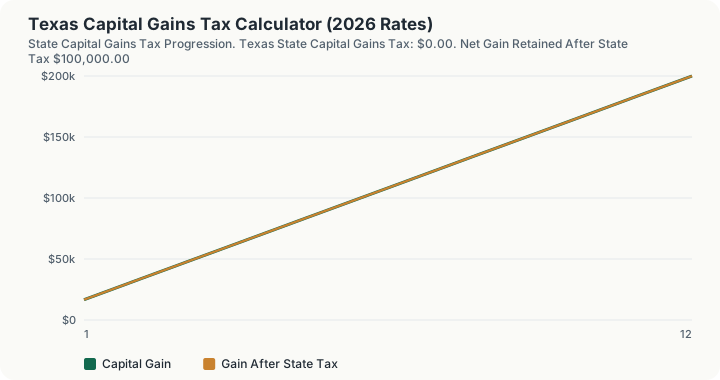
Quick Answer: Texas imposes no state-level tax on capital gains, so an investor realizing a $100,000 gain owes $0 in Texas state tax and keeps the full $100,000, subject only to federal tax.
How This Is Calculated
Texas has no individual income tax, so a realized capital gain carries no Texas tax whether it came from a stock sale, a rental property, or the sale of a business. The state answer is $0 at every gain size. That is genuinely all there is to the state calculation, so this page spends its effort on what the gain still costs federally.
There is no rate schedule to reproduce, so the two identities the calculator applies are simply these.
What the calculator does with your inputs:
- Start with the net gain. The figure you enter is the gain left after capital losses and loss carryforwards have been netted against it.
- Look for a Texas rate schedule. There is none to look up, so the state line resolves to zero before any bracket arithmetic runs. The other-income field has no effect here; it is kept so the page compares cleanly against states where it does matter.
- Effective rate. Zero divided by the realized gain is 0.00%, and it stays 0.00% whether the gain is $10,000 or $10 million.
- Net proceeds. The gain passes through the state layer whole.
- What is still owed. Federal capital gains tax and the federal net investment income tax are unaffected by residence in a no-tax state and are calculated separately.
Worked Example
Consider an investor residing in Texas who realizes $100,000 in capital gains alongside $75,000 in ordinary income during the year.
- Check the state rate. Texas does not levy an individual income tax, and it does not carve out a separate tax on investment gains either, so the state rate applied to this sale is 0.00%.
- Compute the state tax. $100,000 × 0.00% = $0.00. No state return, no state estimated payments, and no state withholding apply to this capital gain.
- Net proceeds. The investor retains the full $100,000 gain after state tax, compared to an investor in a high-tax state who might lose 5% to 13% of the same gain to state liability.
- Federal liability remains. Texas's 0% state rate does not eliminate federal exposure: the gain is still subject to federal long-term or short-term capital gains brackets under IRC § 1(h), plus the 3.8% NIIT surtax where applicable.
Pricing a State Estimate Nobody Owes
Every other page in this family has a bracket edge, a cap or a cliff to walk. This one does not, and manufacturing one would be a fabrication. What the calculator can do instead is put a dollar figure on the mistakes that a zero rate invites.
The error a closing-table reserve costs
The recurring error on a Texas sale is a percentage held back at closing against "state tax", usually by a seller who last transacted in California, New York or Illinois. The calculator prices the right answer at $0.00 on the $100,000 default, with net proceeds of $100,000.00. So the whole of any reserve is the error. A seller holding 1% of a $100,000 gain sets aside $1,000 against a liability the engine computes as $0.00; at 5%, $5,000; on a $2,000,000 gain at 5%, $100,000 immobilised against nothing. There is no Texas return to remit it with, no state estimated-payment date to hit, and no state credit it can later be applied to. Sweeping the gain to the calculator's $100,000,000 ceiling changes none of that: the answer is $0.00 at $0, at $25,000,000, at $50,000,000, at $75,000,000 and at $100,000,000, moving by $0.00 at each step.
The second error is the franchise tax
The other confusion this page can price is treating the Texas franchise tax as a gain tax. The calculator's headline is the individual's state liability on the realized gain, and it is $0.00 at every gain size in the sweep. The franchise tax is a margin tax on taxable entities, computed on the entity's margin rather than on an individual's investment profit, and no part of it flows into the figure this page reports. Someone selling a Texas business has two separate questions, and this calculator answers only one of them, returning $0.00 for the owner's own gain and nothing at all about the entity's franchise position.
The marginal cost of the next unit
Each additional $1,000 of gain costs $0.00. The twelve-row schedule shows the same thing from a different angle: it steps the gain from $16,666.67 to $200,000 and reports State Tax Due of $0.00 in every row, so the Gain After State Tax column tracks the Capital Gain column exactly, $66,666.67 retained on a $66,666.67 gain and $183,333.33 retained on a $183,333.33 gain. In a graduated state those two columns pull apart as the table descends. Here the difference is $0.00 in row one and $0.00 in row twelve.
The reverse question
Asked the other way round, how much can be realised before the state takes anything, the sweep gives no finite answer. There is no first taxed dollar. The only number that behaves like a limit is the calculator's own $100,000,000 input maximum, which is a validation bound on the form and carries no statutory meaning; the constitutional bar in Article VIII, Section 24-a sits behind the zero rather than any dollar threshold.
What this calculator does not do with your other income
The Other Taxable Income field is inert on this page. Sweeping it from $0 to $10,000,000 returns $0.00 throughout, with a change of $0.00 between consecutive points, because the routine finds Texas flagged as a zero-tax state and returns before any income stacking or bracket arithmetic happens. On the graduated pages in this family that field moves the answer by hundreds or thousands of dollars; here it cannot move it at all, and a reader who adjusts it and sees a static result is seeing the engine work as intended.
That inertness is also the boundary of the page. The $100,000.00 shown as retained is what Texas leaves, not what the seller keeps: the federal long-term or short-term tax, the 3.8% net investment income tax, depreciation recapture on a rental, and any nonresident liability on out-of-state property all sit outside this calculation and are not subtracted from it.
Federal Rules That Still Apply
Texas contributes nothing to the bill, which leaves the federal rules doing all the work: - Holding period. More than one year is long-term, taxed at 0%, 15%, or 20% by taxable income; a year or less is taxed at ordinary federal rates that reach 37%. - Net Investment Income Tax. The federal 3.8% charge under IRC § 1411 applies above $200,000 of modified AGI for single filers and $250,000 for joint filers. - Federal estimated payments. The IRS generally expects estimated tax when you will owe $1,000 or more after withholding and credits, and generally accepts 90% of the current year's tax or 100% of the prior year's as a safe harbor. There is no Texas withholding on any sale to soften that, so the entire amount has to be paid deliberately. - Losses. Capital losses net against capital gains federally under IRC § 1211, with up to $3,000 of excess loss against ordinary income and an indefinite carryforward.
What Texas Charges Instead
The prohibition in Texas is constitutional and recent. Proposition 4, approved by voters in November 2019, repealed the older Article VIII, Section 24 and added Section 24-a, which bars the legislature from imposing a net income tax on individuals, including on an individual's share of partnership and unincorporated association income. Undoing that requires another constitutional amendment rather than a statute.
The Comptroller of Public Accounts administers roughly a hundred taxes and fees in place of it. Sales and use tax is the largest, with local jurisdictions adding their own. The franchise tax, a margin tax, falls on entities rather than on individuals. Severance taxes on crude oil and natural gas, motor fuels tax, hotel occupancy tax, and insurance taxes fill in the rest. None of them touch a capital gain.
The bill Texans actually feel is property tax, which is assessed and collected locally rather than by the state, and which is high by national standards precisely because there is no income tax underneath it. For a real estate investor that is the important trade: the annual carrying cost of holding Texas property is higher, while the tax on the eventual profit is federal only.
Residency and Source Rules
Texas draws sellers from California, New York, and Illinois, and the pattern of a move followed shortly by a liquidity event is one those states know well. The determining question is where you were a resident when the gain was recognized. Closing before the move is complete generally leaves the gain in the old state's tax base, and states with an aggressive residency practice examine day counts, where the family lives, where possessions went, and where the seller physically was on the closing date. Deferred compensation, installment sale payments, and equity compensation vesting over a move have their own sourcing rules under the former state's law. Non-Texas real property remains taxable where it sits, so an Austin resident selling an apartment building in Denver files in Colorado.
What This Does Not Account For
This page is exact about the state answer, which is zero. Everything below sits outside the calculator and still has to be worked out separately: - Federal capital gains tax: long-term rates of 0%, 15%, or 20%, and short-term gains taxed at ordinary rates reaching 37%. - Net Investment Income Tax: the 3.8% federal tax under IRC § 1411 on net investment income above $200,000 of modified AGI for single filers and $250,000 for married filing jointly. - Alternative Minimum Tax: federal AMT under IRC § 55, which reaches the bargain element on an incentive stock option exercise. - Section 1031 like-kind exchanges: federal deferral for real property held for productive use in a trade or business or for investment. - Qualified Small Business Stock: the federal gain exclusion under IRC § 1202, which has its own holding period and issuer tests. - Tax owed to another state: a gain sourced to a state that does tax it, which this calculator does not model.
Common Pitfalls
- Reading the state zero as the whole answer. The federal tax on a large long-term gain commonly runs 15% or 20% plus the 3.8% NIIT.
- Recognizing a gain before the move is genuinely complete. The old state's claim generally attaches at recognition, not at the change of address.
- Skipping federal estimated payments. Nothing in Texas withholds, so a mid-year sale can leave an unpaid federal balance accruing a penalty.
- Confusing franchise tax with a gain tax. The margin tax applies to entities doing business in Texas, not to an individual's capital gains.
- Ignoring depreciation recapture on a rental. Depreciation previously taken comes back federally as unrecaptured section 1250 gain, taxed at up to 25%.
Frequently Asked Questions
Does Texas have a state capital gains tax?
How are short-term and long-term gains taxed in Texas?
Can capital losses offset capital gains in Texas?
Do I owe estimated payments after selling a property in Texas?
Does the Texas franchise tax apply to my gain?
Are retirement distributions taxed in Texas?
Sources
- Texas Comptroller of Public Accounts, Taxes (comptroller.texas.gov/taxes): the taxes the state administers, including sales and use tax, franchise tax, crude oil and natural gas severance taxes, motor fuels, and hotel tax. No individual income tax appears among them. comptroller.texas.gov
- IRS, Topic no. 409, Capital Gains and Losses.. irs.gov
- IRS, Publication 550, Investment Income and Expenses (Including Capital Gains and Losses).. irs.gov/publications/p550
Also consulted: Texas Constitution, Article VIII, Section 24-a (added by Proposition 4, approved November 2019): prohibits a net income tax on individuals, including an individual's share of partnership and unincorporated association income. The former Section 24 was repealed at the same time; IRS, Estimated Taxes: the $1,000 threshold and the safe harbor percentages.