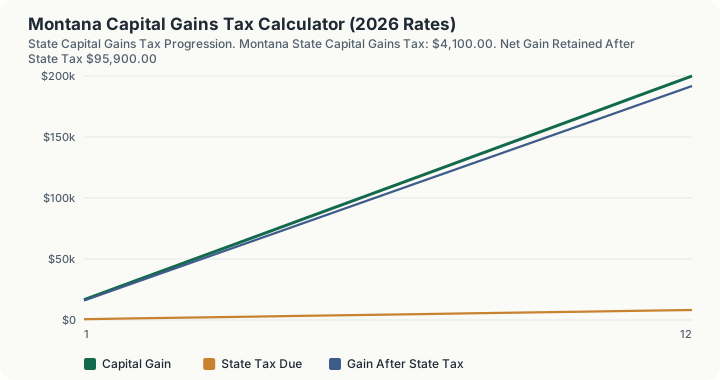
Quick Answer: On a $100,000 long-term capital gain layered on $75,000 of other income, a single filer's Montana tax is $4,100.00, an effective rate of 4.10%. Montana taxes net long-term capital gain at preferential rates of 3.0% and 4.1% under Mont. Code Ann. § 15-30-2103, not at the 4.7% and 5.65% ordinary rates. At ordinary rates the bill would be $5,650.00.
Montana Taxes Long-Term Gain on Its Own Schedule
Montana taxes net long-term capital gain under its own preferential rate schedule, separate from the ordinary income schedule. Under Mont. Code Ann. § 15-30-2103, long-term gain is taxed at 3.0% up to a filing-status threshold and 4.1% above it, while ordinary income is taxed at 4.7% and 5.65%.
The 2026 thresholds are $47,500 for single filers and married filing separately, $95,000 for married filing jointly and surviving spouses, and $71,250 for head of household. Each threshold is reduced by the taxpayer's ordinary income, so a taxpayer whose ordinary income already exceeds the threshold pays 4.1% on the entire gain.
Two things this is not. It is not a percentage exclusion, so no part of the gain leaves the tax base. And it is not the old capital gains credit under § 15-30-2301, which is repealed. Montana's benefit today is delivered entirely through the rate schedule.
How This Is Calculated
Montana is the one state in this group that gives relief through a separate rate schedule rather than an exclusion. Net long-term capital gain is taxed at 3.0% within a filing-status threshold and 4.1% above it, while ordinary income runs its own 4.7% and 5.65% brackets. The thresholds for 2026 are $47,500 for a single filer or married filing separately, $95,000 for married filing jointly or a surviving spouse, and $71,250 for head of household.
The catch is that the threshold is reduced dollar for dollar by ordinary income, so a taxpayer with a substantial salary has little or no room left at 3.0% and sees 4.1% on nearly the whole gain. The former capital gains credit under 15-30-2301 is repealed and is not modeled. Because this is a rate schedule and not an exclusion, the full gain stays in the base and the ordinary brackets are never used for it.
How that plays out:
- Start with the net gain. Capital losses and loss carryforwards are netted against the gain first.
- Find the room left at 3.0%. Take the threshold for your filing status and subtract your ordinary income. Whatever is left, if anything, is the amount of gain that gets the 3.0% rate.
- Apply the two rates (Mont. Code Ann. § 15-30-2103). Tax the gain inside that room at 3.0% and everything beyond it at 4.1%. The 4.7% and 5.65% ordinary brackets play no part in taxing the gain.
- Effective rate. Total tax divided by realized gain, which lands between 3.0% and 4.1% and drifts toward 4.1% as the gain or your ordinary income grows.
- Net proceeds. Subtract the state tax from the gain to get what you keep before federal tax.
Worked Example
Consider an investor in Montana who realizes $100,000 in capital gains on top of $75,000 in baseline ordinary income for the year.
- Start from the filing-status threshold. A single filer's 2026 threshold is $47,500.
- Reduce it by ordinary income. The $75,000 of baseline ordinary income exceeds $47,500, so the threshold is fully consumed and there is no room left at the 3.0% rate.
- Apply the preferential rates. The entire $100,000 long-term gain falls above the threshold and is taxed at 4.1%: $4,100.00.
- Effective rate. Dividing $4,100.00 by the $100,000 gain gives 4.10%, against the 5.65% top ordinary rate that would apply to the same dollars of wage income.
- Net proceeds. After paying $4,100.00 in state tax, the investor keeps $95,900.00 of the $100,000 gain, before any federal tax applies.
Filing status moves this materially. Married filing jointly, the threshold is $95,000, so $20,000 of room survives the $75,000 of ordinary income: $20,000 at 3.0% is $600.00 and the other $80,000 at 4.1% is $3,280.00, for $3,880.00. The head-of-household threshold of $71,250 is stored in the primitive but is not offered in this calculator's filing status selector, which exposes single and married filing jointly only, so that figure cannot be reproduced from the input panel.
The Threshold That Moves: Walking Montana's Ordinary-Income Axis
Montana's preferential schedule has one edge, but it is not fixed at a gain figure. The 3.0% room is a filing-status threshold reduced dollar for dollar by ordinary income, so the edge slides as salary changes. That makes the ordinary-income axis the one worth walking.
The threshold walk. For a single filer the 2026 threshold is $47,500. With $47,400 of ordinary income, $100 of 3.0% room survives and a $100,000 gain computes to $4,098.90. With $47,600 of ordinary income the room is gone and the same gain computes to $4,100.00. Two hundred dollars of extra salary cost $1.10 of capital gains tax on top of the tax on the salary itself, because that $100 of gain moved from 3.0% to 4.1%. Below the line the effect compounds: at $20,000 of ordinary income the same gain computes to $3,797.50, and at zero ordinary income to $3,577.50. The full 3.0% room is worth exactly $522.50 to a single filer, and every dollar of salary erodes it by 1.1 cents.
The marginal cost of the next unit. Once the threshold is consumed, each additional $1,000 of gain costs $41.00: the engine returns $4,100.00 at a $100,000 gain on $75,000 of income and $4,141.00 at $101,000. With no other income the first $47,500 of gain costs $30.00 per $1,000, which the engine confirms at $1,425.00 on a $47,500 gain, and everything above it costs $41.00 per $1,000.
The reverse question. How much gain can be realised at the lower rate? Exactly $47,500 minus ordinary income for a single filer, and $95,000 minus ordinary income filing jointly. A joint filer with no other income realising $100,000 pays $3,055.00; the same couple with $95,000 of ordinary income pays $4,100.00, a difference of $1,045.00 driven entirely by the threshold being consumed. Deferring salary rather than deferring the gain is the lever Montana's structure actually rewards, which is the reverse of the position in the bracket states.
Right method against wrong method, priced. Treating Montana's preference as an exclusion rather than a rate schedule is the error to avoid. No part of the gain leaves the tax base: a 30% exclusion applied to the baseline gain and then taxed at the 5.65% ordinary top rate would give $3,955.00, close enough to the engine's $4,100.00 to look plausible and wrong for a different reason at every other gain size. Running the same gain at ordinary rates instead of preferential ones gives $5,650.00, an overstatement of $1,550.00.
What the engine holds and what it does not. The repealed capital gains credit under 15-30-2301 is deliberately not modelled, because it no longer exists. The preferential schedule is applied only because this calculator passes statutory relief as true; the same primitive called with relief off, which is how the Montana paycheck page uses it, runs the figures through the 4.7% and 5.65% ordinary brackets instead. Short-term gain does not qualify for the preferential rates and the calculator has no holding-period input, so a short-term $100,000 gain would owe more than the $4,100.00 shown.
What This Does Not Account For
While this calculator provides penny-exact state statutory modeling, additional federal and transactional complexities warrant supplementary review: - Federal Capital Gains Taxes: Federal long-term brackets (0%, 15%, 20%) and short-term ordinary rates up to 37% under IRC § 1. - Net Investment Income Tax (NIIT): The 3.8% surtax on net investment income under IRC § 1411 for single filers over $200,000 (married joint over $250,000). - Alternative Minimum Tax (AMT): Federal AMT calculations under IRC § 55 impacting incentive stock option (ISO) exercise spread. - Section 1031 Like-Kind Exchanges: Tax deferral mechanisms for real property held for productive use in trade, business, or investment. - Qualified Small Business Stock (QSBS): Federal Section 1202 gain exclusions where state conformity varies significantly. - The Repealed Capital Gains Credit: Montana's former credit under Mont. Code Ann. § 15-30-2301 no longer exists, and this calculator does not apply it. The benefit is delivered through the § 15-30-2103 rate schedule instead.
Common Pitfalls
- Taxing Long-Term Gain at Montana's Ordinary Rates: Montana's ordinary rates are 4.7% and 5.65%, but net long-term capital gain is taxed at 3.0% and 4.1% under Mont. Code Ann. § 15-30-2103. Applying ordinary rates to a $100,000 gain overstates the bill by $1,800 for a single filer with $75,000 of other income.
- Failing to Track Holding Periods: The preferential 3.0% and 4.1% schedule applies only to net long-term gain. Assets held one year or less are taxed at Montana's 4.7% and 5.65% ordinary rates and at higher federal rates as well.
- Underestimating Multi-State Apportionment: Selling real estate or business assets located in other jurisdictions triggers multi-state non-resident return filing obligations.
- Neglecting Underpayment Penalties: Substantial one-time liquidity events require prompt estimated tax payments within the quarter of sale to avoid statutory penalties.
- Mismatched Cost Basis Records: Failure to document reinvested dividends, stock splits, or structural return-of-capital distributions leads to inflated taxable gain calculations.
Frequently Asked Questions
Does Montana have a state capital gains tax?
How are short-term and long-term capital gains taxed in Montana?
Are retirement account distributions subject to capital gains tax in Montana?
Can capital losses offset capital gains in Montana?
When are estimated state tax payments required on capital gains?
Sources
- Montana Department of Revenue: 2026 Statutory Individual Income Tax Rate Schedules. mtrevenue.gov
- Internal Revenue Service (IRS): Publication 544 (Sales and Other Dispositions of Assets) and Publication 550 (Investment Income and Expenses). irs.gov/publications/p544
Also consulted: Mont. Code Ann. § 15-30-2103: Preferential 3.0% and 4.1% rate schedule for net long-term capital gain, with 2026 thresholds of $47,500 single or married filing separately, $95,000 married filing jointly or surviving spouse, and $71,250 head of household, each reduced by ordinary income.