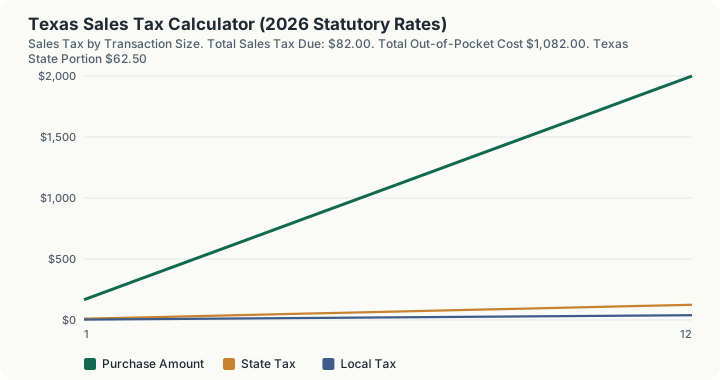
Quick Answer: A $1,000 taxable purchase in Texas costs $82.00 in combined state and local sales tax, for a total of $1,082.00 out the door.
How This Is Calculated
Texas charges 6.25% at the state level and caps all local sales taxes combined at 2%, so no address in Texas can exceed 8.25% no matter how many cities, counties, transit authorities and special districts overlap it. The average local rate is 1.95%, close to the ceiling, giving a typical combined 8.20% and $82.00 on a $1,000 purchase. That hard cap is the defining feature: local jurisdictions in Texas compete for room under a fixed 2% budget rather than stacking freely.
Because the local total is capped rather than additive without limit, the combined rate is bounded, and within that bound the arithmetic is straightforward:
The order of operations is:
- Read the purchase price. The full pre-tax amount you enter becomes the taxable base.
- No item-level exemption filtering. Texas exempts groceries and prescription and over-the-counter drugs. Those exemptions are not applied here.
- Multiply by the state rate. This produces the state portion of the bill: $62.50 on the default $1,000.
- Apply the local surcharge. The engine multiplies the purchase by a single statewide average of 1.95%. It does not enforce the 2% statutory ceiling, because it never adds jurisdictions together in the first place, and it performs no address lookup, so the 1.95% is not the rate at any specific Texas register.
- Add the pieces together. State tax plus local tax gives the total tax, and adding that to the purchase price gives the amount you actually pay.
Worked Example
For a $1,000 taxable purchase in Texas:
- Starting purchase price. The buyer rings up a $1,000.00 taxable retail purchase in Texas, the baseline amount before any tax is applied.
- State portion. Texas's statutory state sales tax rate of 6.25% applies to the full purchase amount: $1,000.00 × 6.25% = $62.50 owed to the state.
- Local portion. Local municipal, county, and special-district surcharges add an average of 1.95% on top of that: $1,000.00 × 1.95% = $19.50 more.
- Combined tax due. Summing the two pieces, $62.50 in state tax plus $19.50 in local surcharge comes to $82.00 in total sales tax owed on the transaction.
- Total out-of-pocket cost. Adding that $82.00 in tax to the $1,000.00 purchase price brings the buyer's total out-of-pocket cost to $1,082.00.
The Band Between 6.25% and 8.25%, Measured
Texas is the one state in this family where the modelling error has a hard ceiling, and it is worth putting a dollar figure on both ends of it rather than describing the cap in the abstract.
The floor. Switching the local surcharge off returns the state rate alone: $62.50 on $1,000, for $1,062.50 out the door. That is the correct answer for an address with no local sales tax at all, and it is also exactly the arithmetic of anyone who quotes "Texas sales tax is 6.25%" and stops.
The engine's answer. With the average local rate applied, $82.00, for $1,082.00. The difference between the two runs is $19.50 on $1,000.
Where the error runs out. Because Texas caps the combined local rate at 2%, the true figure on any $1,000 purchase in the state lies between the $62.50 floor and $82.50 at the 8.25% ceiling. The engine's $82.00 sits within half a dollar of the top of that band. On this page, then, the statewide-average limitation is bounded and small in one direction and up to $19.50 per $1,000 in the other: the calculator will rarely understate a Texas bill and can overstate it by as much as the whole local layer where no local tax applies.
At scale. On a $25,000 purchase the state-only run returns $1,562.50 and the average-rate run returns $2,050.00, a $487.50 spread on a single transaction, with $27,050.00 out the door against $26,562.50.
Reading the Rate Forwards and Backwards
Each additional $100 of taxable purchase costs $8.20. Sweeping the purchase from $900 to $1,300 returns $73.80, $82.00, $90.20, $98.40 and $106.60, an $8.20 step at every point. The increment is identical at every purchase size, because this calculation contains no bracket, no exemption floor, no threshold and no cap on the amount itself. Texas caps the local rate, not the base, and the rate applies from the first cent. With the local layer off the same sweep steps by $6.25.
The reverse question. With $500 to spend out the door rather than $500 before tax, the largest taxable purchase is $462.11, carrying $37.89 of tax for a total of exactly $500.00. At $462.12 the total tips to $500.01. The 8.20% combined rate costs $37.89 of shelf-price capacity on a $500 budget.
Recovering tax from a receipt, priced. A buyer holding a $1,082.00 receipt who multiplies it by 8.20% to get the tax back gets $88.73 from this engine. The tax actually charged was $82.00, so the shortcut overstates it by $6.73 on one receipt and reports $1,170.73 of total cost against the real $1,082.00. The correct extraction is the fraction 8.20/108.20 of the gross, not 8.20% of the gross. The round trip closes: $1,000 net at 8.20% gives $82.00 and the $1,082.00 total the receipt started from. This calculator only runs forward, from a pre-tax price to a total, so a base has to be recovered by entering candidate net prices until the total matches, which is how the $462.11 figure above was found.
What This Does Not Account For
- Any actual local rate, or the 2% statutory ceiling. The engine applies one 1.95% statewide average and never sums jurisdictions, so it neither looks up an address nor enforces the cap. The true answer on $1,000 lies between $62.50 and $82.50.
- Statutory exemptions on unprepared groceries, prescription and over-the-counter medications, or manufacturing equipment.
- The motor vehicle sales and use tax, which Texas levies on vehicles at its own rate outside the general sales tax modelled here.
- Special industry excise taxes (hotel occupancy tax, vehicle rental fees, alcohol and tobacco excise).
- Use tax compliance on out-of-state untaxed online purchases.
- B2B resale certificate exemptions or direct pay permit programs.
Common Pitfalls
- Quoting 6.25% as the rate Texans pay. In almost any populated area that understates the tax by close to the full $19.50 per $1,000, and by $487.50 on $25,000.
- Assuming 8.25% everywhere. The statutory ceiling is 8.25%, but the engine uses the 1.95% average, and addresses outside a taxing city or district pay the $62.50 state-only figure on $1,000.
- Multiplying a tax-inclusive total by 8.20%. On a $1,082.00 receipt that returns $88.73 rather than the $82.00 actually charged.
- Using this page for a vehicle purchase. Texas taxes motor vehicles under a separate regime that this general sales tax calculation does not model.
- Budgeting the shelf price. A $500 out-the-door budget buys $462.11 of goods.
Frequently Asked Questions
What is the sales tax rate in Texas?
How much is Texas sales tax on $25,000?
What is the highest sales tax rate possible in Texas?
How do I get the pre-tax price out of a Texas receipt?
Are groceries taxed in Texas?
Sources
- Texas Comptroller of Public Accounts: 2026 Sales and Use Tax Rate Schedules. comptroller.texas.gov
- Streamlined Sales Tax Governing Board (SSTGB): State Taxability Matrix. streamlinedsalestax.org/for-businesses/taxability-matrix