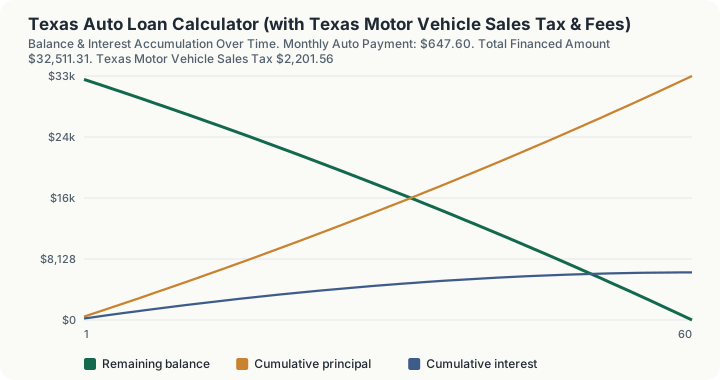
Quick Answer: A $35,000 vehicle in Texas with $5,000 cash down, the $225 documentary fee, a 60-month term, and a 7.25% APR carries a $647.60 monthly payment. That includes $2,201.56 of Texas motor vehicle sales tax at the flat 6.25% state rate and $84.75 in title and state registration, financing $32,511.31 in total.
Overview
Texas is one of the few large states where your ZIP code does not change the tax on a car. The motor vehicle sales tax sits in Chapter 152 of the Tax Code, separate from the general sales tax in Chapters 321 through 323, and the city, county, and transit rates that push general purchases to 8.25% in Houston, Dallas, San Antonio, and Austin do not reach a vehicle. Tex. Tax Code 152.021 imposes 6.25% of total consideration, and that is the whole rate everywhere in the state.
That single fact settles the question most Texas buyers arrive with. Shopping across county lines to save tax does not work here. A dealer in Plano and a dealer in Lubbock quote the same tax on the same price. What varies by county is the registration line, because counties add road-and-bridge and child-safety fees to the state base, and the title fee itself is $28 in most counties but $33 in the emissions-program counties that contain the major metros.
Two things do move the Texas number, and this calculator models both. The trade-in is excluded from total consideration outright, so it reduces tax at the full 6.25%. And the documentary fee is inside the tax base, so a $225 fee costs $239.06 once its own tax is counted.
Auto Loan APR by Credit Score
The APR columns below are national averages, not Texas figures. No primary source publishes average auto loan APR by state: Experian's report has no geographic cut, the CFPB publishes state origination volume but no rates, and the New York Fed publishes state delinquency only. The payment column is the part that is specific to Texas, because it runs this calculator's own Texas tax and fee rules at each tier's rate.
| Credit Tier | VantageScore 4.0 | Avg New APR | Avg Used APR | Est. Payment in Texas |
|---|---|---|---|---|
| Super prime | 781-850 | 4.55% | 6.30% | $606.85 |
| Prime | 661-780 | 6.23% | 8.77% | $632.02 |
| Nonprime | 601-660 | 9.67% | 14.03% | $685.50 |
| Subprime | 501-600 | 13.44% | 19.42% | $747.08 |
| Deep subprime | 300-500 | 16.01% | 21.77% | $790.78 |
Payment assumptions: $35,000 vehicle price, $0 trade-in, $5,000 cash down, $225 dealer documentation fee, 60-month term, new-vehicle APR applied to the Texas delivered price including tax and statutory fees. At the 6.39% overall new-car average the same purchase costs $634.45 a month.
The score bands are VantageScore 4.0, not FICO. The same borrower can land in a different tier under each model, so a FICO score pulled from a card issuer will not always match the band here. Source: Experian, State of the Automotive Finance Market, Q1 2026, slide 45.
What Moves Your Payment
Each row changes one input and leaves the rest at the baseline below. The dollar effects are this calculator's own output for Texas, not a rule of thumb.
| Factor | What Changes | Effect on Monthly Payment | Effect on Total Interest |
|---|---|---|---|
| Vehicle Price | Each extra $1,000 of price raises both the amount financed and the sales tax base, so the tax rises with it. | +$21.17 | +$207.36 |
| Trade-In Allowance | A $1,000 allowance cuts the amount financed by $1,000 and reduces the sales tax base by the same amount, so it saves tax as well as principal. | -$21.16 | -$207.36 |
| Cash Down Payment | A $1,000 larger down payment cuts the amount financed by $1,000. It never reduces the sales tax, which is assessed on the price, not on what you borrow. | -$19.91 | -$195.16 |
| Dealer Doc Fee | A $100 higher documentation fee adds $100 to the amount financed and is inside the sales tax base, so it is taxed on top of itself. Texas caps the fee at $225. | +$2.12 | +$20.74 |
| Longer Term | Stretching the same balance from 60 months to 72 months spreads the principal over twelve more payments at the same rate. | -$89.40 | +$1,333.89 |
Baseline: $35,000 vehicle price, $0 trade-in, $5,000 cash down, $225 documentation fee, 60 months at 7.25% APR, giving a $647.60 payment and $6,345.01 of total interest.
How This Is Calculated
Texas taxes total consideration at 6.25% with no local component, and the statute lists exactly what may be subtracted from it. Four steps.
1. Total consideration. Tex. Tax Code 152.002(a) forbids deducting the seller's costs and expenses from the price, so the documentary fee stays in the base. Subsection (b) lists eight exclusions and a documentary fee is not among them, while "the value of a motor vehicle taken by a seller as all or a part of the consideration for sale of another motor vehicle" is.
The trade-in credit is bounded by the price of the vehicle being bought, so an oversized trade cannot push the base below zero or refund tax that was never paid.
2. Motor vehicle sales tax. One rate, statewide, with no local component.
3. Title and registration. A fixed $84.75, being the $33 title application fee that applies in emissions-program counties and the $51.75 state base annual registration for a passenger vehicle at or under 6,000 lbs GVW. Both sit outside the tax base.
4. Amount financed and amortization. The trade-in works twice: it cut the tax base in step one, and it reduces the balance borrowed.
The balance amortizes as a fixed-rate installment loan:
where $P$ is the financed amount, $i$ is the monthly rate (APR ÷ 12), and $n$ is the term in months. Each period's interest is the outstanding balance times $i$, the remainder reduces principal, and the schedule reconciles to zero at maturity.
Worked Example
Texas runs a single 6.25% motor vehicle sales tax with no local add-on, which makes it one of the few states where the headline rate really is the rate. The documentary fee is inside the base.
- Vehicle price: $35,000
- Trade-in allowance: $0
- Cash down: $5,000
- Documentary fee: $225
- Term: 60 months at 7.25% APR
Step 1 -- Total consideration. Price plus the capped documentary fee, less the value of a motor vehicle taken in trade: $35,000 + $225 - $0 = $35,225.00
Step 2 -- Motor vehicle sales tax at 6.25%. $35,225.00 x 6.25% = $2,201.56
Step 3 -- Title and state registration, outside the base. $33.00 title + $51.75 registration = $84.75
Step 4 -- Total delivered price. $35,000 + $225.00 + $2,201.56 + $84.75 = $37,511.31
Step 5 -- Amount financed. $37,511.31 - $0 trade-in - $5,000 cash down = $32,511.31
Step 6 -- The monthly payment. $32,511.31 at 7.25% over 60 months = $647.60
Step 7 -- Month 1. $32,511.31 x (7.25% / 12) = $196.42 interest, $451.18 principal, balance $32,060.13
Step 8 -- Month 2. $32,060.13 x (7.25% / 12) = $193.70 interest, $453.90 principal, balance $31,606.23. Cumulative interest: $390.12
Step 9 -- The accumulation. Interest through month 12 is $2,173.50, balance $26,913.61. Over the full 60 months, $6,345.01
Add a $10,000 trade-in and the base falls to $25,225, the tax falls to $1,576.56, and the payment drops to $435.96. The trade-in saved $625.00 in tax by itself. That is the number to beat if you are weighing a private sale: a private buyer has to pay more than $625 above the dealer's trade offer before selling separately comes out ahead, and that is before you account for the time and the risk of carrying the old car while you shop.
Drop the documentary fee to zero and the delivered price falls to $37,272.25, a saving of $239.06 rather than $225, because the fee carried $14.06 of its own tax.
Stretching the same $32,511.31 balance from 60 to 72 months lowers the payment to $558.20 and raises total finance charges to $7,678.74. The tax does not change, because nothing about the term touches the tax base.
What This Does Not Account For
- Private-party purchases and standard presumptive value. Tex. Tax Code 152.0221 taxes a private sale on the greater of the stated price or 80% of the vehicle's standard presumptive value, unless a certified appraisal on Form 14-128 is filed within 30 days. This calculator models a dealer sale at the stated price, so it understates tax on a lowball private purchase.
- The new resident tax. Tex. Tax Code 152.023 charges a flat $90 instead of 6.25% when a new Texas resident brings in a vehicle already titled in their name in another state.
- County registration add-ons. Counties add road-and-bridge, child-safety, and in some cases transportation-district fees to the $51.75 state base, commonly $10 to $22. These are set per county and were not individually verified, so they are left out rather than guessed. Expect your registration line to run above the figure here.
- The $28 title fee in non-emissions counties. This calculator uses the $33 amount that applies in the emissions-program counties containing the major metros, so a rural purchase will be $5 high.
- Inspection, state inspection replacement fees, and safety-related charges billed separately at the dealership.
- GAP insurance, extended service contracts, and aftermarket accessories, unless you fold them into the vehicle price yourself.
- Texas does not levy an annual property tax on a personal-use vehicle. Tex. Const. art. VIII sec. 1(j) and Tax Code 11.254 exempt one personal-use vehicle per person, so unlike Virginia or Missouri there is no recurring ad valorem bill to plan for. Business-use vehicles can be taxed.
Common Pitfalls
- Using your local sales tax rate. Someone in Houston reads 8.25% off a rate lookup and applies it to a car. On a $35,225 base that overstates the tax by $704.50. The general rate has nothing to do with a Chapter 152 vehicle purchase.
- Assuming the $225 documentary fee is a legal maximum. It is not a cap. Under 7 TAC 84.205 a fee of $225 or less on a retail installment sale is presumed reasonable and needs no filing. A dealer who wants to charge more may do so after filing a cost analysis with the Office of Consumer Credit Commissioner. The $225 figure took effect on 11 July 2024, up from $150, so older guidance is out of date.
- Forgetting the documentary fee is taxed. It is part of total consideration, so it costs 6.25% more than its face amount.
- Trading in something that is not a motor vehicle. The 152.002(b) exclusion covers a motor vehicle taken as consideration for another motor vehicle. A boat, a trailer that is not a motor vehicle, or personal property handed over as part of the deal does not qualify.
- Rolling negative equity forward. If you owe more on the trade than it is worth, the shortfall is added to the new loan. It raises the principal and the interest, and it does not shrink your tax credit, which is based on the allowance rather than your equity.
- Judging the loan by the payment alone. The 72-month version of this deal looks $89.40 cheaper per month and costs $1,333.89 more in finance charges.
Frequently Asked Questions
What is the sales tax on a car in Texas?
Does a trade-in reduce sales tax in Texas?
Is the $225 dealer documentary fee a legal cap in Texas?
Why is my registration bill higher than the calculator shows?
How is a private-party car purchase taxed in Texas?
Do I pay an annual property tax on my car in Texas?
Sources
- Texas Comptroller of Public Accounts, motor vehicle tax guidance. comptroller.texas.gov
- Tex. Const. art. VIII sec. 1(j) and Tex. Tax Code 11.254 (personal-use vehicle property tax exemption) sec.gov
- Consumer Financial Protection Bureau, Truth in Lending Act (Regulation Z, 12 CFR 1026.22) disclosure requirements for installment credit. ecfr.gov/current/title-12/chapter-X/part-1026
Also consulted: Tex. Tax Code 152.021 (motor vehicle sales tax, 6.25% of total consideration); Tex. Tax Code 152.002 (definition of total consideration; subsection (b) trade-in exclusion; subsection (a) no deduction for the seller's costs); Tex. Tax Code 152.0221 (standard presumptive value for private-party sales) and 152.023 (new resident tax); 7 TAC 84.205, Office of Consumer Credit Commissioner (documentary fee presumed reasonable at $225, effective 11 July 2024); Texas Department of Motor Vehicles, Texas Registration Fees chart effective 1 January 2026, and titling fee guidance ($28 or $33 by county); Experian, State of the Automotive Finance Market, Q1 2026, slide 45 (average new and used auto loan APR by VantageScore 4.0 credit tier; national, no state level cut published).