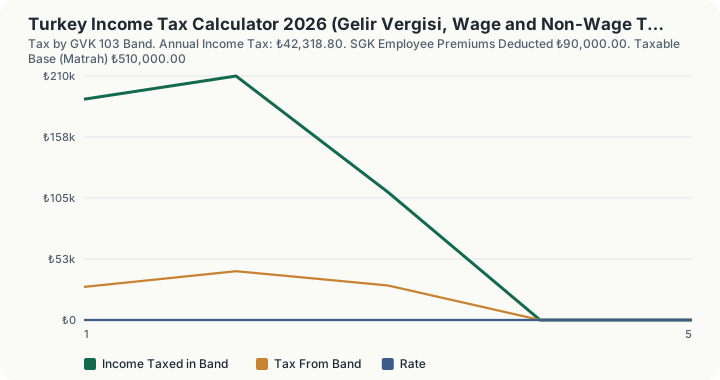
Quick Answer: On a gross annual salary of 600,000 TL, income tax for 2026 is 42,318.80 TL. That is after 90,000 TL of SGK employee premiums have reduced the taxable base to 510,000 TL, and after the minimum wage exemption has removed 57,881.20 TL of tax as a credit. A further 1,545.63 TL of stamp duty applies, leaving 466,135.57 TL net.
What does this calculator do?
Turkish income tax has two features that generalist calculators routinely miss, and both change the answer materially.
The first is that there are two tariffs, not one. Article 103 of the Income Tax Law sets a single ladder of rates at 15%, 20%, 27%, 35% and 40%, but inserts a parenthetical raising the ceiling of the third band for wage income only. For 2026 the 27% band runs to 1,500,000 TL for a salaried employee but stops at 1,000,000 TL for everyone else. A consultant and an employee with the same 1,400,000 TL of taxable income are in different bands, and the difference is worth 32,000 TL.
The second is the minimum wage exemption in Article 23/18, introduced by Law 7349. It is delivered as a credit, not as a deduction from the base. The employer computes tax on the full taxable income under the ordinary tariff, then subtracts the tax that the minimum wage alone would have borne. Because the exempt slice still consumes the lower bands, a higher earner reaches the 27% and 35% rates sooner than a subtract-then-tax model would suggest. The relief is also worth the same in lira to every employee, which is exactly what a credit does and a deduction does not.
Underneath both sits a third point: the tax base is never the gross wage. SGK employee premiums come off first, at 15% of the earnings base, and that base is itself clamped between the minimum wage and a ceiling of nine times it.
Almost every figure here moves annually. The 2026 tariff was set by a General Communiqué in December 2025 and the minimum wage is redetermined each year, so the minimum wage is exposed as an editable input rather than buried as a constant.
How is this calculated?
Step one, the SGK deduction, for wage income only. Premiums are charged on the prime esas kazanç, the monthly gross clamped between the minimum wage floor and a ceiling of nine times it:
PEK = min(max(Monthly Gross, Minimum Wage), 9 × Minimum Wage)
Employee Premiums = PEK × 15% × 12
The 15% is 14% SGK plus 1% unemployment insurance.
Step two, the taxable base.
Taxable Base = Annual Gross − Employee Premiums
Non-wage income has no such deduction, so its base is the gross figure.
Step three, the tariff. The Article 103 ladder is applied to that base, using the wage ladder or the non-wage ladder as appropriate.
Step four, the minimum wage exemption credit. The exempt base is the minimum wage net of the employee premiums, annualised:
Exempt Base = (Minimum Wage − Employee Premiums on it) × 12
Credit = Tax computed on that exempt base under the same tariff
Income Tax = max(0, Tax on Full Base − Credit)
Step five, wage stamp duty at 7.59 per mille, with the portion matching the gross minimum wage exempt:
Stamp Duty = (Annual Gross − 12 × Gross Minimum Wage) × 0.759%
Note carefully that this exempt base is the gross minimum wage, whereas the income tax exempt base above is the minimum wage net of premiums. They are different numbers and using one for both is a real and common error.
Worked Example
A salaried employee on 600,000 TL gross a year, which is 50,000 TL a month.
Step 1: Establish the SGK earnings base. 50,000 TL sits between the 33,030 TL floor and the 297,270 TL ceiling, so the base is the wage itself.
PEK = 50,000 TL a month
Step 2: Compute the employee premiums at 15%.
50,000 × 14% = 7,000 and 50,000 × 1% = 500
Monthly premiums = 7,500 TL, so annual premiums = 90,000 TL.
Step 3: Deduct them to reach the taxable base.
600,000 − 90,000 = 510,000
Taxable base = 510,000 TL
Step 4: Apply the wage tariff. The first 190,000 TL is taxed at 15%, the next 210,000 TL at 20%, and the remainder at 27%.
190,000 × 15% = 28,500
210,000 × 20% = 42,000
110,000 × 27% = 29,700
Tax before relief = 100,200 TL
Step 5: Build the exempt base. The gross minimum wage of 33,030 TL less its own 4,954.50 TL of premiums leaves 28,075.50 TL a month.
28,075.50 × 12 = 336,906
Exempt base = 336,906 TL
Step 6: Compute the credit as the tax on that base.
190,000 × 15% = 28,500 and 146,906 × 20% = 29,381.20
Credit = 57,881.20 TL
Step 7: Subtract the credit.
100,200 − 57,881.20 = 42,318.80
Income tax = 42,318.80 TL
Step 8: Compute stamp duty on the excess over twelve gross minimum wages.
600,000 − 396,360 = 203,640
203,640 × 0.759% = 1,545.63
Stamp duty = 1,545.63 TL
Step 9: Arrive at net pay.
600,000 − 90,000 − 42,318.80 − 1,545.63 = 466,135.57
Net annual income = 466,135.57 TL, or 38,844.63 TL a month.
A useful check: run this calculator on the minimum wage itself, 396,360 TL a year. The credit exactly equals the tax and the stamp duty exemption exactly covers the wage, so both fall to zero and the net figure is 336,906 TL, which is 28,075.50 TL a month. That is precisely the net minimum wage the Ministry of Labour publishes, reproduced here with no special-casing.
What does this calculator not account for?
- Cumulative monthly withholding. Turkish payroll applies the tariff to a running cumulative base month by month, so an employee crosses into a higher band part-way through the year. This page computes the annual result, which matches for level pay but not for irregular pay or a mid-year start.
- Bonuses, overtime and irregular pay, which change both the SGK base in the month received and the point at which bands are crossed.
- Deductions and allowances such as private pension contributions, private health insurance premiums, education and health expenditure relief, and disability allowance.
- Multiple employers. The Article 23/18 exemption applies only to the highest wage where an employee has several, and combined income may trigger a filing obligation.
- Non-wage income specifics. Business, professional, rental and capital income each have their own expense rules, exemptions and withholding regimes. The calculator applies the non-wage tariff to whatever figure you enter without computing deductible expenses.
- The self-employed SGK regime (4/b, Bag-Kur), which differs from the employee 4/a regime modelled here.
- Asgari geçim indirimi, the older minimum living allowance, which the Article 23/18 exemption replaced.
- Whether the minimum wage figure is current. It is redetermined annually and has moved mid-year historically, so it is an editable input and the default should be confirmed.
- Provisional tax and filing deadlines for taxpayers outside PAYE withholding.
What mistakes do people make with this?
- Applying the tariff to gross pay. SGK employee premiums come off first. Skipping that step overstates tax on a 600,000 TL salary by roughly 24,000 TL.
- Using the non-wage ladder for a salary. The 27% band runs 500,000 TL further for wage income. Getting this wrong pushes a salaried employee into 35% far too early.
- Treating the minimum wage exemption as a deduction. Deducting the exempt amount from the base and then taxing gives a different, larger answer than the credit method the statute actually uses, because the deduction method also frees up the lower bands.
- Using one exemption base for both taxes. The income tax exemption uses the minimum wage net of premiums, 28,075.50 TL. The stamp duty exemption uses the gross minimum wage, 33,030 TL. They are different figures.
- Forgetting stamp duty entirely. At 7.59 per mille it is small but real, and it is withheld from every payslip above the minimum wage.
- Carrying last year's tariff. The bands are re-set every December by General Communiqué. Turkish inflation means a stale table is badly wrong, not slightly wrong.
- Assuming the SGK ceiling is 7.5 times the floor. For 2026 it is nine times. That change alone moves the premium for high earners considerably.
Frequently Asked Questions
What are the 2026 income tax rates in Turkey?
Why are there two different tariffs?
Is the minimum wage really tax free in Turkey?
What is the tax base for a salary?
How is the exemption applied if I earn well above the minimum wage?
Does stamp duty apply to my whole salary?
Sources
- Gelir İdaresi Başkanlığı, "Gelir Vergisi Tarifesi 2026". cdn.gib.gov.tr/api/gibportal-file/file/getFileResources (read 31 August 2026). Source for both the wage and non-wage ladders, including the parenthetical raising the third-band ceiling to 1,500,000 TL for wage income.
- Law 7349, Resmî Gazete 25 December 2021, sayı 31700, inserting Article 23/18 into the Income Tax Law and amending the stamp duty schedule. Source for the minimum wage exemption mechanism and for the stamp duty exemption limited to the gross minimum wage portion. dol.gov/agencies/whd/minimum-wage/state
- Sosyal Güvenlik Kurumu, "İşveren Prim Oranları", published 13 January 2026. sgk.gov.tr/Content/Post/c7812ea8-5087-413f-aeb5-d3c1d153e11a/Isveren-Prim-Oranlari-2026-01-13-04-52-38 (read 31 August 2026). Source for the 14% employee SGK and 1% employee unemployment rates.
- Çalışma ve Sosyal Güvenlik Bakanlığı, "Asgari Ücretin Net Hesabı ve İşverene Maliyeti", 1 January to 31 December 2026. csgb.gov.tr/Media/gm2fekds/asgari-%C3%BCcret-2026.pdf (read 31 August 2026). Source for the gross minimum wage of 33,030.00 TL, the 4,954.50 TL of employee deductions, the net minimum wage of 28,075.50 TL, and the zero income tax and zero stamp duty on it.
- Gelir İdaresi Başkanlığı, 488 sayılı Kanuna ekli (1) Sayılı Tablo, entry IV/1/b. Source for wage stamp duty at binde 7,59 (consolidated text, 1 October 2025). cdn.gib.gov.tr/api/gibportal-file/file/getFile