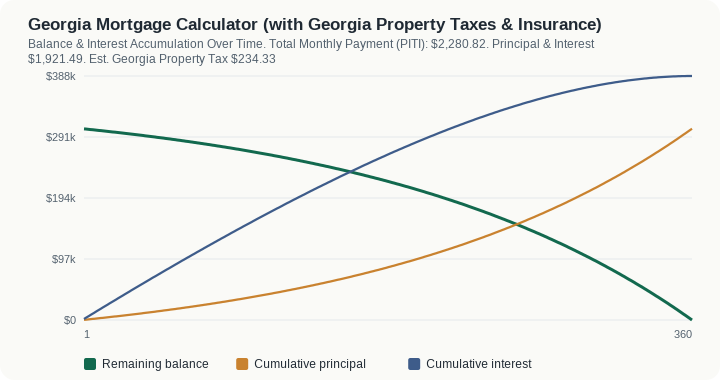
Quick Answer: Georgia's default case, a $380,000 house with $76,000 down and a 6.5% fixed rate, shows $2,308.15 a month: $1,921.49 repays the loan, $234.33 covers property tax at 0.74% of the price, and $152.33 covers homeowners insurance at the Georgia average.
A Georgia Mortgage Payment in the Middle of the Pack
Run every state page at the same $380,000, 20% down and 6.5%, and Georgia finishes 25th of 50, between Louisiana and Maine. Illinois tops that list at $2,652.82 and Hawaii sits at the bottom with $2,136.07, so the Georgia figure is $344.67 under the most expensive state and $172.08 over the cheapest.
That ratio comes from Census survey data for Georgia owners in 2024: what they reported paying in real estate tax, set against what they said their homes were worth. Measured against 0.89%, which is the plain unweighted mean of the fifty state ratios rather than any national average, Georgia's tax line on the default house is $46.81 a month lighter.
Across the borders the spread is wider than most buyers expect:
- Alabama, 0.38%: $2,200.65, or $107.50 a month less than Georgia. Columbus buyers looking over the river at Phenix City see $114.00 of tax saving, trimmed by an Alabama premium $6.50 higher.
- Tennessee, 0.45%: $2,201.41, $106.74 under Georgia, $91.83 of it tax and $14.91 insurance. Dalton against Chattanooga falls here.
- South Carolina, 0.45%: $2,210.07, $98.08 under Georgia. The tax gap is the same $91.83; South Carolina's premium is only $6.25 lower. Augusta against North Augusta is this pairing.
- North Carolina, 0.61%: $2,268.99, $39.16 less, after a premium $2.00 dearer than Georgia's.
- Florida, 0.75%: $2,390.57, $82.42 more. Only $3.17 of that is tax, so a Valdosta or St. Marys buyer weighing a Florida address is really looking at a $79.25 insurance difference.
The loan is identical on every state page, so each gap is tax plus the difference in average premiums.
Payments at Georgia Prices
The default is not a typical Georgia house. Census puts the 2024 median owner-occupied value at $343,300, and at that price with 20% down the payment drops to $2,099.94: $1,735.91 for the $274,640 loan, $211.70 of tax and the $152.33 insurance line.
A few other price points, all at 20% down and 6.5%:
- $200,000, say a smaller house in Macon or Albany: $1,286.97, with $123.33 of tax.
- $450,000, say a newer build in Cobb or Gwinnett: $2,705.27, with $277.50 of tax.
- $600,000: $3,556.26, of which $370.00 is tax.
Tax overtakes the $152.33 insurance figure at a price of $247,022. Above that, which covers the Georgia median, tax is the bigger of the two escrow items; on the $200,000 house insurance is still larger.
The rate matters more than the county. On the default house, 6% gives $2,209.29 and 7% gives $2,409.18, so half a point either way moves the payment by about $100, close to half of the whole tax line. Pushing the price up a quarter, to $475,000 with $95,000 down, brings the total to $2,847.11 and the tax to $292.92.
Down payment works on the loan side only. Keeping the default price, 10% down shows $2,548.33, 5% shows $2,668.43 and nothing down shows $2,788.52. The tax line stays at $234.33 in all three because it is charged on the price, not the balance, and the premium does not move either.
How is this calculated?
Price less the down payment gives the loan: $304,000 on the defaults. The engine amortizes it over 360 monthly payments at one twelfth of the annual rate, carrying each month's interest to the cent, which lands on $1,921.49. On the first payment $1,646.67 is interest and $274.82 reduces the balance. Tax is the full price times 0.74%, divided by twelve, and never changes over the loan; insurance is $152.33, NAIC's average 2023 HO-3 premium for Georgia ($1,828 a year) divided by twelve. Georgia ranks 16th of the 50 states on that measure, $91 a year above the $1,737 countrywide average; the figure blends every coverage amount statewide, so it is a reference point rather than a quote, and it does not rise with the price. Adding the three gives $2,308.15. Across 30 years the loan collects $387,732.82 in interest and the tax line totals $84,358.80. No mortgage insurance is added at any down payment.
Worked Example
A first-time buyer in Georgia's Dream program, buying at the $343,300 median with an FHA-style 3.5% down payment at 6.5%:
- Loan: $343,300 less $12,015.50 down is $331,284.50.
- Principal and interest over 30 years: $2,093.94.
- Tax: $343,300 at 0.74% is $2,540 a year, entered as $211.70 a month.
- Insurance: $152.33.
- Total shown: $2,457.97, with $422,537.44 of interest over the term.
That figure leaves out FHA mortgage insurance, which this page never adds, and it treats the 3.5% as the buyer's own cash. If a Dream second mortgage supplies part of the down payment (see below), the first mortgage is unchanged because that second loan carries no monthly payment.
The Intangible Recording Tax on Your Loan
Georgia taxes the note itself. When a long-term note secured by real estate is recorded, the Department of Revenue sets the intangible recording tax at $1.50 for each $500 of the face amount, with any part of $500 counted as a whole step, up to $25,000 on one note. The Clerk of Superior Court usually collects it in the county where the house sits. Worked from that rate:
- the default $304,000 loan owes $912.00;
- the $274,640 loan on a median-priced home owes $825.00;
- the $331,284.50 FHA-style loan in the example above owes $994.50.
It is paid once at closing, so it never shows in the monthly figure, but it rises with every dollar borrowed. The deed transfer tax is a separate charge; the Georgia transfer tax calculator covers it.
Georgia Dream Down Payment Help
The Department of Community Affairs runs Georgia Dream for first-time buyers. Its July 2026 program matrix describes a 30-year fixed first mortgage (FHA, VA, USDA or conventional) paired with a 0% second mortgage that has no monthly payments and deferred repayment. The standard tier is 5% of the price or $10,000, whichever is less. Protectors, educators and nurses, and households with an eligible disability, can receive 6% or $12,500, again whichever is less. The matrix sets a 640 minimum credit score and price limits of up to $625,000 depending on area.
At the $343,300 median, 5% would be $17,165, so the standard tier hits its $10,000 cap; the 6% tier is $20,598 and caps at $12,500. DCA also sets the first mortgage rate, so enter the rate a participating lender quotes rather than the default 6.5%.
Tax Bills and the Homestead Filing
Georgia bills come from county assessments and local millage, not from a statewide ratio, and homesteads get an exemption plus, where the local government did not opt out, a limit on yearly growth in value; the Georgia property tax calculator works through those. For escrow purposes, the Department of Revenue's default due date is December 20, with some counties billing earlier or in two parts. A buyer who files the homestead application with the county can expect the real escrow to come in below this page's line once it takes effect.
What does this calculator not account for?
- County, city and school millage in Georgia's 159 counties, replaced by one 0.74% ratio.
- The homestead exemption and the cap on assessment growth.
- FHA, VA or private mortgage insurance, at any down payment.
- The intangible recording tax, transfer tax and other closing costs.
- A Georgia Dream second mortgage or any other assistance loan.
- Your own insurance price. The $152.33 is one statewide average, so it does not change between a Chatham County coastal home and one in the north Georgia hills, or for construction, deductible, claims history and coverage amount. Flood cover is separate.
- HOA dues, common in newer subdivisions.
What mistakes do people make with this?
- Comparing Augusta with North Augusta on price alone. On this calculator the South Carolina side runs $98.08 a month lower at $380,000.
- Forgetting the recording tax scales with the loan. Dropping from 20% to 3.5% down on the median house adds $169.50 to it.
- Assuming the Dream second loan adds a payment. It has none while deferred, but it is still owed later.
- Pricing above the Dream limit. The cap varies by area and tops out at $625,000 in the standard program.
- Budgeting a coastal home at the $152.33 state average. Wind exposure near Savannah or Brunswick can push a real premium higher. Get a quote first.
Frequently Asked Questions
Why is Georgia above Indiana when both use 0.74%?
How much is the Georgia intangible recording tax on a $250,000 loan?
How much does Georgia Dream give a standard buyer on a $180,000 house?
Does the calculator change the tax line when I lower the down payment?
When does a Georgia servicer usually pay the county?
Sources
- Census Bureau ACS 2024 1-Year, Georgia home value (B25077) and taxes paid (B25103). data.census.gov/table/ACSDT1Y2024.B25077
- Georgia Department of Revenue, Intangible Recording Tax. dor.georgia.gov/intangible-recording-tax
- Georgia Department of Community Affairs, Georgia Dream Standard program matrix, v. 2026-7-8. dca.georgia.gov/document/resources/georgia-dream-standard-matrix/download
- Georgia DOR, due dates for county property tax. dor.georgia.gov/property-tax-returns-and-payment
- Georgia DOR, homestead exemption filing. dor.georgia.gov/property-tax-homestead-exemptions
- NAIC, Homeowners Insurance Report, data for 2023 (Table 4, HO-3 average premium, Georgia). content.naic.org/sites/default/files/publication-hmr-zu-homeowners-report.pdf