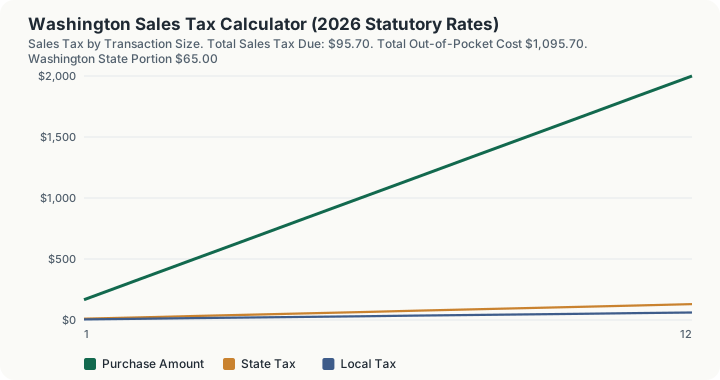
Quick Answer: A $1,000 taxable purchase in Washington costs $95.70 in combined state and local sales tax, for a total of $1,095.70 out the door.
Overview
Ring up a purchase almost anywhere in Washington and the receipt starts with the state's 6.50% statutory sales tax rate before anything local gets added on. Local jurisdictions (cities, counties, and in some cases special taxing districts) are free to add their own surcharges on top of that, and the statewide average of those add-ons is 3.07%, which brings the typical combined rate to 9.57%.
That 9.57% average combined rate ranks among the five highest of any state that levies a general sales tax. Retailers operating storefronts in multiple Washington jurisdictions have to track which local rate applies at each location, since the state does not collect a single uniform combined rate. It sets the 6.50% floor and lets local governments decide what, if anything, to add above it. Point-of-sale systems configured for Washington generally pull the applicable rate by ZIP code or street address rather than applying one number statewide, which is the same logic this calculator uses when it defaults to the statewide average.
How This Is Calculated
Washington pairs a 6.50% state rate with the heaviest local layer outside the Deep South, averaging 3.07%, for a combined 9.57% and $95.70 on a $1,000 purchase. Washington has no individual income tax, so sales tax does most of the work, and its local rates are built from city, county and regional transit authority levies that stack. Washington also sources sales to the destination address rather than the seller's location, so an online or delivered purchase is taxed at the buyer's rate, not the store's.
Destination sourcing determines which local rate applies; once chosen, it is added to the state rate:
The calculator performs:
- Take the entered amount as the base. No adjustments are made to the price before tax is computed.
- No item-level exemption filtering. Groceries and prescription drugs are exempt in Washington and are not filtered out of the amount you enter.
- Compute the state portion. The base is multiplied by the state statutory rate.
- Apply the destination local rate. The 3.07% average includes regional transit authority levies in the Puget Sound area, which are the reason the highest Washington rates exceed 10%.
- Sum and total. The state and local amounts are added to give total tax, and the total is added back to the price to give the out-of-pocket cost.
Worked Example
For a $1,000 taxable purchase in Washington:
- Starting purchase price. The buyer rings up a $1,000.00 taxable retail purchase in Washington, the baseline amount before any tax is applied.
- State portion. Washington's statutory state sales tax rate of 6.50% applies to the full purchase amount: $1,000.00 × 6.50% = $65.00 owed to the state.
- Local portion. Local municipal, county, and special-district surcharges add an average of 3.07% on top of that: $1,000.00 × 3.07% = $30.70 more.
- Combined tax due. Summing the two pieces, $65.00 in state tax plus $30.70 in local surcharge comes to $95.70 in total sales tax owed on the transaction.
- Total out-of-pocket cost. Adding that $95.70 in tax to the $1,000.00 purchase price brings the buyer's total out-of-pocket cost to $1,095.70.
This example uses Washington's statewide average local rate of 3.07%; actual combined rates vary by city and county, so a real receipt could show a combined rate above or below the 9.57% average used here.
Why The Local Share Dominates A Washington Purchase
The per-$100 figure. A $100 taxable purchase in Washington carries $9.57 of combined tax. That is the whole marginal story on this page: the engine multiplies one base by one combined rate, so tax scales exactly linearly and the figure for any amount is $9.57 for every hundred dollars of it. At $1,000 it is $95.70; at $30,000 it is $2,871.00, which is thirty times $9.57 to the cent.
The state share against the local share. On the $1,000 default the split is $65.00 to the state at 6.50% and $30.70 to local jurisdictions at the 3.07% statewide average, so the local layer is 32.1% of the total tax collected. Turn the local surcharge off and the tax falls from $95.70 to $65.00, a difference of $30.70. On a $30,000 vehicle the same toggle moves the bill from $2,871.00 to $1,950.00, a difference of $921.00, which is the practical size of the question "which county did this sale happen in".
The reverse question, and the error it usually attracts. Someone holding a Washington receipt for $1,095.70 and wanting the pre-tax base cannot subtract the combined rate from it. Feed $1,095.70 back into this calculator as the purchase amount and it returns $104.86 of tax, because $1,095.70 is not the base: it already contains the tax. Deducting that $104.86 leaves $990.84, when the true base is $1,000.00. The error is $9.16 on a single $1,000 purchase, and it scales: on the $32,871.00 total of a $30,000 purchase the same wrong step returns $3,145.76 of tax and a base of $29,725.24, understating by $274.76.
The correct operation. Divide the tax-inclusive total by 1 plus the combined rate, or equivalently multiply it by the 9.57% fraction of the gross rather than of the base. The calculator adds tax to a base and does not run that direction: there is no tax-inclusive input on this page, and every figure it reports assumes the amount entered is exclusive of tax. Entering a till total instead of a net price overstates the tax by $9.16 per $1,000 every time.
What This Does Not Account For
- There is no tax-inclusive mode. The amount entered is treated as the pre-tax base without exception, so a total that already contains tax returns $104.86 rather than $95.70 on the $1,000 example.
- The local figure is a single statewide average, not an address lookup. The engine holds one 3.07% number for the whole state and applies it or does not; no county, city or special district rate exists anywhere in the code path.
- No item is exempt. The combined rate is applied to the whole amount entered, so groceries, prescriptions and any other statutory exemption have to be excluded from the input before it is entered.
- Statutory exemptions on unprepared groceries, prescription medications, or manufacturing equipment.
- Special industry excise taxes (lodging hotel taxes, vehicle rental fees, alcohol/tobacco excise).
- Use tax compliance on out-of-state untaxed online purchases.
- B2B resale certificate exemptions or direct pay permit programs.
Common Pitfalls
- Confusing State and Combined Rates: Quoting the state base rate without factoring in local city and county add-on taxes.
- Overlooking Consumer Use Tax: Failing to self-report and remit use tax on untaxed out-of-state purchases on your state income tax return.
- Missing Annual Sales Tax Holidays: Many states offer annual tax-free weekends for back-to-school items, severe weather supplies, or energy-efficient appliances.
- Failing to Collect Resale Certificates: Selling wholesale without collecting valid exemption certificates exposes sellers to full sales tax liability upon audit.
Frequently Asked Questions
What is the sales tax rate in Washington?
Are groceries taxed in Washington?
How does use tax differ from sales tax?
Are digital goods and SaaS taxable in Washington?
Sources
- Streamlined Sales Tax Governing Board (SSTGB): State Taxability Matrix. streamlinedsalestax.org/for-businesses/taxability-matrix
- Washington State Department of Revenue, the official state tax authority for Washington rates, rules and forms. dor.wa.gov
Also consulted: Washington Department of Revenue: 2026 Sales and Use Tax Rate Schedules.