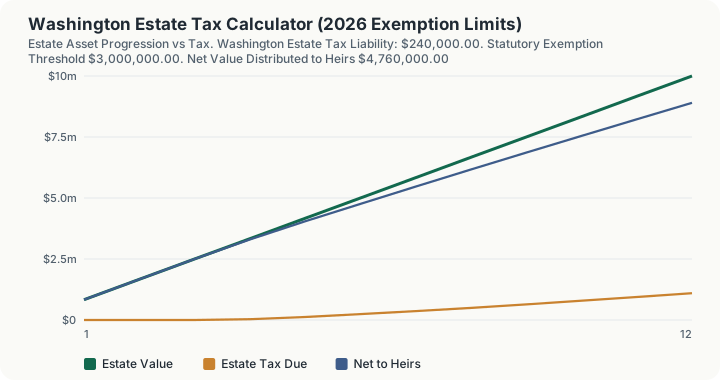
Quick Answer: A $5,000,000 estate in Washington owes $240,000 in state estate tax after the $3,000,000 exemption. The $2,000,000 above the threshold is taxed through graduated brackets, not at a single rate: the first $1,000,000 at 10% and the next $1,000,000 at 14%. That is an effective rate of 4.80% on the whole estate, leaving $4,760,000 to heirs.
Overview
Washington taxes estates above a $3,000,000 exemption at progressive rates that top out at 20%, a rate that ties Hawaii for the highest top marginal rate among the twelve states that still levy their own estate tax.
That combination of a mid-range exemption and the nation's steepest state-level top rate means Washington's estate tax can take a larger bite out of very large estates than any other state's, even those with a lower exemption threshold like Oregon's.
Washington has no state income tax, which shifts more of the state's overall revenue reliance onto taxes like this one, a structural reason its estate tax rates run as high as they do.
Washington doesn't add a separate inheritance tax on top of that total, so beneficiaries face no additional state-level charge based on their relationship to the decedent. Neighboring Oregon and Idaho give Washington families a study in contrasts: Oregon also taxes estates, at a considerably lower exemption, while Idaho levies no estate tax of its own at all.
How This Is Calculated
The calculator starts from two numbers you enter: the gross estate at fair market value, and the marital, charitable, and administrative deductions the estate can claim. It subtracts the second from the first to get the net estate, then applies Washington's own schedule to that figure. Nothing else feeds the result.
Below the exemption the tax is zero. Above it, Washington does not apply one rate to the whole excess. Each dollar is taxed at the rate for the bracket that dollar falls into, so the schedule below is read slice by slice.
| Net Estate Falls In | Rate On That Slice |
|---|---|
| $3,000,000 to $4,000,000 | 10% |
| $4,000,000 to $5,000,000 | 14% |
| $5,000,000 to $6,000,000 | 15% |
| $6,000,000 to $7,000,000 | 16% |
| $7,000,000 to $9,000,000 | 18% |
| $9,000,000 to $10,000,000 | 19% |
| $10,000,000 to $12,000,000 | 19.5% |
| Over $12,000,000 | 20% |
- Value the gross estate. Fair market value at the date of death of all real property, business interests, securities, cash, and life insurance proceeds the decedent owned.
- Subtract allowable deductions. Debts, administrative expenses, qualifying charitable bequests, and the unlimited marital deduction come off the gross figure. What remains is the net estate.
- Test it against the $3,000,000 exemption. If the net estate is at or below that line, the answer is $0 and the calculation stops.
- Walk the brackets. Each slice of the net estate above $3,000,000 is multiplied by its own rate and the products are added together. Quoting the top rate against the whole excess overstates the bill on any estate that does not reach the final bracket.
- Subtract the tax. What is left of the net estate is what beneficiaries actually receive.
The bracket boundaries and rates come from RCW 83.100.040 as amended in 2025, for decedents dying on or after July 1, 2026. Washington's headline 20% rate is reached only above $12,000,000; on a $5,000,000 estate the correct answer is $240,000, not the $400,000 a flat 20% would suggest.
That is the entire computation. The calculator does not carry over a deceased spouse's unused exemption, add back lifetime taxable gifts, apply the generation-skipping transfer tax, discount closely held interests, or figure the separate federal return. Those sit under "What This Does Not Account For" below, not in the math above.
Worked Example
- Start with the gross estate. This example uses a $5,000,000 gross estate: the fair market value of all property, business interests, equities, cash, and life insurance the decedent owned at death, before deductions.
- Apply Washington's exemption. Washington taxes estates only above $3,000,000, so that amount passes tax-free and only the remainder is exposed to state tax.
- Taxable estate above exemption. $5,000,000 minus $3,000,000 leaves $2,000,000 subject to Washington estate tax.
- Walk the graduated brackets. Washington does not apply one rate to the whole excess. The $3,000,000 to $4,000,000 slice is taxed at 10% ($100,000) and the $4,000,000 to $5,000,000 slice at 14% ($140,000), for $240,000 in total. Washington's top 20% rate is reached only above $12,000,000, so quoting it on a $5,000,000 estate overstates the tax by $160,000.
- Net estate distributed to heirs. $240,000 in tax leaves $4,760,000 ($5,000,000 minus $240,000) to beneficiaries, an effective rate of 4.80%.
- What this leaves out. This is Washington's state-level computation only; federal estate tax is assessed separately under IRC § 2010.
Climbing Washington's Eight Estate Bands
At a $3,000,000 net estate. The tax is $0.00 and the taxable estate above the exemption is $0.00. At $3,000,100 the tax is $10.00, which is the first band's 10% rate on $100. Like Vermont's, Washington's exemption is a deduction rather than a cliff, and the step across it costs ten dollars.
At $4,000,000, the second band edge. The tax is $100,000.00 and the effective rate is 2.50%. At $4,000,100 it is $100,014.00: the extra $100 costs $14.00, because the 14% band has opened. Two edges, $1,000,000 apart, and the marginal cost of $100 of estate value goes from $10 to $14 across the second one.
The top band, at $12,000,000. The tax is $1,490,000.00 at an effective rate of 12.42%. At $12,100,000 it is $1,510,000.00, so that $100,000 costs $20,000.00, the 20% top rate. Eight bands separate the two ends of this schedule and the marginal cost of $100,000 of estate value doubles across them, from $10,000 in the first band to $20,000 in the last.
The whole ladder, priced. $3,100,000 returns $10,000.00; $5,000,000 returns $240,000.00; $6,000,000 returns $390,000.00; $7,000,000 returns $550,000.00; $9,000,000 returns $910,000.00; $15,000,000 returns $2,090,000.00. Effective rates across the same span run 0.32%, 4.80%, 6.50%, 7.86%, 10.11% and 13.93%, and none of them is close to the 20% top rate.
The reverse question. $3,000,000 passes with no Washington tax. Staying inside the 10% band means staying at or under $4,000,000, which caps the bill at $100,000.00. A $6,000,000 estate that can move $1,000,000 out through deductions drops from $390,000.00 to $240,000.00, and the $2,000,000 of deductions on the $5,000,000 baseline drops it from $240,000.00 to $0.00.
Right method against wrong method, priced. Applying the 20% top rate to the excess above the exemption is the error this eight-band schedule invites. On the $5,000,000 baseline that gives $400,000 against the $240,000.00 the engine returns, overstating by $160,000. Applying it to the whole estate gives $1,000,000, overstating by $760,000. The engine only reaches a 20% marginal rate above $12,000,000.
What This Does Not Account For
- The qualified family-owned business interest deduction is not applied. It is the largest single relief in the Washington schedule and no input collects it.
- The $3,000,000 exemption is the figure for deaths on or after 1 July 2026. Deaths between 1 January and 30 June 2026 fell under a temporary schedule with a higher $3,076,000 exemption and a top rate up to 35%, and that schedule is not in this code path.
- There is no portability between spouses in this calculation.
- Portability of a deceased spouse's unused exemption. Most states with an estate tax, including this one, do not allow it at the state level, and the calculator does not apply it in either direction.
- Lifetime taxable gifts added back into the taxable estate, and any QTIP election, credit shelter trust, or state QTIP decoupling that would change what the taxable estate actually is.
- Valuation discounts for minority or non-marketable interests in closely held entities. Enter the discounted value yourself if the appraisal supports one.
- Federal generation-skipping transfer (GST) tax under IRC Chapter 13.
- Ancillary probate requirements for real property situated in other jurisdictions.
- Complex liquidity discounts for minority non-voting family business entities.
- State-specific inheritance taxes levied directly on beneficiaries (e.g. PA, NJ, MD, KY, NE).
Common Pitfalls
- Assuming State Exemption Matches Federal: Forgetting that states like Oregon ($1.0M) and Massachusetts ($2.0M) tax estates far below the federal threshold.
- The "Cliff" Effect in Specific States: Failing to recognize that states like New York eliminate the exemption entirely if the estate exceeds 105% of the threshold.
- Out-of-State Real Property Exposure: Holding real estate in states with active estate taxes exposes non-resident estates to proportional state estate taxes.
- Failing to Fund Revocable Living Trusts: Assets held outside trust structures are subjected to public probate proceedings and statutory executor fees.
Frequently Asked Questions
Does Washington have a state estate tax?
Does Washington have an inheritance tax?
When is state estate tax due?
What assets are included in the taxable estate?
Sources
- Washington State Department of Revenue: Estate Tax Guidance (2026). dor.wa.gov