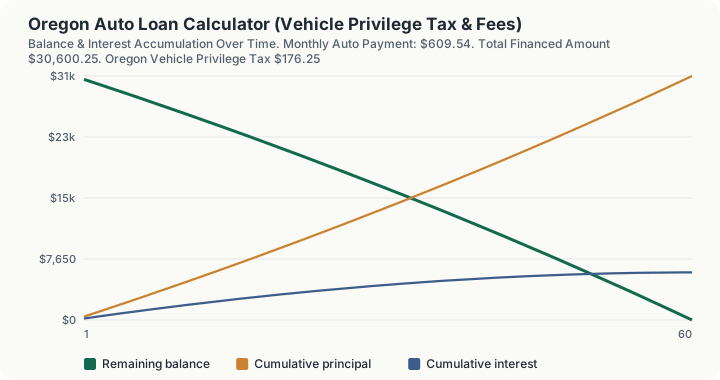
Quick Answer: Most Oregon car buyers owe no purchase tax at all. The 0.5% vehicle privilege tax reaches only vehicles with 7,500 miles or fewer, so a used car costs $0 in tax. On a new $35,000 vehicle with a $250 doc fee, $5,000 cash down, 60 months at 7.25% APR, the payment is $609.54, including $176.25 of privilege tax and $174 of title and registration.
Overview
Oregon has no general sales tax. That fact does most of the work on this page. There is no 6% line on an Oregon buyer's order, no county add-on, and no city rate, because Oregon levies none of them.
What Oregon does have is a narrow 0.5% vehicle privilege tax created by ORS 320.405. It is not a sales tax and it does not behave like one. It applies only when every one of these is true: the vehicle was bought from a dealer on or after 1 January 2018, its odometer reads 7,500 miles or less (or it is sold with a manufacturer's certificate of origin), its gross vehicle weight rating is 26,000 pounds or less, and it has never been registered in Oregon. Dealer demonstrators are the one carve-out from that last condition.
Put together, the tax reaches new and near-new cars and nothing else. Buy a three-year-old sedan with 40,000 miles from an Oregon dealer and the purchase tax is zero. That is the single most useful thing to know about buying a car in Oregon, and it is the reason a flat percentage model of this state produces the wrong answer for the majority of transactions.
The second Oregon quirk is the mirror image of the first. Where nearly every other state lets a trade-in reduce the taxable price, Oregon does not. ORS 320.400(2)(a) defines retail sales price as the total price paid at retail, excluding only the excise, privilege, or use tax itself. There is no trade-in exclusion in the definition, and the Department of Revenue's return instructions tell filers not to treat a trade-in as a discount. Your trade shrinks the loan. It does not shrink the tax.
Auto Loan APR by Credit Score
The APR columns below are national averages, not Oregon figures. No primary source publishes average auto loan APR by state: Experian's report has no geographic cut, the CFPB publishes state origination volume but no rates, and the New York Fed publishes state delinquency only. The payment column is the part that is specific to Oregon, because it runs this calculator's own Oregon tax and fee rules at each tier's rate.
| Credit Tier | VantageScore 4.0 | Avg New APR | Avg Used APR | Est. Payment in Oregon |
|---|---|---|---|---|
| Super prime | 781-850 | 4.55% | 6.30% | $571.18 |
| Prime | 661-780 | 6.23% | 8.77% | $594.87 |
| Nonprime | 601-660 | 9.67% | 14.03% | $645.21 |
| Subprime | 501-600 | 13.44% | 19.42% | $703.16 |
| Deep subprime | 300-500 | 16.01% | 21.77% | $744.30 |
Payment assumptions: $35,000 vehicle price, $0 trade-in, $5,000 cash down, $250 dealer documentation fee, 60-month term, new-vehicle APR applied to the Oregon delivered price including tax and statutory fees. At the 6.39% overall new-car average the same purchase costs $597.15 a month.
The score bands are VantageScore 4.0, not FICO. The same borrower can land in a different tier under each model, so a FICO score pulled from a card issuer will not always match the band here. Source: Experian, State of the Automotive Finance Market, Q1 2026, slide 45.
What Moves Your Payment
Each row changes one input and leaves the rest at the baseline below. The dollar effects are this calculator's own output for Oregon, not a rule of thumb.
| Factor | What Changes | Effect on Monthly Payment | Effect on Total Interest |
|---|---|---|---|
| Vehicle Price | Each extra $1,000 of price raises both the amount financed and the vehicle privilege tax base, so the tax rises with it. | +$20.02 | +$196.13 |
| Trade-In Allowance | A $1,000 allowance cuts the amount financed by $1,000, but it does not reduce the vehicle privilege tax base. Oregon gives no trade-in tax credit, so you are taxed on the full price. | -$19.92 | -$195.17 |
| Cash Down Payment | A $1,000 larger down payment cuts the amount financed by $1,000. It never reduces the vehicle privilege tax, which is assessed on the price, not on what you borrow. | -$19.92 | -$195.17 |
| Dealer Doc Fee | A $100 higher documentation fee adds $100 to the amount financed and is inside the vehicle privilege tax base, so it is taxed on top of itself. Oregon caps the fee at $250. | +$2.00 | +$19.61 |
| Longer Term | Stretching the same balance from 60 months to 72 months spreads the principal over twelve more payments at the same rate. | -$84.15 | +$1,255.47 |
Baseline: $35,000 vehicle price, $0 trade-in, $5,000 cash down, $250 documentation fee, 60 months at 7.25% APR, giving a $609.54 payment and $5,971.94 of total interest.
How This Is Calculated
Oregon has no sales tax. It has a 0.5% Vehicle Privilege Tax that applies only to a new vehicle with 7,500 miles or fewer, and it gives no trade-in credit. Four steps.
1. Retail sales price. The doc fee is part of the total price paid at retail, so it sits inside the base. There is no trade-in subtraction.
2. Privilege tax. The rate is 0.5% on a qualifying vehicle and 0% on everything else. There is no local rate to stack on top, because Oregon has no local sales tax at all.
3. Title and registration. A fixed $174, being the $106 title fee for the 20 to 39 MPG tier plus $68, the annual equivalent of the two-year passenger registration. Both are separately stated and outside the tax base.
4. Amount financed and amortization.
where $P$ is the financed amount, $i$ is the monthly rate (APR ÷ 12), and $n$ is the term in months. Interest each period is the outstanding balance times $i$, the remainder reduces principal, and the schedule closes at zero.
Worked Example
Oregon's vehicle privilege tax is 0.5%, the lowest purchase tax in the country, and it applies only to new vehicles. It also ignores trade-ins entirely. Both facts show up below.
- Vehicle price: $35,000, new, under 7,500 miles
- Trade-in allowance: $0
- Cash down: $5,000
- Dealer doc fee: $250
- Term: 60 months at 7.25% APR
Step 1 -- The retail sales price taxed. Total price paid including the capped doc fee, with no deduction for a trade-in: $35,000 + $250 = $35,250.00
Step 2 -- Vehicle privilege tax at 0.5%. $35,250.00 x 0.5% = $176.25
Step 3 -- Title and registration, outside the base. $106.00 title + $68.00 registration = $174.00
Step 4 -- Total delivered price. $35,000 + $250.00 + $176.25 + $174.00 = $35,600.25
Step 5 -- Amount financed. $35,600.25 - $0 trade-in - $5,000 cash down = $30,600.25
Step 6 -- The monthly payment. $30,600.25 at 7.25% over 60 months = $609.54
Step 7 -- Month 1. $30,600.25 x (7.25% / 12) = $184.88 interest, $424.66 principal, balance $30,175.59
Step 8 -- Month 2. $30,175.59 x (7.25% / 12) = $182.31 interest, $427.23 principal, balance $29,748.36. Cumulative interest: $367.19
Step 9 -- The accumulation. Interest through month 12 is $2,045.73 with $25,331.50 still owed. Over 60 months, $5,971.94
Switch the condition to used and the tax disappears. The delivered price falls to $35,424.00, the financed balance to $30,424.00, and the payment to $606.03. The whole difference is $176.25 of tax, which is what a 0.5% rate looks like: real, but small enough that it should never drive the buying decision.
Now add a $10,000 trade-in to the new-car case. The payment drops to $410.34, but the privilege tax stays at exactly $176.25 and the tax saved by the trade-in is $0.00. That is Oregon's rule, and it changes the private-sale arithmetic. In a state that credits trade-ins, selling privately has to beat the dealer offer by more than the tax credit. In Oregon there is no credit to beat, so any private offer above the trade allowance wins outright.
What This Does Not Account For
- County registration fees. Multnomah County adds $112 and Washington and Clackamas each add $60 per two-year registration. These are flat dollar charges, not percentage taxes, and they are not in the $174 figure used here.
- MPG and fuel-type variation in title and registration. Oregon tiers both fees. Title runs $101 for 0 to 19 MPG, $106 for 20 to 39 MPG, $116 for 40+ MPG, and $192 for all-electric. Two-year registration runs $126, $136, $216, and $376 respectively, with $86 for OReGO road-usage-charge enrollees. This calculator uses the middle tier.
- 2026 fee increases. Secondary sources report larger 2026 registration increases under HB 3991 that the ODOT DMV fee page did not show at the time of research. Confirm the current figure with DMV before you sign.
- The Vehicle Use Tax. ORS 320.410 imposes a matching 0.5% on an Oregon resident who buys a qualifying vehicle from an out-of-state dealer. The calculator's new-vehicle result is the right number for that case too, but the tax is remitted by the buyer rather than collected by the dealer.
- Who legally owes the privilege tax. ORS 320.405 imposes it on the dealer, not the buyer. Dealers routinely pass it through as a line item, and this calculator assumes they do, but it is negotiable in a way a sales tax would not be.
- Non-Oregon buyers. If you register the car in another state, that state's sales tax applies at registration and Oregon's zero rate does not follow you home.
- GAP insurance, extended warranties, and aftermarket add-ons, unless folded into the vehicle price.
Common Pitfalls
- Assuming Oregon means zero tax on every car. A new vehicle does carry the 0.5% privilege tax. On a $60,000 truck with a doc fee that is roughly $300.
- Assuming the privilege tax works like a sales tax on used cars. It does not reach them. Any calculator that applies 0.5% to a used Oregon purchase overstates the cost.
- Expecting a trade-in tax credit. There is none. Buyers moving from Washington or California often carry that assumption across the border.
- Overpaying the doc fee. ORS 822.043 caps it, reported at $250 with an electronic title integrator and $200 without. Anything above that is not permitted.
- Registering in Oregon to dodge another state's sales tax. Your home state taxes on registration, and vehicle-registration fraud is prosecuted. The zero rate belongs to Oregon residents.
- Judging the loan by payment alone. Stretching this $30,600.25 balance from 60 to 72 months cuts the payment to $525.39 and raises total finance charges from $5,971.94 to $7,227.46.
Frequently Asked Questions
Does Oregon charge sales tax on cars?
How much is the Oregon vehicle privilege tax on a $35,000 car?
Does a trade-in reduce Oregon vehicle tax?
What is the difference between the privilege tax and the use tax?
Is there a cap on Oregon dealer doc fees?
Does Oregon have an annual car property tax?
Sources
- Oregon Department of Revenue, Vehicle Privilege and Use Taxes program page, including the 7,500-mile, 26,000-pound GVWR, and never-registered-in-Oregon conditions. oregon.gov/dor
- Consumer Financial Protection Bureau, Truth in Lending Act (Regulation Z, 12 CFR § 1026.22) disclosure requirements for installment credit. ecfr.gov/current/title-12/chapter-X/part-1026
Also consulted: ORS 320.400 to 320.490 (Vehicle Privilege Tax at ORS 320.405, Vehicle Use Tax at ORS 320.410, retail sales price defined at ORS 320.400(2)(a)); OAR 150-320-0400 to 150-320-0420 (administrative rules implementing the privilege and use taxes); Oregon Department of Revenue, Vehicle Privilege Tax Overview, 23 January 2025; ORS 822.043 (dealer document processing fee cap); Oregon DMV, vehicle fee schedule (MPG-tiered title and two-year registration fees, county registration fees for Multnomah, Washington, and Clackamas); Experian, State of the Automotive Finance Market, Q1 2026, slide 45 (average new and used auto loan APR by VantageScore 4.0 credit tier; national, no state level cut published).