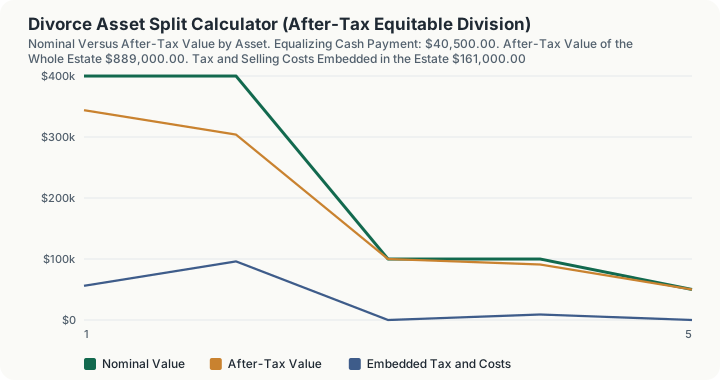
Quick Answer: A settlement where spouse A keeps $400,000 of home equity, a $100,000 brokerage account and $50,000 of cash while spouse B keeps a $400,000 pre-tax retirement account and a $100,000 Roth needs an equalizing payment of $40,500.00 from A to B. After tax and selling costs the $1,050,000 estate is worth $889,000. A division struck on nominal values would have called for $25,000.
What does this calculator do?
A dollar of pre-tax 401(k) is not a dollar of home equity, and neither is a dollar of Roth. Each carries a different embedded tax, and a house carries an embedded transaction cost as well. None of that appears on a statement, so a settlement schedule that lists five balances and adds them up is adding quantities that are not the same unit.
The result is that dividing an estate on nominal values divides it unequally in the only terms that matter, which is spendable dollars. The gap is not small. At the defaults here, $161,000 of the $1,050,000 estate belongs to nobody in the room: it is income tax on the retirement account, capital gains tax on the brokerage gain, and the commission and closing costs that stand between the house and its equity.
This calculator does not decide who should get what, and it makes no statement of family law. Division rules, the marital or separate characterisation of any asset, and any fairness standard are jurisdictional, and none is modelled. You supply the assignment and the target share; the engine converts each asset into spendable dollars and prices the cash transfer that makes the after-tax split match your target.
The single most common version of this problem is the house-for-the-401(k) trade, and the calculator has a scenario for it. Two balances of $400,000 look like an even swap and are not.
How is this calculated?
Each asset is converted to after-tax value by its kind:
V_pretax = N × (1 − t_ord − t_pen)
V_taxable = N − t_cg × max(0, N − B)
V_home = E − S − t_cg × max(0, G − S − B − X)
where $N$ is nominal value, $B$ is cost basis, $E$ is equity, $G$ is gross market value, $S$ is selling costs charged on $G$, and $X$ is the gain exclusion. Roth and cash carry neither tax nor transaction cost. The equalizing transfer is then:
T = V_total × target_A − V_A
Step 1: Price the home equity. Selling costs: $700,000 x 8% = $56,000 Net gain: $700,000 - $56,000 - $400,000 basis = $244,000 Taxable gain after the $250,000 exclusion: $244,000 - $250,000 is negative, so $0 of tax After-tax value: $400,000 - $0 - $56,000 = $344,000
Step 2: Price the pre-tax retirement account. Combined rate: 24% ordinary plus 0% penalty = 24% $400,000 x 24% = $96,000 of embedded tax $400,000 - $96,000 = $304,000
Step 3: Price the Roth. Roth money has already been taxed, so it carries nothing: $100,000 - $0 = $100,000
Step 4: Price the taxable brokerage. Embedded gain: $100,000 - $40,000 basis = $60,000 $60,000 x 15% = $9,000 of tax $100,000 - $9,000 = $91,000
Step 5: Price the cash. Cash carries no embedded tax, which is exactly what makes it the natural equalizing asset: $50,000 - $0 = $50,000
Step 6: Total the estate both ways. Nominal: $400,000 + $400,000 + $100,000 + $100,000 + $50,000 = $1,050,000 After tax: $344,000 + $304,000 + $100,000 + $91,000 + $50,000 = $889,000 The difference, $161,000, is embedded tax and selling cost.
Step 7: Total each spouse's side. Spouse A, holding the house, the brokerage and the cash: $344,000 + $91,000 + $50,000 = $485,000 Spouse B, holding the pre-tax account and the Roth: $304,000 + $100,000 = $404,000
Step 8: Compare the paper split with the real one. On paper: $550,000 / $1,050,000 = 52.38% to spouse A After tax: $485,000 / $889,000 = 54.56% to spouse A The difference is +2.18 percentage points, in spouse A's favour, and it is invisible on the schedule.
Step 9: Price the equalizing transfer. Target for spouse A: $889,000 x 50% = $444,500 $444,500 - $485,000 = -$40,500, so spouse A pays spouse B $40,500.00
Step 10: Compare against the naive answer. On nominal values: $1,050,000 x 50% = $525,000, against $550,000 held, calling for a $25,000 payment. $40,500 - $25,000 = $15,500 of mispricing
Worked Example
The clearest version of the problem is the straight swap, and it is a scenario on this page: zero out the Roth, the brokerage and the cash, and leave a $400,000 house traded against a $400,000 pre-tax account.
Step 1: Price the house. $700,000 x 8% selling costs = $56,000 Gain after costs: $700,000 - $56,000 - $400,000 = $244,000, fully covered by the $250,000 exclusion $400,000 - $56,000 = $344,000 of spendable value
Step 2: Price the 401(k). $400,000 x 24% = $96,000 $400,000 - $96,000 = $304,000 of spendable value
Step 3: Measure the gap on a trade that looked even. $344,000 - $304,000 = $40,000
Step 4: Price the transfer that would even it up. Total after-tax estate: $344,000 + $304,000 = $648,000 Half of that is $324,000, against the $344,000 spouse A holds, so spouse A pays spouse B $20,000
Two balances printed as $400,000 differ by $40,000 in spendable dollars, and the settlement that trades one for the other transfers $20,000 of value without anyone intending it. Add a 10% early withdrawal penalty, which the scenario list also offers, and the pre-tax account falls to $264,000 and the required payment rises again.
What does this calculator not account for?
- Family law of any kind. No division rule, no community property regime, no equitable distribution standard, and no characterisation of assets as marital or separate.
- The basis step-up at death, which can eliminate the embedded capital gains tax on the brokerage account entirely for an asset held to death.
- State income tax as a separate layer. The ordinary and capital gains rates you enter are combined federal and state figures, entered as one number each.
- The net investment income tax, depreciation recapture, and the 0% and 20% long-term capital gains bands. One flat capital gains rate is applied.
- Progressivity. A $400,000 retirement account withdrawn in one year would not be taxed at a single marginal rate. Here it is.
- Timing. All embedded taxes are charged as if realised today, undiscounted. A pre-tax account left to grow for twenty years is not economically identical to one liquidated tomorrow.
- Qualified domestic relations orders, their cost, their timing, and the section 72(t)(2)(C) exception that lets a QDRO distribution to an alternate payee avoid the early withdrawal penalty. The penalty here is whatever you enter.
- Mortgages, refinancing and assumability. The home equity you enter is already net of the mortgage, and whether either spouse can actually refinance is not tested.
- Illiquidity and risk. A dollar of cash and a dollar of concentrated stock are treated as equal once tax is netted off.
- Pensions, deferred compensation, stock options, restricted stock, business interests and debts, none of which appear as asset kinds.
What mistakes do people make with this?
- Adding balances of different tax character. This is the whole subject of the page. $400,000 of Roth, $400,000 of pre-tax and $400,000 of home equity are three different amounts of money.
- Entering the home's market value where the field asks for equity. Equity is market value less the mortgage. The gross value is a separate input, used only to charge selling costs and compute the gain.
- Using the joint $500,000 gain exclusion after the divorce. The exclusion figure should be the one that applies to the spouse who keeps the house, in the year they sell, under their own filing status.
- Setting the early withdrawal penalty to 10% by default. It applies only if the pre-tax money will actually be withdrawn before 59.5 outside an exception. If it stays invested, the penalty is zero and entering it overstates the transfer.
- Skipping the selling costs because nobody intends to sell. The equity cannot be converted to spendable dollars without them, whenever that happens.
- Reading the equalizing payment as a legal entitlement. It is the payment that makes the after-tax split match a target you chose. Choosing the target is not arithmetic.
- Assuming a 50/50 after-tax split is the fair one. It is one target among many, and the calculator will price any other.
Frequently Asked Questions
Why is a 401(k) worth less than the same balance in cash?
Should I take the house or the retirement account?
Do I owe tax when assets are transferred in a divorce?
What is an equalizing payment?
Why does the calculator charge selling costs on a house nobody is selling?
Does the 10% early withdrawal penalty always apply to a divided 401(k)?
Sources
- The tax concepts referenced are Internal Revenue Code section 1041 (transfers incident to divorce), section 121 (exclusion of gain on the sale of a principal residence), section 72(t) (the additional tax on early distributions, and the qualified domestic relations order exception at 72(t)(2)(C)), and section 414(p) (qualified domestic relations orders). law.cornell.edu/uscode/text/26/1041
This calculator uses no statutory tables. Every rate, cost percentage, exclusion amount and assignment is a value you enter, and the engine performs pure after-tax valuation arithmetic on them.
Also consulted: For the rates to enter, your own return and your state's schedule are the authority. This page does not look up a bracket, and it deliberately does not pretend to; Division rules and fairness standards are set by state law and by a court. Nothing on this page is legal advice or a prediction of any order.